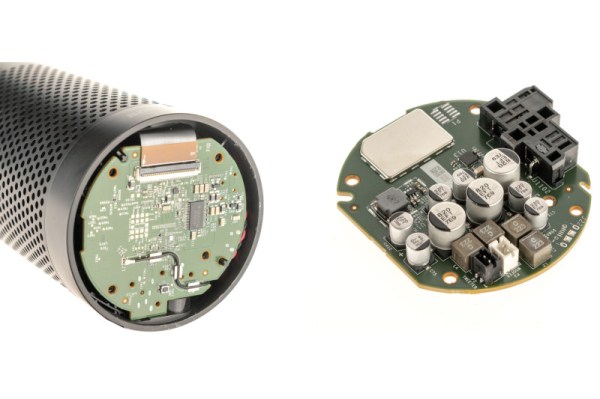
Taking things apart is always fun, and this What Cracking Open a Sonos One Tells Us About the Sonos IPO”>excellent writeup of a teardown of a Sonos and Amazon smart speaker by [Ben Einstein] shows what you can learn. [Ben] is a Venture Capitalist and engineer, so much of his write up focuses on what the devices say about how the company spends money. There are plenty of things to learn for hackers, though: he details how the Sonos One uses a PCI daughterboard for wireless communications, while the Amazon Echo has a programmable radio on the main board.
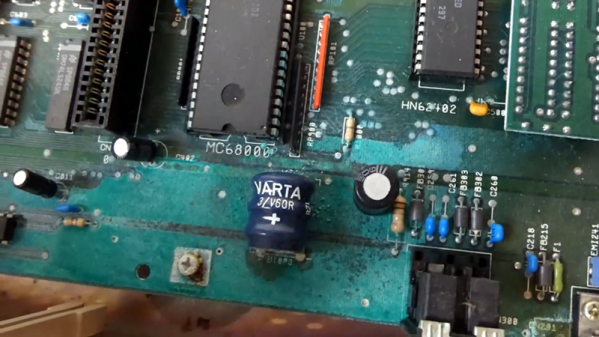
Big companies spend small fortunes on making sure their computers stay running and that they can be repaired quickly in an emergency. You wouldn’t expect an emergency repair on an Amiga 2000, though. [RETR-O-MAT] bought an Amiga 2000 that did boot, but was known to have a leaky battery on the motherboard. He wanted to rush to replace the battery before the leakage caused serious damage. You can see all this in the video below.
The computer looked lightly used over its 32-year lifespan, even when the case came off. The battery corrosion was evident, though. Even the bolt holding down the motherboard was clearly corroded from the leaking battery, causing it to be very difficult to remove.
The battery leakage also made unsoldering the battery a challenge. Several chips and sockets — including the CPU — were affected, so they had to come out. You can see a nice demonstration of the “old screwdriver trick” which might be eye-opening if you’ve only worked with SMD chips.
Even if you don’t care much about the Amiga 2000, it is interesting to see inside an old computer like this and note the differences — and similarities — to modern designs. The video is as much a tear down as it is a repair story. It also might be useful if you ever face having to tear out a leaky battery on any piece of gear. Continue reading “Amiga 2000 Emergency Repair”→
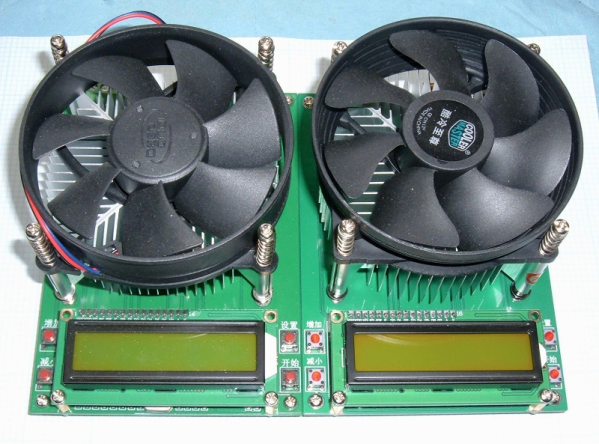
[Syonyk] has been acquiring some large load banks to test power supplies and battery packs. These devices consist of a big current sink, a measurement device, and a fan. He picked up two similar-looking boards from the usual Chinese sources, both rated for 150W, both for about $30. Upon closer examination, though, he found that one was really a bargain and the other was likely to blow up.
The loads are rated for 60V and as you can see from the photos, appear virtually identical at a glance. They offer a configurable cut-off voltage and even use 4-wire measurement to avoid problems with voltage drop through the power cables.
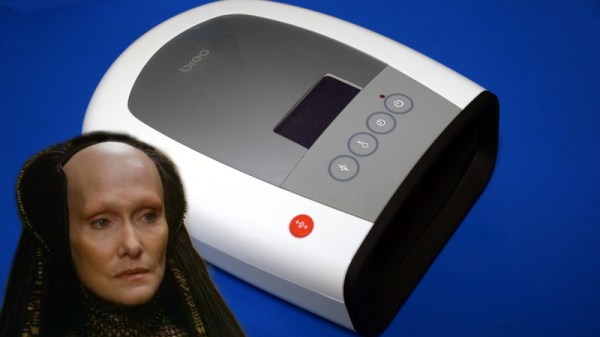
I immediately felt uncomfortable when I realized this thing is called the “Breo iPalm520 Acupressure Hand Massager”. You’re supposed to stick your hand into it, and through unknown machinations it performs some kind of pressure massage complete with heating action. It’s like one of those pain boxes from Dune. It’s all the more disturbing when you realize the red button on the thing is an emergency release. That’s right, once your hand is in this contraption you can’t take it out until the thing has had its way with you or you tap out.
Press to administer the Gom Jabbar
At least once a week I try to get to the local thrift store to look for interesting things. I’d like to be more specific than “interesting things”, but truth be told, I never really know what I’m looking for until I see it. Sure there’s the normal consumer electronics kind of stuff, but I’ve also found some very nice laboratory equipment, computer parts, software, technical books, etc. You just have to go regularly and keep an eye out for the occasional needle amongst the hay.
I want you to know, Dear Readers, that I did briefly summon the courage to put my hand into this thing and turn it on. Now I am not what one might call an overly brave man, and perhaps that might explain my personal experience. But when it started to hum and heat up, constricting around my hand to the point I couldn’t move my fingers, I screamed like a child and mashed the emergency button as if I was a pilot trying to eject from a mortally wounded aircraft. As far as Frank Herbert is concerned, I’m no human at all.
In an effort to better understand this torture device, lets open it up and see what lurks beneath that futuristic exterior.
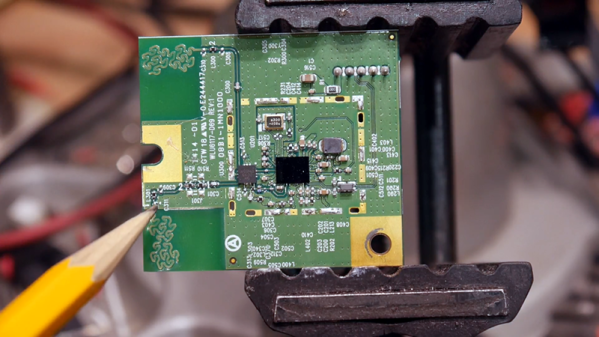
[IMSAI Guy] tore apart a device with a wireless network card and decided to investigate what was under the metal can. You can see the video of his examination below. Overall, it was fairly unremarkable, but one thing that was interesting was its use of an antenna on the PCB that uses a fractal design.
You probably know fractals are “self-similar” in that they are patterns made of smaller identical patterns. The old joke is that the B. in Benoit B. Mandelbrot (the guy who coined the term fractal) stands for Benoit B. Mandelbrot. You can think of it as akin to recursion in software. Antennas made with fractal patterns have some unusual and useful properties.
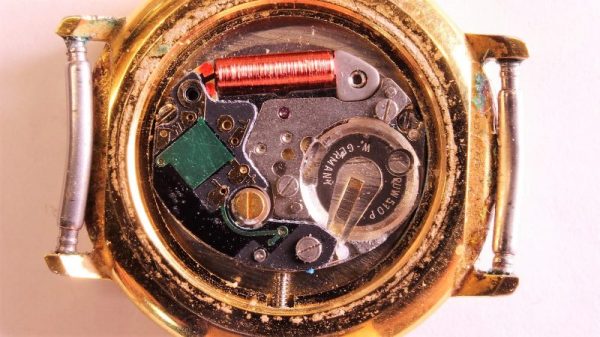
In an age of smartwatches, an analog watch might seem a little old-fashioned. Whether it’s powered by springs or a battery, though, the machinery that spins those little hands is pretty fascinating. Trouble is, taking one apart usually doesn’t reveal too much about their tiny workings, unless you get up close and personal like with this microscopic tour of an analog watch.
This one might seem like a bit of a departure from [electronupdate]’s usual explorations of the dies within various chips, but fear not, for this watch has an electronic movement. The gross anatomy is simple: a battery, a coil for a tiny stepper motor, and the gears needed to rotate the hands. But the driver chip is where the action is. With some beautiful die shots, [electronupdate] walks us through the various areas of the chip – the oscillator, the 15-stage divider cascade that changes the 32.768 kHz signal to a 1 Hz pulse, and a remarkably tiny H-bridge for running the stepper. We found that last section particularly lovely, and always enjoy seeing the structures traced out. There are even some great tips about using GIMP for image processing. Check out the video after the break.
[electronupdate] knows his way around a die, and he’s a great silicon tour guide, whether it’s the guts of an SMT inductor or a Neopixel close-up. He’s also looking to improve his teardowns with a lapping machine, but there are a few problems with that one so far.
Sure, we all love fixing stuff, but there’s often a fine line between something that’s worth repairing and something that’s cheaper in the long run to just replace. That line gets blurred, though, when there’s something to be learned from a repair.
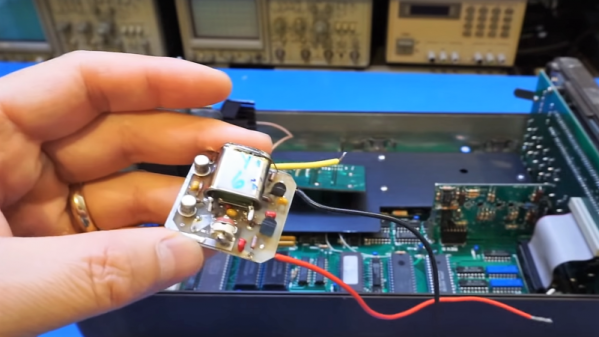
This wonky temperature-compensated crystal oscillator is a good example of leaning toward repair just for the opportunity to peek inside. [Kerry Wong] identified it as the problem behind a programmable frequency counter reading significantly low. A TCXO is supposed to output a fixed frequency signal that stays stable over a range of temperatures by using a temperature sensor to adjust a voltage-controlled oscillator that corrects for the crystal’s natural tendency to vary its frequency as it gets hotter or colder. But this TCXO was pretty old, and even the trimmer capacitor provided was no longer enough to nudge it back in range. [Kerry] did some Dremel surgery on the case and came to the conclusion that adding another trim cap between one of the crystal’s leads and ground would help. This gave him a much wider adjustment range and let him zero in on the correct 10-MHz setting. [Mr. Murphy] still runs the show, though – after he got the TCXO buttoned up with the new trimmer inaccessible, he found that the frequency was not quite right. But going from 2 kHz off to only 2 Hz is still pretty good.