Electromagnetic Field: A Cyberpunk Headdress To Be Noticed In

At the recent Electromagnetic Field hacker camp in the UK, one of the highlights was the Null Sector, a cyberpunk-themed zone best described as something close to the set of Blade Runner made from shipping containers, clever props, and lighting. Our community rose to the occasion with some truly impressive costumes and wearable electronics, lending the venue a real authenticity.

Among the many creations on show there was one that stood quite literally head and shoulders above the rest. [Chebe]’s colour stealing sound reactive LED headdress is a confection of Neopixels, organza, and transparent floor protectors on a wire frame, driven by a Lillypad wearable microcontroller board with a microphone and colour sensor attached. The resulting sound-and-colour-reactive display stood out across a crowded venue full of hackers who’d all made their own efforts to produce similar outfits, which is really saying something!

The Lillypad and LEDs are standard fare, but the wire part of this project isn’t, and that’s what makes it rather interesting from our perspective. Anyone can make something that goes over their head, but to make something that’s comfortable takes a bit of effort and thought. Have you ever tried a set of ill-fitting sunglasses? If you have then you might understand. In this case stiff garden wire is used, bent to shape and joined with rolled-up tape, before being covered with wound-on ribbon for extra comfort. A Hackaday scribe travels the field at a hacker camp, and though [Chebe]’s cranium is a little more petite than the Hackaday bonce it was certainly an enveloping fit when we tried it.

Anyone can attach an LED to an item of clothing and call it a wearable. But to be noticed like this one it has to be done with style. If you’ve not had your fill of this topic, we suggest you continue with the Hackaday Belgrade talk from our friend [Rachel “Konichiwakitty” Wong].
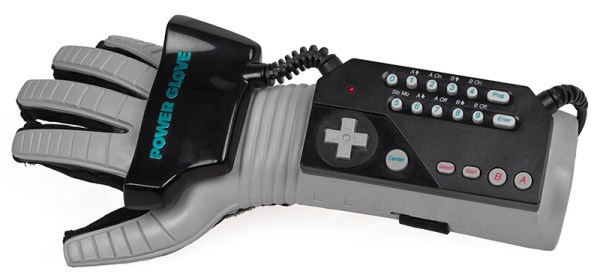

Now, Finally, We Can Play With Power

In case you’re not a ’90s kid, the Nintendo Power Glove is the greatest device for human-computer interaction ever created. It’s so good, they called it bad, and then they made a movie about it. At its heart, the Power Glove is just some force sensors in the fingers of a glove, but that hasn’t stopped hackers from cracking these gloves open for years. We’ve seen the Power Glove used in Hackaday Prize entries before, we’ve seen it control quadcopters, we’ve seen it used as a Vive controller, and the Ultimate Power Glove comes loaded up with Bluetooth, motion tracking, a 9-axis IMU, and a 20-hour battery life. With all these Power Glove hacks, what more can be done?

Surprisingly, we haven’t seen a Power Glove hack that transmutes this icon of cyberpunk into a usable keyboard and mouse. That’s exactly what [Scott] is doing for his Hackaday Prize entry, and the results are looking good so far.

First up, the mouse. This is actually a joystick-based version of cursor control, capitalizing on the force sensors in the Power Glove to register clicks. Add in a button, some perfboard, and an Arduino, and you have a USB input device that can control a cursor. Without any good solution for a small keyboard, [Scott] turned to a normal ‘ol Bluetooth keyboard mounted to the Power Glove’s wrist.

It might not be as fancy as the great Power Glove hacks out there, but this is certainly the most useful. Who wouldn’t want to wear their keyboard and mouse at all times, all while looking like they stepped out of a time machine controlled by a Commodore 64? This is the heights of early ’90s futurism, and a great entry for the Hackaday Prize.

Don’t Look Now, But Your Necklace Is Listening

There was a time when the average person was worried about the government or big corporations listening in on their every word. It was a quaint era, full of whimsy and superstition. Today, a good deal of us are paying for the privilege to have constantly listening microphones in multiple rooms of our house, largely so we can avoid having to use our hands to turn the lights on and off. Amazing what a couple years and a strong advertising push can do.

So if we’re going to be funneling everything we say to one or more of our corporate overlords anyway, why not make it fun? For example, check out this speech-to-image necklace developed by [Stephanie Nemeth]. As you speak, the necklace listens in and finds (usually) relevant images to display. Conceptually this could be used as an assistive communication technology, but we’re cool with it being a meme display device for now.

Hardware wise, the necklace is just a Raspberry Pi 3, a USB microphone, and a HyperPixel 4.0 touch screen. The Pi Zero would arguably be the better choice for hanging around your neck, but [Stephanie] notes that there’s some compatibility issues with Node.js on the Zero’s ARM6 processor. She details a workaround, but says there’s no guarantee it will work with her code.

The JavaScript software records audio from the microphone with SoX, and then runs that through the Google Cloud Speech-to-Text service to figure out what the wearer is saying. Finally it does a Google image search on the captured words using the custom search JSON API to find pictures to show on the display. There’s a user-supplied list of words to ignore so it doesn’t try looking up images for function words (such as “and” or “however”), though presumably it can also be used to blacklist certain imagery you might not want popping up on your chest in mixed company.

We’d be interested in seeing somebody implement this software on a Raspberry Pi powered digital frame to display artwork that changes based on what the people in the room are talking about. Like in Antitrust, but without Tim Robbins offing anyone.

All The Badges Of DEF CON 26 (vol 4)

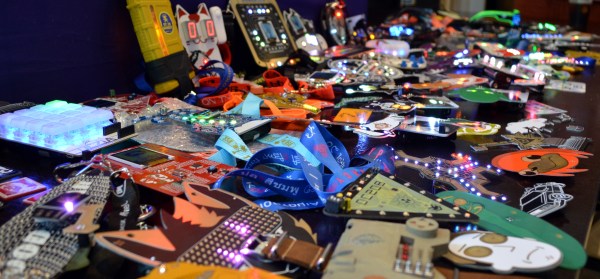
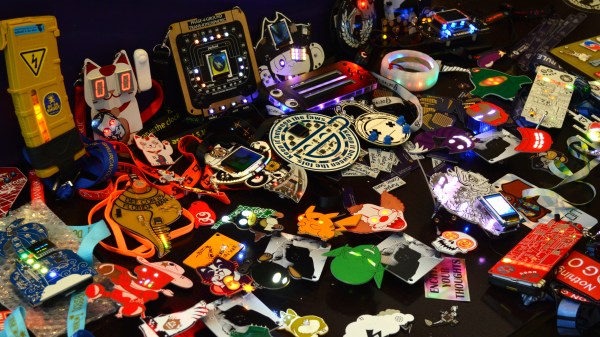
From a cockroach filled with LEDs, to an impressively dense 576 RGB LED display, and even a hunk of carpet, our final installment of the unofficial hardware badges at DEF CON 26 are beyond impressive. I tried to see every badge and speak to every badge maker this year. So far we’ve covered a ton of badges in volume 1, volume 2, and volume 3 of this series, and now it’s time to finish up!

If I didn’t get a chance to cover your badge in these articles, we still want to hear about it. What everyone wants is to dig into the details of these gorgeous examples of unique hardware. So post a project page for you badge on Hackaday.io, and make sure you get on the Conference Badges list that has been growing by leaps and bounds.

Continue reading “All The Badges Of DEF CON 26 (vol 4)”

All The Badges Of DEF CON 26 (vol 3)

I tried my best to see every badge and speak with every badge maker at DEF CON 26. One thing’s for sure, seeing them all was absolutely impossible this year, but I came close. Check out the great badges shown off in volume 1 and in volume 2 of this series. The game is afoot, and if you are headed to a hacker conference there’s never been a better time to build your own hardware badge — whether you build 5 or 500!

All right, let’s look at the badges!

Continue reading “All The Badges Of DEF CON 26 (vol 3)”

All The Badges Of DEF CON 26 (vol 2)

There were so many amazing unofficial badges at DEF CON this year that I can’t possibly cover them all in one shot. I tried to see every badge and speak with every badge maker — like a hardware safari. Join me after the jump for about fourteen more badges that I saw at DEF CON 26!

If you missed the first batch, check those badges out too — there’s even a Badgelife Documentary that you need to add to your watch list. Okay, let’s dig in.

Continue reading “All The Badges Of DEF CON 26 (vol 2)”

A Surprisingly Practical Numitron Watch

Regular Hackaday readers are surely familiar with Nixie tubes: the fantastically retro cold cathode display devices that hackers have worked into all manner of devices (especially timepieces) to give them an infusion of glowing faux nostalgia. But unfortunately, Nixie displays are fairly fragile and can be tricky to drive due to their high voltage requirements. For those who might want to work with something more forgiving, a possible alternative is the Numitron that uses incandescent filaments for each segment.

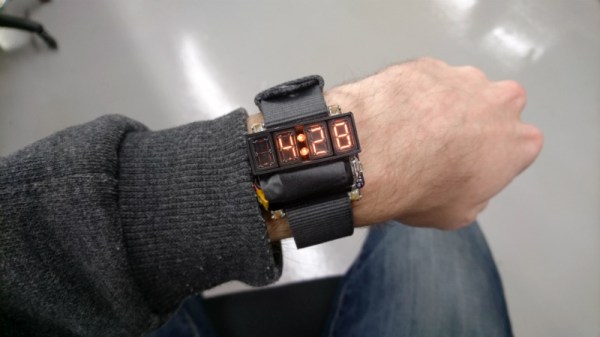
There hasn’t been a lot of prior-art that utilizes Numitrons, but that might be changing, given how fantastic this wristwatch created by [Dycus] looks. With a multi-day battery life, daylight readability, and relatively straightforward construction, the Filawatch is likely to end up being something of a reference design for future Numitron watches.

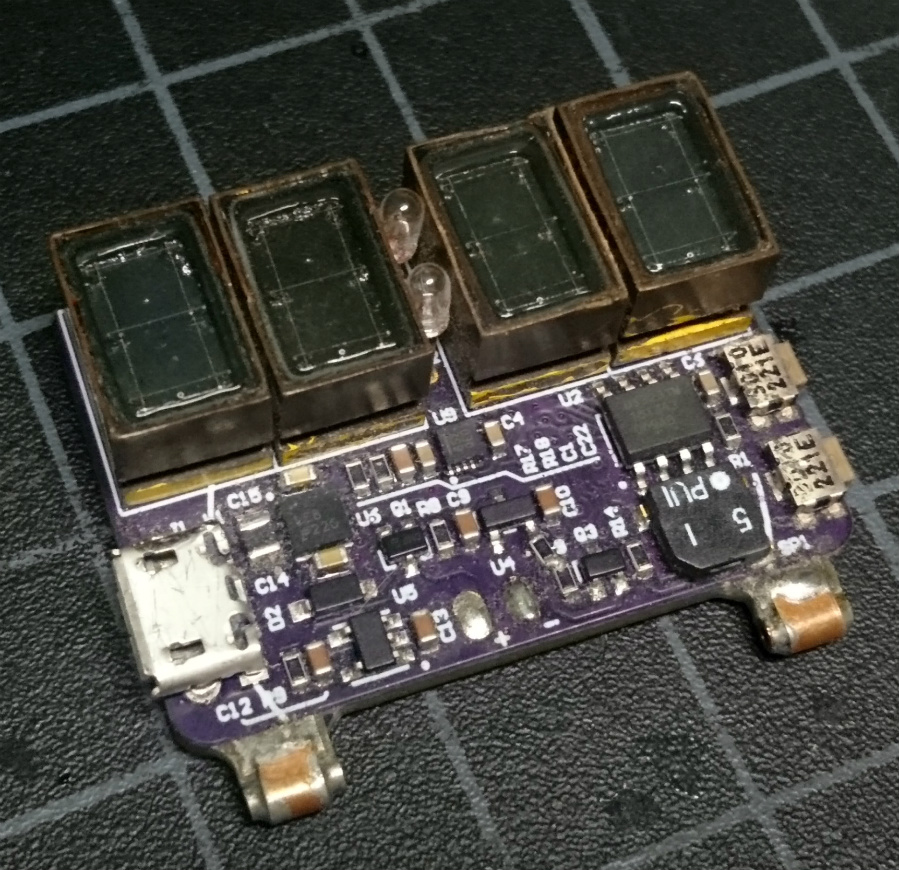
[Dycus] has gone through three revisions of the Filawatch so far, with probably at least one more on the way. The current version is powered by a ATmega328 microcontroller with dual 16-bit LED drivers to control the filaments in the KW-104S Numitron display modules. He’s also included an accelerometer to determine when the wearer is looking at the display, and even a light sensor to control the brightness of the display depending on the ambient light level.

If there’s a downside to Numitron displays, it’s their monstrous energy consumption. Just like in the incandescent light bulbs most of us have been ditching for LED, it takes a lot of juice to get that filament glowing. [Dycus] reports the display draws as much as 350 mA while on, but by lighting it up for only five seconds at a time it can be checked around 150 times before the watch needs to be recharged.

Its been a few years since we’ve seen a Numitron watch, and it’s interesting to see how the state of the art has advanced.

[via /r/electronics]