3D Printing Gets Cheesy

Has it ever crossed your mind that everything you see for sale–no matter how mundane–is someone’s life passion? Or, at least, their work passion. Somewhere as we speak two or three people are in a room trying to figure out how to make a whoopie cushion for two cents less than before. Someone is touting the virtues of the newest design in egg cartons. The guys that make the tube that carries your money to the bank teller at the drive through window? They exist, too.

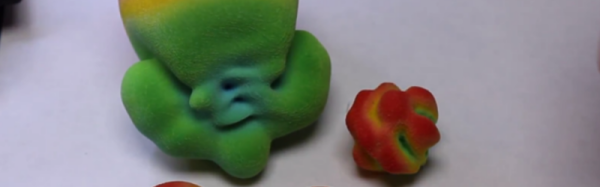
It is natural for us to think about improving 3D printers but most of us print plastic. We might wish we could print metal. But researchers in a few places are printing cheese. We didn’t say hackers with the muchies, we said researchers. There’s a colorful slide show from the University College Cork in Ireland, for example. They printed cheese at two different speeds and used a laser scanning microscope and a rheometer to analyze the results. We’ve seen rheometers in plastic factories, but never in the kitchen. Meanwhile on the hacker front, apparently spray cheese cans work as an easy cold extruder (see video below).

Continue reading “3D Printing Gets Cheesy”

Stop Printing Air With A Filament Sensor

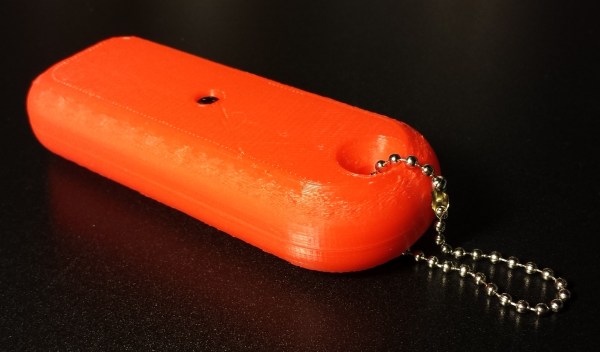
If you have had a 3D printer for awhile, you know the heartbreak of coming in to check on an 8-hour print only to find that in hour 7 you ran out of filament (or the filament broke) and your printer has been dutifully moving around for no reason. [Chuck Hellebuyck] knows and he decided to make a filament sensor he found on Thingiverse.

Finding a part on Thingiverse and printing it probably doesn’t warrant much attention. But if you watch the video, below, it is a good example of how things from Thingiverse don’t always meet your needs. The microswitch [Chuck] had was bigger than the design used. So he loaded the STL file into TinkerCAD and fixed it. He shows you exactly how he did it. That’s a useful skill because you never know when you’ll need to modify some part you’ve found on the Internet.

Continue reading “Stop Printing Air With A Filament Sensor”

Making Laser Cutter Designs Work In A 3D Printer

The main mechanical tools in a hacker’s shop used to be a drill press and a lathe. Maybe a CNC mill, if you were lucky. Laser cutters are still a rare tool to find in a personal shop, but today’s hackers increasingly have access to 3D printers. What happens when you have a design for a laser cutter (2D parts) but only have access to a 3D printer? You punt.

[DIY3DTECH] has a two-part video on taking a 2D design (in an SVG file) and bringing it into TinkerCad. At that point, he assembles the part in software and creates a printable object. You can see the videos below.

Continue reading “Making Laser Cutter Designs Work In A 3D Printer”

Speech To Sign Language

According to the World Federation of the Deaf, there are around 70 million people worldwide whose first language is some kind of sign language. In the US, ASL (American Sign Language) speakers number from five hundred thousand to two million. If you go to Google translate, though, there’s no option for sign language.

[Alex Foley] and friends decided to do something about that. They were attending McHack (a hackathon at McGill University) and decided to convert speech into sign language. They thought they were prepared, but it turns out they had to work a few things out on the fly. (Isn’t that always the case?) But in the end, they prevailed, as you can see in the video below.

Continue reading “Speech To Sign Language”

DIY 3D Slicer Is A Dynamo

We all know that hacker that won’t use a regular compiler. If he’s not using assembly language, he uses a compiler he wrote. If you don’t know him, maybe it is you! If you really don’t know one, then meet these two. [Nathan Fuller] and [Andy Baldwin] want to encourage you to write your own 3D slicer.

Their post is very detailed and uses Autodesk Dynamo as a graphical programming language. However, the details aren’t really specific to Dynamo. It is like a compiler. You sort of know what it must be doing, but until you’ve seen one taken apart, there are a lot of subtleties you probably wouldn’t think of right away if you were building one from scratch.

Continue reading “DIY 3D Slicer Is A Dynamo”

3D printing with holograms

3D Printing Using Holograms Is Actually Printing In 3D

It’s the year 2260 and you’re being beamed from your starship to the planet below. Being a descendant of present day 3D printers, the transporter prints you out, slowly making one layer before moving on to the next, going from the ground up. The you-that-was hopes nothing spills out before you’re done. But what if you could print every atom in your body at the same time? If those transporters are descendant’s of Daqri’s holographic 3D printing technology then that’s just what will happen.

Daqri’s process is akin to SLA (stereolithography) and SLA/DLP (digital light processing). In SLA, a laser beam is shone onto a pool of resin, hardening the resin at the beam’s point. The laser scans across the resin’s surface, drawing one layer. More resin is added and then the next layer is drawn. In SLA/DLP, the light for an entire layer is projected onto the surface at once. While both methods involve stereolithography, the acronym SLA by itself is commonly used to refer to the laser approach.

Holograhically 3D printing a paperclip

Daqri’s process however, uses a holographic chip of their own making to project the light for all the layers at the same time into the material, a light-activated monomer. Their chip is a silicon wafer containing a grid of tunable crystals. Those crystals control the magnitude and phase of light reflected down into the monomer, creating a 3D volume of interference patterns. The brief description of the process says that a laser is used to shine light onto the crystals, so there’s probably still some scanning going on. However, in the video, all of the object being printed appears illuminated at the same time so the scanning is likely very fast, similar to how a laser in a light show seemingly paints what appears to be a 2D shape on the side of a building, even though it’s really just a rapidly moving point. There’s also the possibility that the beam’s point is large enough to encapsulate all of the chip at once. You can see a demonstration of it in the video below.

Continue reading “3D Printing Using Holograms Is Actually Printing In 3D”

Ask Hackaday: Is Owning A 3D Printer Worth It?

3D printers are the single best example of what Open Hardware can be. They’re useful for prototyping, building jigs for other tools, and Lulzbot has proven desktop 3D printers can be used in industrial production. We endorse 3D printing as a viable tool as a matter of course around here, but that doesn’t mean we think every house should have a 3D printer.

Back when Bre was on Colbert and manufacturing was the next thing to be ‘disrupted’, the value proposition of 3D printing was this: everyone would want a 3D printer at home because you could print plastic trinkets. Look, a low-poly Bulbasaur. I made a T-rex skull. The front page of /r/3Dprinting. Needless to say, the average consumer doesn’t need to spend hundreds of dollars to make their own plastic baubles when WalMart and Target exist.

The value proposition of a 3D printer is an open question, but now there is some evidence a 3D printer provides a return on its investment. In a paper published this week, [Joshua Pearce] and an undergraduate at Michigan Tech found a 3D printer pays for itself within six months and can see an almost 1,000% return on investment within five years. Read on as I investigate this dubious claim.

Continue reading “Ask Hackaday: Is Owning A 3D Printer Worth It?”