Another Radio Module For IoT Fun – EMW3162

The availability of cheap radio modules is making them ubiquitous in an increasing number of projects that we have been seeing recently. The usual go-to solution is using any one of the several modules based on the ESP8266 device. [Willem] wrote in to share with us his experiences with another radio module – the EMW3162 from MXChip, which at $10 isn’t as cheap as the ESP8266 modules, but is a more capable, power packed, device.

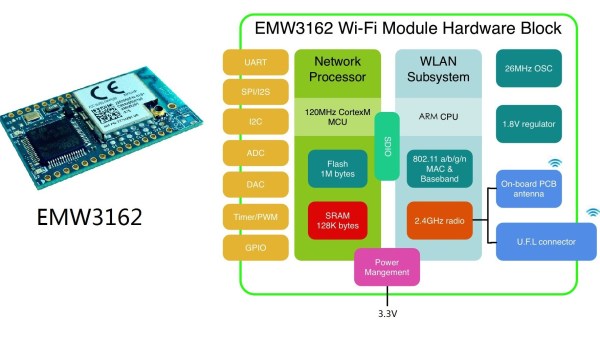
The EMW3162 (PDF datasheet) is a low-power embedded WiFi module with integrated wireless LAN, and a STM32F205 Cortex-M3 microcontroller that runs a “self-hosted” WiFi networking library and software application stack. The microcontroller has 1M flash, 128k RAM and runs at 120MHz. And since MXChip is a Broadcom partner, they are allowed to use the WICED_SDK.

The on-board ARM M3 means all kinds of useful interfaces are available: UART, SPI, I2C, ADC, DAC, PWM, TIMERS, GPIO, and a JTAG flash interface. The good news could be on the power consumption figures – the module is touted to be low-power, and the data sheet shows 7mA when connected to an access point but with no data transfer. When transmitting at 20kbps, the current draw is about 24mA, which goes up to 320mA at 11Mbps.

[Willem] has his EMW3162_WICED repository up on Github, but also take a look at the MXChips MICO (Mico-controller based Internet Connectivity Operation System) repository. At the moment, he has it working using Linux, with a gnu gcc compiler and a JLINK JTAG programmer. He also has the WICED SDK working and has a WiFi AP with an on-board 120MHz arm chip. It would be interesting to hear about other users’ experiences with this radio module. Do let us know in the comments below!
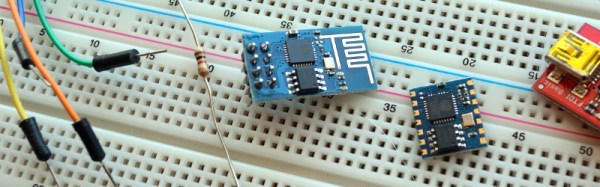
 

How To Directly Program An Inexpensive ESP8266 WiFi Module

The ESP8266 is the answer to “I want something with Wifi.” Surprisingly, there are a number of engineers and hobbyists who have not heard of this chip or have heard of it but don’t really understand what it is. It’s basically the answer to everything IoT to so many engineering problems that have plagued the hobbyist and commercial world alike.

The chip is a processor with integrated RAM, some ROM, and a WiFi radio, and the only external components you will need are 4 capacitors, a crystal and an external flash! It’s CHEAP, like $4/ea cheap! Or $5 if you want it on a nice, convenient carrier board that includes all these components. The power consumption is reasonable (~200mA)1, the range is insane ~300m2 without directional equipment, and a PCB trace antenna and ~4km if you want to be ridiculous.

One place thing that more people need to know about is how to program directly for this chip. Too many times projects use it as a crutch via the AT commands. Read on and find out how to hello world with just this chip.

Continue reading “How To Directly Program An Inexpensive ESP8266 WiFi Module”

TwitterPrinter Keeps Track Of 2015 Hack-A-Day Prize

[Mastro Gippo] is getting to be somewhat of a Hackaday legend. He didn’t win the 2014 Hackaday prize but was in attendance at the event in Munich, and to make sure he keeps up with this year’s Prize, he built this old-school printer that prints all of the updates from the Hackaday Prize Twitter account.

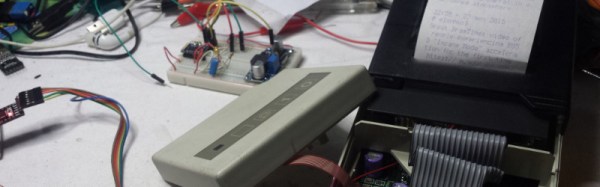
The device uses the now-famous ESP8266 module for connecting the printer to the Internet. It doesn’t scrape data straight from Twitter though, it looks at [Mastro Gippo]’s own server to avoid getting inundated with too many tweets at once. The program splits the tweets into a format that is suitable for the printer (plain text) and then the printer can parse the data onto the paper. The rest of the design incorporates a 3.3V regulator for power and some transistors to turn the printer on and off. Be sure to check out the video of the device in action after the break!

[Mastro Gippo] notes that this eliminates the need to have a smartphone in order to keep up with the 2015 Hackaday Prize, which is ironic because his entry into the Trinket Everyday Carry Contest was a smarter-than-average phone. We’ll be expecting something that doesn’t waste quite as much paper for his official contest entry, though!

Continue reading “TwitterPrinter Keeps Track Of 2015 Hack-A-Day Prize”

Hackaday Links Column Banner

Hackaday Links: March 1, 2015

The somewhat regular Hardware Developers Didactic Galactic was a few days ago in San Francisco. Here’s the video to prove it. Highlights include [James Whong] from Moooshimeter, the two-input multimeter, [Mark Garrison] from Saleae, and a half-dozen other people giving talks on how to develop hardware.

[Taylor] made a portable NES with a retron, a new-ish NES clone that somehow fits entirely in a glop top IC. The controllers sucked, but [Taylor] made a new one with touch sensors. All that was required was eight transistors. The enclosure is an Altoid tin, and everything works great.

Here’s a YouTube channel you should subscribe to: Ham College. The latest episode covers the history of radio receivers and a crystal radio demonstration. They’re also going through some of the Technical class question pool, providing the answers and justification for those answers.

[Prusa] just relaunched prusaprinters and he’s churning out new content for it. Up now is an interview with [Rick Nidata] and his awesome printed container ship.

The tip line is overflowing with ESP8266 breakout boards. Here’s the simplest one of them all. It’s a breadboard adapter with stickers on the pin headers. Turn that into a right-angle breadboard adapter, and you’ll really have something.

Here’s something that’s a bit old, but still great. [Dillon Markey], one of the stop-motion animators for Robot Chicken modified a Nintendo Power Glove for animation duties. It seems to work great, despite being so bad. Thanks [Nicholas] for the link.

[David] the Swede – a consummate remote control professional we’ve seen a few times before – just flew his tricopter in a mall so dead it has its own Wikipedia page. Awesome tricopter, awesome location, awesome video, although we have to wonder how a few really, really bright LEDs would make this video look.

Here’s an item from the tip line. [Mark] wrote in with an email, “Why do you put names in [square brackets] in the blog entries? Just curious.” The official, [Caleb]-era answer to that question is that sometimes people have bizarre names that just don’t work in text. Imagine the sentence, “[12VDC] connected the wires to the terminal” without brackets. The semi-official answer I give is, “because.”

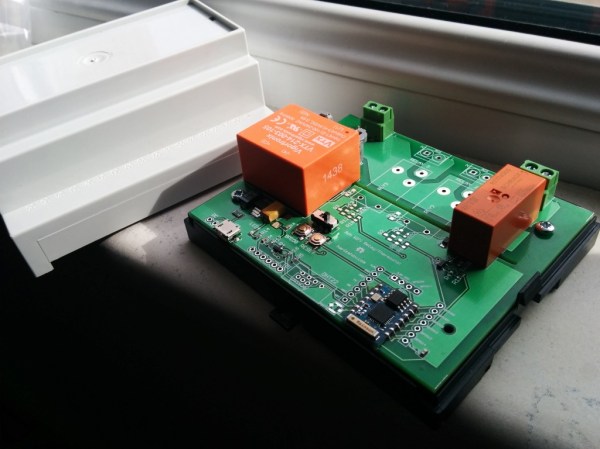
Control board for a Wi-Fi enabled thermostat

Controlling Central Heating Via Wi-Fi

If you’ve ever lived in a building with manually controlled central heating, you’ll probably understand [Martin]’s motivation for this hack. These heating systems often have old fashioned valves to control the radiator. No Nest support, no thermostat, just a knob you turn.

To solve this problem, [Martin] built a Wi-Fi enabled thermostat. This impressive build brings together a custom PCB based on the ESP8266 Wi-Fi microcontroller and a mobile-friendly web UI based on the Open Thermostat Scheduler. The project’s web server is fully self-contained on the ESP8266.

To replace that manual value, [Martin] used a thermoelectric actuator from a Swiss company called HERZ. This is driven by a relay, which is controlled by the ESP8266 microcontroller. Based on the schedule and the measured temperature, the actuator lets fluid flow through the radiator and heat the room.

As a bonus, the device supports NTP for getting the time, MQTT for publishing real-time data, and ThingSpeak for logging and graphing historic data. The source code and design files are available under a Creative Commons license.

Wearable WiFi Finder Uses The ESP8266

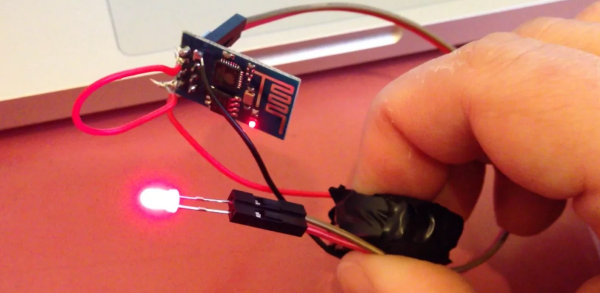
It seems like a day doesn’t go by without an ESP8266 project here on Hackaday. There’s a good reason for that, the chip and associated modules have brought low-cost WiFi connectivity to the masses. Today we have [Stevica Kuharski], who has built an open WiFi access point detector using the ESP8266. To do this he’s using the Lua compatible NodeMcu firwmare. [Stevica] wrote his own Lua scripts to run on the ESP8266’s internal 32 bit microcontroller. The freewifi script scans and searches for open WiFi networks. If a network is detected, the user is informed via a blinking LED.

To make the project wearable, [Stevica] powered the project with a pair of CR2450 coin cell batteries. The ESP8266 is not known for being a particularly low power device, so we’re curious to see what sort of battery life  [Stevica] gets with his project. The project source is already available on GitHub, and [Stevica] is hoping to kick off an Indiegogo campaign in the next few weeks. Click past the break to see the WiFi detector in action.

Continue reading “Wearable WiFi Finder Uses The ESP8266”

ESP8266 ESP07 Module DoA Fix

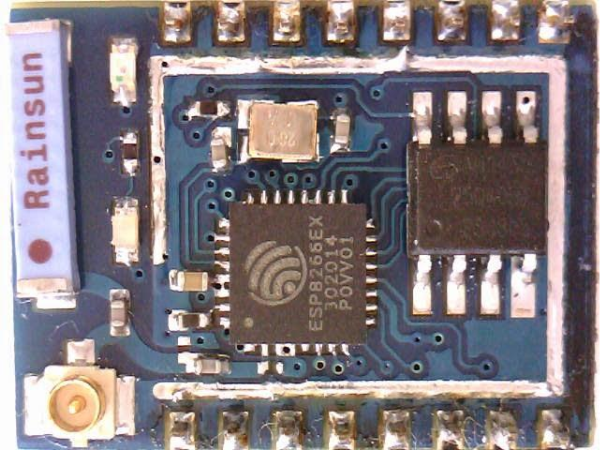
It seems the Far-East factories can’t churn out ESP8266 based modules fast enough to feed all the world’s hackers. Well, Pick-n-Place machines are human too, so it’s not too long before you end up with a messed up batch from a factory. [Tracker Johnny] found a bunch of ESP07 modules which had their resonator mounted the wrong way around, effectively making them DoA. The resonator mounting isn’t consistently wrong too – most have reported them 90 deg offset, while others had them 180 deg. off.

Unfortunately, you need some tools and skills to fix the error. The ESP07 modules have a metal shield which needs to be removed to access the resonator. This is best done using a hot air gun. With the cover removed, you need to de-solder the resonator, and put it back in the right orientation as shown in the pictures on [Tracker Johnny]’s blog. You can find other people reporting the same fault at this forum thread. Coming in the wake of the problem with magic smoke from ESP8266 based ESP01 modules we reported earlier, it seems obvious that quality comes at a cost.