Text Adventures For Arduino Starting With Hunt The Wumpus

Let’s be honest, you’re going to have trouble getting kids to play text-based adventure games these days. But this is one way to get them interested. This weekend you should get together with niece, nephew, son, or daughter and help them build their own hardware and program it with an adventure game. One last project before school’s out and the weather’s nice.

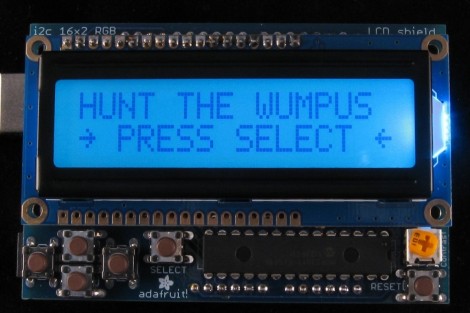
This is [Dan’s] shiny example of Hunt the Wumpus. He used Adafruit’s RGB LCD shield for Arduino. It’s got a character LCD and five buttons. But you can easily breadboard this yourself using a few tactiles plus a screen and uC of your own choosing. One nice touch with this one is the RGB backlight which is used to add an element of danger to the story line. He also mentions a few bugs in the Arduino language which he found while setting up the game.

We’ve been meaning to make our version of Zork using an Arduino, GLCD, and PS/2 keyboard ever since we read “Ready Player One”. This is just a bit more encouragement to get moving on that project.

[Thanks PT]
Using GPS To Stay Aware Of Red Light Cameras

red-light-camera-alerter

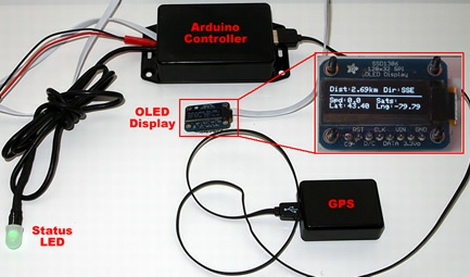
Depending on how you view them, red light cameras are a great way to get people to drive carefully, or an utter nuisance. We agree with the latter opinion, as does [Dave], so he built a handy little device that alerts him when he’s about to approach one of these intersections.

His Red Light Camera Alerter is based around an Atmega 328P sporting the Arduino bootloader. The micro obtains GPS coordinates while [Dave] is driving, comparing his current location with a table of all known red light intersections in the area. As he nears a red light camera, the status LED changes colors from blue to yellow to red as he gets closer, making it easy to keep aware of his situation. He also included an Adafruit OLED display in his device, which relays his speed, GPS coordinates, heading, and actual distance from the red light in real time.

While [Dave] admits that he doesn’t really have a need for the alerter as there are only a couple located in his immediate vicinity, he says it was a fun and easy way to get some experience with using GPS sensors in his projects. He doesn’t have any video of it in action, but you can find the code he uses to drive the alerter on his blog.

Antique Phone Provides A Soundtrack Perfect For Restoring Old Cars

crank-phone-music

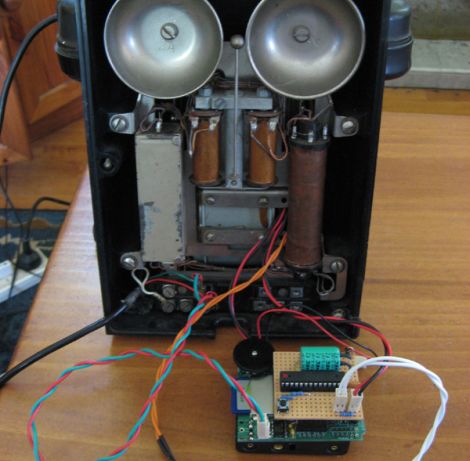
[Simon] is in the middle of restoring/building himself an Austin 7 Special out in his garage, and like most tinkerers, found that music helps to move the process along. He happened to have an old Bakelite generator phone out in the garage as well, and figured that he might as well have it do something other than simply hang on the wall.

Playing music from the 1930 seemed like a fitting enough task, so he picked up an Adafruit Waveshield and spent some time wiring it up to the old telephone. His new radio works simply enough, piping .wav files through the handset, provided someone has cranked the phone’s generator recently.

While cranking the generator is required to play music, the Arduino is actually powered off a pair of AA batteries. The cranking is all cosmetic, but he did program the Arduino to slow the music down every once in awhile, requiring that the generator be turned to get things back up to speed.

It really is a neat way to repurpose the old phone, and we like the fact that [Simon] did not gut it to put this project together.

Continue reading to see a short video of his new music player in action.

Continue reading “Antique Phone Provides A Soundtrack Perfect For Restoring Old Cars”

A TV-B-Gone With A PIC Twist

pic-tvbgone

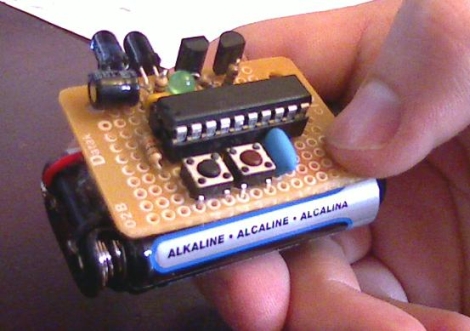
[Kayvon] thought that the TV-B-Gone was a fun little device and wanted to build one, but he didn’t have an AVR programmer handy. Rather than picking up some AVR kit and simply building a replica, he decided to give his PIC skills a workout and build a Microchip derivative of his own.

The PIC-based TV-B-Gone is pretty similar to its AVR-borne brethren, featuring a PIC24F08KA101 at the helm instead of an ATTiny. His version of the TV-B-Gone can be left on indefinitely, allowing him to situate the device in a convenient hiding place to wreak havoc for as long as he likes.

[Kayvon’s] TV-B-Gone does everything the original can at just under $7, which is quite a bit cheaper than the Adafruit kit. If you’re not averse to perfboard construction, be sure to check out the build thread over in the Adafruit forums. [Kayvon] has done most of the heavy lifting for you – all you need to do is build it.

Circuit Playground – An Electronics Reference App From Adafruit

It’s not everyday that we review software around here, but the folks at Adafruit recently put together an iOS app that I figured might be of interest. Their iPad/iPhone compatible application is called “Circuit Playground”, and it includes all sorts of handy electronics reference tools. For the context of this review, it should be noted that I paid for the application myself, and that I have had no communication with the Adafruit team regarding my assessment of the app.

Continue reading “Circuit Playground – An Electronics Reference App From Adafruit”

10 Meter Long Moving Light Show Is Mesmerizing

light-show

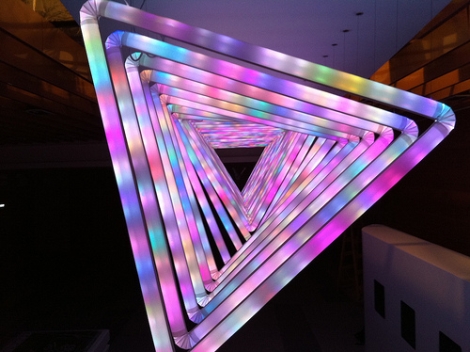
[Marcus] was recently commissioned to put together the electronics for a slick 10 meter long LED installation at the Hsinchu Biomedical Science Park Exhibition Center in Taiwan. While you might assume that he was asked to construct a large LED matrix, this project is a little bit different from what you probably expected.

The display is actually a long light tunnel made up of 30 moving triangles suspended from the ceiling. The triangle movement is governed by 60 separate stepper motors, while the lighting is provided by 30 HL1606 RGB LED strips he picked up from Adafruit. The display’s logic is handled completely by an XMOS controller, which is beefy enough to handle controlling all of the stepper motors and the LEDs simultaneously.

After he hand assembled all of the motor driver boards and tested things in his workshop, the whole lot was shipped over to Taiwan for assembly by the on-site crew. After a bit of troubleshooting, they were able to get things working properly, and the display looks great as you can see from the image above.

[Marcus] says that he doesn’t have video of the display in action just yet, though he will update his post whenever he does.

[Thanks, Paul]

Adafruit Celebrates Ada Lovelace Day

ada_lovelace_day

If you weren’t aware, today is [Ada Lovelace] day, so [Ladyada] and Adafruit Industries are spending the day celebrating the achievements of women in the fields of technology, art, engineering, and electronics. Specifically, the focus is on fellow female makers/hackers who are helping shape and promote the industry.

Once every hour, Adafruit Industries is profiling one influential woman, paying tribute to her work and contributions to the tech/maker/art/science space. You’ll see a lot of familiar faces throughout the day, including electronics extraordinaire [Jeri Ellsworth], Make’s own [Becky Stern], as well as [Sherry Huss] and [Louise Glasgow], two of Maker Faire’s leading ladies.

The bios are certainly worth taking a look at – aside from some of the more familiar faces, it’s a great chance to learn about a few makers who you may not have heard of before.

As an added bonus, Adafruit is offering 10% off all purchases from the store using a coupon code that can be found on their site, so be sure to check it out!