Artificial Limbs And Intelligence

Prosthetic arms can range from inarticulate pirate-style hooks to motorized five-digit hands. Control of any of them is difficult and carries a steep learning curve, rarely does their operation measure up to a human arm. Enhancements such as freely rotating wrist might be convenient, but progress in the field has a long way to go. Prosthetics with machine learning hold the promise of a huge step to making them easier to use, and work from Imperial College London and the University of Göttingen has made great progress.

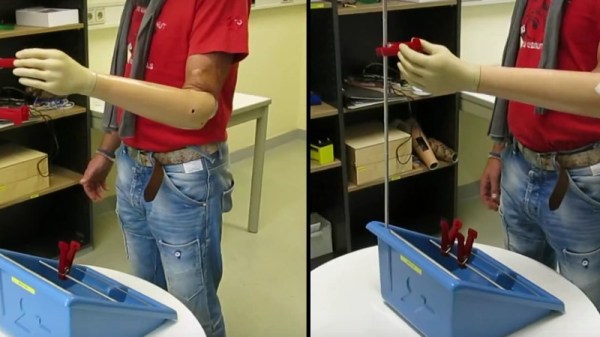
The video below explains itself with a time-trial where a man must move clips from a horizontal bar to a nearby vertical bar. The task requires a pincer grasp and release on the handles, and rotation from the wrist. The old hardware does not perform the two operations simultaneously which seems clunky in comparison to the fluid motion of the learning model. User input to the arm is through electromyography (EMG), so it does not require brain surgery or even skin penetration.

We look forward to seeing this type of control emerging integrated with homemade prosthetics, but we do not expect them to be easy.

Continue reading “Artificial Limbs And Intelligence”

Artificial Intelligence Composes New Christmas Songs

One of the most common uses of neural networks is the generation of new content, given certain constraints. A neural network is created, then trained on source content – ideally with as much reference material as possible. Then, the model is asked to generate original content in the same vein. This generally has mixed, but occasionally amusing, results. The team at [Made by AI] had a go at generating Christmas songs using this very technique.

The team decided that the easiest way to train their model would be to use note data from MIDI files. MIDI versions of Christmas songs are readily available and provide a broad base with which to train the model. For a neural network, the team chose to use a Long-short Term Memory (LSTM) architecture. This is a model which is contextually sensitive, which is important when dealing with structured formats like music or language.

The neural network generated five tunes which you can listen to on the Made by AI Soundcloud page. The team notes their time was limited, and we think that with some further work and more adherence to musical concepts such as structure and repetition, it might be possible to generate something a little more catchy.

There are other applications for AI in music, too – like these intelligent musical prostheses.

Quick Face Recognition With An FPGA

It’s the 21st century, and according to a lot of sci-fi movies we should have perfected AI by now, right? Well we are getting there, and this project from a group of Cornell University students titled, “FPGA kNN Recognition” is a graceful attempt at facial recognition.

For the uninitiated, the K-nearest neighbors or kNN Algorithm is a very simple classification algorithm that uses similarities between given sets of data and a data point being examined to predict where the said data point belongs. In this project, the authors use a camera to take an image and then save its histogram instead of the entire image. To train the network, the camera is made to take mug-shots of sorts and create a database of histograms that are tagged to be for the same face. This process is repeated for a number of faces and this is shown as a relatively quick process in the accompanying video.

The process of classification or ‘guess who’, takes an image from the camera and compares it with all the faces already stored. The system selects the one with the highest similarity and the results claimed are pretty fantastic, though that is not the brilliant part. The implementation is done using an FPGA which means that the whole process has been pipe-lined to reduce computational time. This makes the project worth a look especially for people looking into FPGA based development. There is a hardware implementation of a k-distance calculator, sorting and selector. Be sure to read through the text for the sorting algorithm as we found it quite interesting.

Arduino recently released the Arduino MKR4000 board which has an FPGA, and there are many opensource boards out there in the wild that you can easily get started with today. We hope to see some of these in conference badges in the upcoming years.

Continue reading “Quick Face Recognition With An FPGA”

The Naughty AIs That Gamed The System

Artificial intelligence (AI) is undergoing somewhat of a renaissance in the last few years. There’s been plenty of research into neural networks and other technologies, often based around teaching an AI system to achieve certain goals or targets. However, this method of training is fraught with danger, because just like in the movies – the computer doesn’t always play fair.

It’s often very much a case of the AI doing exactly what it’s told, rather than exactly what you intended. Like a devious child who will gladly go to bed in the literal sense, but will not actually sleep, this can cause unexpected, and often quite hilarious results. [Victoria] has created a master list of scholarly references regarding exactly this.

The list spans a wide range of cases. There’s the amusing evolutionary algorithm designed to create creatures capable of high-speed movement, which merely spawned very tall creatures that generated these speeds by falling over. More worryingly, there’s the AI trained to identify toxic and edible mushrooms, which simply picked up on the fact that it was presented with the two types in alternating order. This ended up being an unreliable model in the real world. Similarly, the model designed to assess malignancy of skin cancers determined that lesions photographed with rulers for scale were more likely to be cancerous.

[Victoria] refers to this as “specification gaming”. One can draw parallels to classic sci-fi stories around the “Laws of Robotics”, where robots take such laws to their literal extremes, often causing great harm in the process. It’s an interesting discussion of the difficulty in training artificially intelligent systems to achieve their set goals without undesirable side effects.

We’ve seen plenty of work in this area before – like this use of evolutionary algorithms in circuit design.

Open Data Cam Combines Camera, GPU, And Neural Network In An Artisanal DIY Cereal Box

The engineers and product designers at [moovel lab] have created the Open Data Cam – an AI camera platform that can identify and count objects as they move through its field of view – along with an open source guide for making your own.

Step one: get out your ruler and utility knife. In this world of ubiquitous 3D-printers they’ve taken a decidedly low-tech approach to the project’s enclosure: a cut, folded, and zip-tied plastic box, with a cardboard frame inside to hold the electronic bits. It’s “splash proof” and certainly cheap to make, but we’re a little worried about cooling and physical protection for the electronics inside, as they’re not exactly cheap and rugged components.

So what’s inside? An Nvidia Jetson TX2 board, a LiPo battery with some charging circuitry, and a standard webcam. The special sauce, however, is the software, which is available on GitHub. [Moovel lab]’s engineers have put together a nice-looking wifi-accessible mobile UI for marking the areas where you’d like the software to identify and tally objects. The actual object detection and identification tasks are performed by the speedy YOLO neural network, a task the Nvidia board’s GPU is of course well suited for.

As the Open Data Cam’s unblinking glass eye gazes upon our urban environments, it will log its observations in an ancient and mysterious language: CSV. It’s up to you, human, to interpret this information and use it for good.

A summary video and build time lapse are embedded after the break.

Continue reading “Open Data Cam Combines Camera, GPU, And Neural Network In An Artisanal DIY Cereal Box”

Kinetic Sculpture Achieves Balance Through Machine Learning

We all know how important it is to achieve balance in life, or at least so the self-help industry tells us. How exactly to achieve balance is generally left as an exercise to the individual, however, with varying results. But what about our machines? Will there come a day when artificial intelligences and their robotic bodies become so stressed that they too will search for an elusive and ill-defined sense of balance?

We kid, but only a little; who knows what the future field of machine psychology will discover? Until then, this kinetic sculpture that achieves literal balance might hold lessons for human and machine alike. Dubbed In Medio Stat Virtus, or “In the middle stands virtue,” [Astrid Kraniger]’s kinetic sculpture explores how a simple system can find a stable equilibrium with machine learning. The task seems easy: keep a ball centered on a track suspended by two cables. The length of the cables is varied by stepper motors, while the position of the ball is detected by the difference in weight between the two cables using load cells scavenged from luggage scales. The motors raise and lower each side to even out the forces on each, eventually achieving balance.

The twist here is that rather than a simple PID loop or another control algorithm, [Astrid] chose to apply machine learning to the problem using the Q-Behave library. The system detects when the difference between the two weights is decreasing and “rewards” the algorithm so that it learns what is required of it. The result is a system that gently settles into equilibrium. Check out the video below; it’s strangely soothing.

We’ve seen self-balancing systems before, from ball-balancing Stewart platforms to Segway-like two-wheel balancers. One wonders if machine learning could be applied to these systems as well.

Continue reading “Kinetic Sculpture Achieves Balance Through Machine Learning”

Jump Into AI With A Neural Network Of Your Own

One of the difficulties in learning about neural networks is finding a problem that is complex enough to be instructive but not so complex as to impede learning. [ThomasNield] had an idea: Create a neural network to learn if you should put a light or dark font on a particular colored background. He has a great video explaining it all (see below) and code in Kotlin.

[Thomas] is very interested in optimization, so his approach is very much based on mathematics and algorithms of optimization. One thing that’s handy is that there is already an algorithm for making this determination. He found it on Stack Exchange, but we’re sure it’s in a textbook or paper somewhere. The existing algorithm makes the neural network really impractical, but it makes training easy since you can algorithmically develop a training set of data.

Once trained, the neural network works well. He wrote a small GUI and you can even select among various models.

Don’t let the Kotlin put you off. It is a derivative of Java and uses the same JVM. The code is very similar, other than it infers types and also adds functional program tools. However, the libraries and the principles employed will work with Java and, in many cases, the concepts will apply no matter what you are doing.

If you want to hardware accelerate your neural networks, there’s a stick for that. If you prefer C and you want something lean and mean, try TINN.

Continue reading “Jump Into AI With A Neural Network Of Your Own”