Arduino Based EATC Replacement

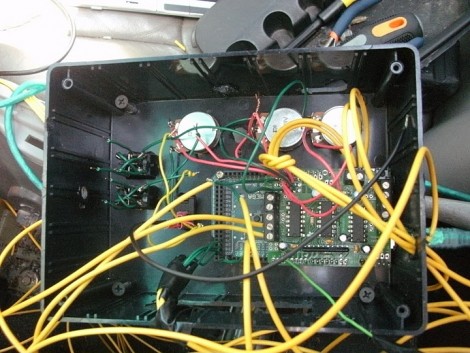
The Electronic Automatic Temperature Control Module on [Dan Mattox’s] 2000 Ford Taurus bit the dust. The junkyards in the area didn’t have a matching replacement and a new one is pretty hard to come by so he built an EATC  replacement from an Arduino Mega. It includes a solenoid controller board for the vent selector, blower control, and new switches to control the power windows. He’s got the system up and running which is important because after removing the broken EATC the car was stuck blowing 90-degree air at full blast. He’s put together a demo and an installation video which we’ve embedded after the break but there’s also a photo album you can page through. The sketch that we developed to control the system is up at pastebin so get it while it’s hot.

Continue reading “Arduino Based EATC Replacement”

Final Projects: WiFi Coil Gun Turret

[youtube=http://www.youtube.com/watch?v=PU3QB3ScnGQ]

[Chris Farnell] and [Michael Helms] are the brains behind this scary looking piece of machinery. It is a Coil gun, mounted on a turret, that is controlled over WiFi. If that wasn’t scary enough, they have rigged it to their iphone/ipad for remote shooting. Though it looks bulky, you can see that it is surprisingly responsive in action.

Kaossilator On The Cheap

We recently stumbled on a way to turn a regular laptop into a poor man’s Kaossilator. Using the touchpad of your laptop, some PureData software, Touchpad2MIDI and a couple custom patches, [zenpho] has set everyone up to create that crazy electronic music that kids listen to these days.

But what was that? You cant afford a whole laptop, and need to make this happen on an even tighter budget? Oh, we’ve got your back. Using just the trackpad and an Arduino, [Bastiaan] has created a basic PS2 to Arduino to USB link which can be parsed by your favorite language of choice into a working MIDI interface. Good news for all the lazy hackers out there, he’s planning on swapping out the Arduino for a Teensy, and making a real USB to MIDI interface.

Minimalist AVR Programmer Is Just Fab!

Whether you’re burning a new bootloader to an Arduino board, or doing away with a bootloader to flash Atmel chips directly, an in-system programmer (ISP) is an indispensable tool for working with AVR microcontrollers. If cost has held you back, it’s no longer an excuse: FabISP is a barebones USB-based AVR programmer that can be pieced together for about ten bucks.

FabISP was created by [David Mellis] as a product of MIT’s Fab Lab program, which provides schools with access to design and manufacturing tools based around a core set of fabrication capabilities, so labs around the world can share results. But the FabISP design is simple enough that you don’t need a whole fab lab. It’s a small, single-sided board with no drilling required; the parts are all surface-mounted, but not so fine-pitched as to require reflow soldering. Easy!

There’s still the bootstrap problem, of course: you need an AVR programmer to get the firmware onto the FabISP. This would be an excellent group project for a hackerspace, club or school: if one person can provide the initial programmer to flash several boards, each member could etch and assemble their own, have it programmed, then take these out into the world to help create more. We must repeat!

[Thanks Juan]

Biopunk Watch: Time, Temperature, Gaming

[Matthew Garten] built this watch based on an Arduino. The face is a small color display which allows you to choose to show time in digital, binary, or analog formats. In keeping with the recent trend here on Hackaday he has a glove-based add-on that has temperature sensors in the fingers; for Firefighters or those with nerve damage to their fingers (we’re thinking Darkman). For entertainment in any situation he’s included a trackball and the ability to play breakout or draw in 16-bit color. Details are scarce but apparently he’ll be sharing more soon. For now, watch the video after the break and think of ways to shrink this down into a nice package like the Pong Watch enjoys.

Continue reading “Biopunk Watch: Time, Temperature, Gaming”

Twilio Adds Touch Tone Telephone Control For Arduino

An Arduino with an Ethernet shield, nothing new right? Not quite, [Chris] is showing us how to use Twilio to control an Arduino via a touch tone telephone. We saw Twilio used before in a cellphone video game but this time around an audio menu system comes into play. You can make your own menus whose options will be read by the WOPR (see the demo after the break) when you call the Twilio number. This application just turns an LED on and off but once you’ve got access to the Arduino the sky’s the limit. Most immediately this is an easy implementation for all those cellphone door lock systems we’ve seen. We also envision some classic home automation such as feed the cats or turn on the lights.

Continue reading “Twilio Adds Touch Tone Telephone Control For Arduino”