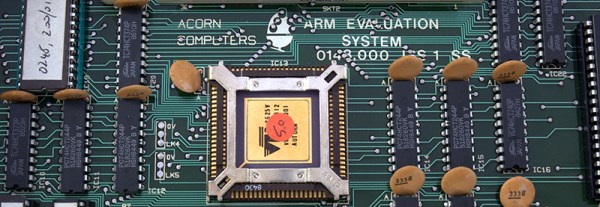
Source: Flibble CC-BY-SA 3.0 https://commons.wikimedia.org/wiki/File:Acorn-ARM-Evaluation-System.jpg

Reverse Engineering The IPhone’s Ancestor

By all accounts, the ARM architecture should be a forgotten footnote in the history of computing. What began as a custom coprocessor for a computer developed for the BBC could have easily found the same fate as National Semiconductor’s NS32000 series, HP’s PA-RISC series, or Intel’s iAPX series of microprocessors. Despite these humble beginnings, the first ARM processor has found its way into nearly every cell phone on the planet, as well as tablets, set-top boxes, and routers. What made the first ARM processor special? [Ken Shirriff] potsed a bit on the ancestor to the iPhone.

The first ARM processor was inspired by a few research papers at Berkeley and Stanford on Reduced Instruction Set Computing, or RISC. Unlike the Intel 80386 that came out the same year as the ARM1, the ARM would only have a tenth of the number of transistors, used one-twentieth of the power, and only use a handful of instructions. The idea was using a smaller number of instructions would lead to a faster overall processor.

This doesn’t mean that there still isn’t interesting hardware on the first ARM processor; for that you only need to look at this ARM visualization. In terms of silicon area, the largest parts of the ARM1 are the register file and the barrel shifter, each of which have two very important functions in this CPU.

The first ARM chip makes heavy use of registers – all 25 of them, holding 32 bits each. Each bit in a single register consists of two read transistors, one write transistor, and two inverters. This memory cell is repeated 32 times vertically and 25 times horizontally.

The next-largest component of the ARM1 is the barrel shifter. This is just a device that allows binary arguments to be shifted to the left and right, or rotated any amount, up to 31 bits. This barrel shifter is constructed from a 32 by 32 grid of transistors. The gates of these transistors are connected by diagonal control lines, and by activating the right transistor, any argument can be shifted or rotated.

In modern terms, the ARM1 is a fantastically simple chip. For one reason or another, though, this chip would become the grandparent of billions of devices manufactured this year.

PSoC VGA On A $10 Development Board

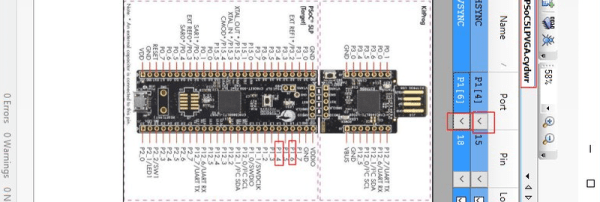
We’ve always found the Cypress PSoC an interesting beast. It’s a CPU with functional blocks that you can configure to build various I/O devices, including incorporating FPGA logic using Verilog. [MiguelVP] has an excellent multi-part project that produces VGA output from a PSoC. So far it just generates a fixed pattern, but a frame buffer is in the works, and there is plenty of detail about how to configure the PSoC for the task.

Although the PSoC has some analog capability, [MiguelVP] uses a cheap R2R DAC and VGA connector to interface to the VGA monitor. You can get the same PSoC board the project uses for about $10. The software, unfortunately, is Windows-only, so be prepared to fire up a virtual machine if you run Linux or Mac. Our own [Bil Herd] did a video introduction to PSoC that you can watch after the break.

Continue reading “PSoC VGA On A $10 Development Board”

Reverse Engineering The ARM ALU

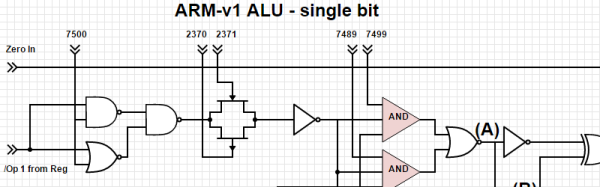
[Dave] wanted to learn more about the ARM architecture, so he started with an image of the ARMV1 die. If you’ve had some experience looking at CPU die, you can make some pretty good guesses at what parts of the chip have certain functions. [Dave], however, went further. He reverse engineered the entire ALU–about 2,200 transistors worth.

Continue reading “Reverse Engineering The ARM ALU”

The rust language logo being branded onto a microcontroller housing

Programming With Rust

Do hardware hackers need a new programming language? Your first answer might be no, but hold off a bit until you hear about a new language called Rust before you decide for sure.

We all know real hackers use assembly language to program CPUs directly, right? Well, most of us don’t do as much assembly language as we used to do. Languages like C can generate tight, predictable code and are easier to manage.

Although some people use more abstract languages in some embedded systems, it is no secret that for real-time systems, device driver development, and other similar tasks, you want a language that doesn’t obscure underlying details or generate code that’s difficult to reason about (like, for example, garbage collection). It is possible to use special techniques (like the Real-Time Java Specification) to help languages, but in the general case a lean language is still what most programmers reach for when you have to program bare metal.

Even C++, which is very popular, obscures some details if you use things like virtual functions (a controversial subject) although it is workable. It is attractive to get the benefit of modern programming tools even if it does conceal some of the underlying code more than straight C.

About Rust

That’s where Rust comes in. I could describe what Rust attempts to achieve, but it is probably easier to just quote the first part of the Rust documentation:

Rust is a systems programming language focused on three goals: safety, speed, and concurrency. It maintains these goals without having a garbage collector, making it a useful language for a number of use cases other languages aren’t good at: embedding in other languages, programs with specific space and time requirements, and writing low-level code, like device drivers and operating systems. It improves on current languages targeting this space by having a number of compile-time safety checks that produce no runtime overhead, while eliminating all data races. Rust also aims to achieve ‘zero-cost abstractions’ even though some of these abstractions feel like those of a high-level language. Even then, Rust still allows precise control like a low-level language would.

Continue reading “Programming With Rust”

Polyphonic FM Synthesizer Uses ARM

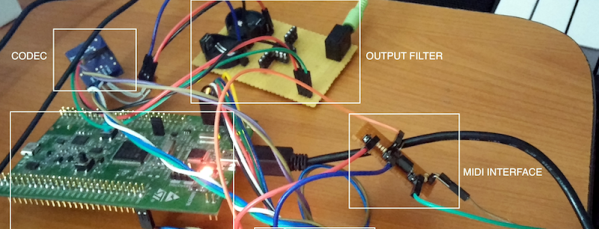
There seems to be a direct correlation between musicians and people who can program. Even programmers who don’t play an instrument often have a profound appreciation of music and so we see quite a few musical projects pop up. [Ihsan Kehribar’s] latest project is a good example. He married an STM32F031 ARM development board, an audio codec, and a simple op amp filter to make a playable MIDI instrument. Of course, it is hard to appreciate a music project from a picture, but if you want to listen to the results, there’s always Soundcloud.

He’d started the project using an 8-bit micro, but ran into some limitations. He switched to an STM32F031, which is a low-end ARM Cortex M0 chip. [Ihsan] mentions that he could have used the DSP instructions built into larger ARM chips, but he wanted to keep the project done on minimal hardware. The audio CODEC chip is from Cirrus Logic (a WM8524), and it produces two output channels at 192 kHz. As an unexpected benefit, the CODEC uses a charge pump to generate a negative voltage (much like a MAX232 does) and [Ihsan] was able to tap that voltage to provide the op-amps in the audio filter with a negative supply rail.

Continue reading “Polyphonic FM Synthesizer Uses ARM”

Physical Fitness For The Truly Lazy

We’re going to get in shape around here, starting today. Well… in the United States, it is almost Thanksgiving, so we might as well wait until… but then it is going to be the end of the year and between Christmas, Hanukkah,  and New Year’s, we should put it off until then.

OK, we get it. There’s always some excuse. We know we should go on and do some push ups today. Of course, we are a lazy bunch, so not everyone’s going to do a full push up. Then we’ll all argue how many we actually did. If this sounds like you, maybe you need an Arduino-based project that counts proper push ups.

Continue reading “Physical Fitness For The Truly Lazy”

Hackaday Links: November 15, 2015

There are a surprising number of Raspberry Pis being used in industrial equipment. This means the Arduino is left behind, but no longer. There’s your PLCs that use Arduinos.

A few weeks ago, Google introduced a machine intelligence and computer vision technique that made the world look psychedelic. Now, this library is available. On another note, head mounted displays exist, and a sufficiently creative person could mash these two things together into a very, very cool project.

Welcome to Kickstarter! Kickstarter is an uphill battle. People will doubt you because you don’t have a ‘target audience’ or ‘the rights to this franchise’ or ‘any talent whatsoever’, but that’s what crowdfunding is for!

Several years ago, Apple shipped a few million 17″ iMacs with defective displays. They’re still useful computers, though, especially if you can find a replacement LCD. Apple, in all its wisdom, used a weird connector for this LCD. Here’s the adapter board, and this adapter will allow displays running up to 1920×1200.

[Jan] has earned a reputation of building some very cool synths out of single ARM chips. His previous build was a Drumulator and now he’s shrinkified it. He’s put four drum sounds, pitch CV, and audio out on an 8-pin DIP ARM.

YouTube gives you cadmium! [AvE], recently got 100,000 subscribers on his YouTube channel. Apparently, YouTube sends you a terrible belt buckle when you manage to do that. At least he did it without playing video games and screaming.