Cheap Voice-controlled Lighting

voice_controlled_home_automation_board

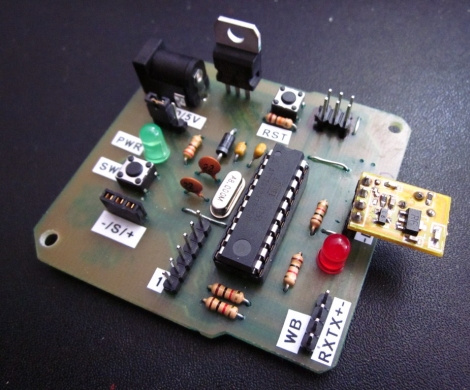
Voice-controlled home automation doesn’t have to be wildly expensive if you have a little bit of time and some know-how to do the job yourself. [jjshortcut] wanted to control the lighting in his room without using physical switches. On his blog, he describes how he did it without spending a ton of money.

He picked up a VRBot speech recognition module on eBay, which is an easy way to get your feet wet with voice control. The device has a bunch of built-in speaker independent commands, as well as the ability to record up to 32 custom triggers. Rather than mess with mains voltage and build his own light relays, he purchased a simple set of wireless light switches and began hacking.

He spent some time sniffing the wireless communications protocol to figure out how the lights were triggered, then he replicated that functionality using an AVR and a cheap 433 MHz module.

The system seems to work quite well despite how cheaply he was able to put it together. Stick around to see a quick video of his voice recognition system in action.

Continue reading “Cheap Voice-controlled Lighting”

Hardware XOR For Output Pins On AVR Microcontrollers

Did you know that most AVR chips have a type of hardware exclusive OR (XOR) option when it comes to the logic levels of the output pins? If you look in the datasheet (the image above is a screenshot from an ATtiny13 datasheet) you’ll find a section on Toggling the Pin. It turns out that if you set a PORT as an output, writing logic one to the corresponding PIN register will toggle the logic levels of that out. This is really easy to overlook if you’re writing in C, but I’ve been working on learning a bit of assembler language and found this to be very useful. Keep reading after the break and I’ll tell you how I happened upon this info and what it’s good for.

Continue reading “Hardware XOR For Output Pins On AVR Microcontrollers”

Disco Isn’t Dead: Diy Dance Floor Spotted At Student Parties

Your party is lame if it doesn’t include interactive blinking lights on the dance floor. [Mario] and [Lukas] didn’t want to have lame parties, so they enlisted some fellow students to build an interactive dance floor (translated). The finished party-piece is 4 meters by 2.5 meters (that’s about 13’x8′ for us yanks) and includes 160 lighted squares. But it’s the electronics that really make this a heavy project.

Milled into the underside of the pressboard base are a series of pockets and channels to hold various components. If you look hard enough, you’re going to find eight AVR microcontrollers which control the LEDs, 8 CPLDs to manage the weight sensors which make the floor interactive, and an FPGA and embedded computer to tie everything together. It’s movable, a hit at parties, and so far it seems to hold up to the occasional spilled beverage.

You can’t share a project like this without some video. See it after the break.

Continue reading “Disco Isn’t Dead: Diy Dance Floor Spotted At Student Parties”

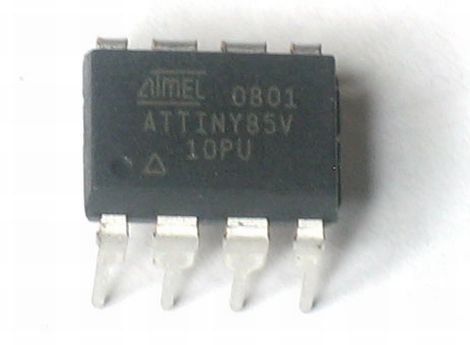
Programming An ATtiny Using An Arduino

attiny

[Scott] is a big fan of the Arduino platform, and he’s not afraid to admit it. It does all the things he needs, but now and again he would like to use something a bit smaller, without all the bells and whistles the Arduino has to offer. He contemplated using an ATtiny for smaller projects, but after looking into what he would need to program the chip under Linux, he could never find the motivation to give it a go.

That all changed when he discovered the Arduino-Tiny project, which aims to bring a limited Arduino IDE to the ATtiny line of microcontrollers. He found the project to be quite useful, so he put together a brief tutorial that walks through everything you need to get started.

The tutorial is fairly straightforward, and even demonstrates how the Arduino can be used as an ISP for the ATtiny, removing the need to purchase a standalone programmer. Be sure to check it out if you are searching for an easy way to get started with ATtiny chips under Linux.

Adding Persistent Memory And Ethernet To Vintage Arcade Machines

z80_bus_tapper

If you are a frequent reader, you are undoubtedly familiar with hacker [Sprite_tm]. He has been working with fellow members of the TkkrLab hackerspace to get things ready for their official grand opening on May 28th, and wrote in to share a project he recently completed to kick things off.

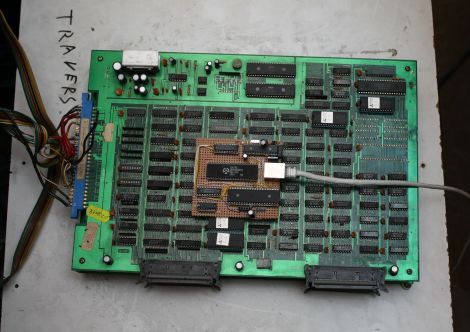
As part of their preparations, they have been stocking the joint with all sorts of hacker-friendly goodies including plenty of tools and Club Mate, as well as a vintage ‘1943’ arcade cabinet. The game is a group favorite, though every time the power is turned off, it loses all of the hard-earned high scores. [Sprite_tm] knew he could improve on the current paper-based score register, so he pulled the machine open to see what could be done.

He used an AVR to tap into the machine’s Z80 logic board, allowing him to read and write to the entirety of the game’s RAM whenever he pleased. This enabled him to keep tabs on the high scores, restoring them to memory whenever the machine is powered back on. The addition of the AVR also allowed him to add a TCP/IP interface, which is used to send high scores to Twitter whenever someone beats the previous record.

His modular bus tap can be used in all sorts of Z80-based hardware, so if you have some vintage equipment laying around, be sure to swing by his site for a more detailed look at the build process.

BAMF2011: ChipKIT Is Arduino To The Power Of 32

If you’ve been hungry for more power for your microcontroller projects, but reluctant to dump your investment in Arduino shields or the libraries and community knowledge that go with them all, Digilent has you covered. Their new chipKIT boards are built around the Microchip PIC32 MCU…a powerful 32-bit chip that until recently was left out of the cross-platform scene. A majority of code and quite a number of Arduino shields will work “out of the box” with the chipKIT, and the familiar development tools are available for all three major operating systems: Windows, Mac and Linux.

We first mentioned these a couple weeks ago, but the software was unavailable at the time. Seeing the development tools in action was quite unexpected…

Continue reading “BAMF2011: ChipKIT Is Arduino To The Power Of 32”

ir_power_meter

Monitor Your Home’s Power Usage On The Cheap

[Paul] was pretty sure that he and his family used a lot of electricity throughout the day. Admittedly, he enjoys his creature comforts, but was wiling to try living a little greener. The problem was, he had no idea how much electricity he was using at a given time.

While some power companies offer devices allowing homeowners to monitor their energy usage, [Paul’s] did not. After a bit of research however, he was ready to build a power monitoring system of his own. He found that his meter emits a small infrared pulse every time a watt-hour of electricity is consumed, so his system counts how many flashes occur to measure usage.

The counting circuit is pretty simple consisting of only an AVR, a resistor, a capacitor, and a phototransistor. The data is fed to a computer where the results are graphed with gnuplot.

It’s quite a useful little hack, and undoubtedly far cheaper than purchasing a whole house power monitor.