
World Smallest TV-B-Gone

uTVBG

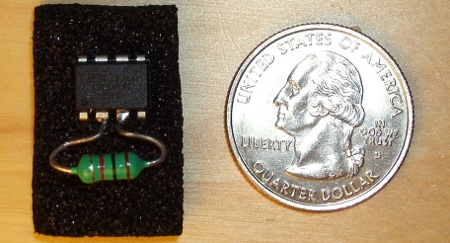
The TV-B-Gone has proven to be a dangerous and versatile gadget. At Interactive Matter, they created an even smaller version with more sneaking potential. Called the µTVBG, it packs an entire TV-B-Gone in a 1.4 x 2.5 cm footprint and even has room for a programming header. He found some high-powered surface-mount IR LEDs that would match the original TV-B-Gone’s power. To drive the board, they used a CR1220 button battery on the bottom of the board. The whole thing is smaller than your thumb and should be easier to hide next time you wreak havoc.

SparkFun Open-sources Latest Kits

09205-5

SparkFun has started to release some of their kits as open-source hardware. Projects such as ClockIt, a simple alarm clock, have their schematics, board designs, and source code released under the CC-by-sa license. Although most of their widgets and projects already had example code and schematics available, they are now using an open-source license. They are joining adafruit and EMSL and others in pushing OSH, but it is interesting to see an established company turn to this. Normally, startups do this to encourage early adoption.

[via adafruit]

Motors And Microcontrollers 101

[youtube=http://www.youtube.com/watch?v=WnWJki-zwsE]

[Humberto] from NerdKits sends in the newest addition to their excellent collection of videos. This video goes over the basics of DC motor control with microcontrollers. They begin by showing nine experiments and observations that can be done by the average hacker with a multimeter, motor, LED, and jumperwire. Using the results from these they show how to model and calculate the properties of a motor. Lastly, it shows how to control a motor using PWM. They have supplemental text and demonstration code for an ATmega168 on their website.

AVR RFID Tag

[pc486] sent in his hack that uses an ATtiny85 to act like an EM4102, a chip used for RFID tags. Minimally, all that is needed is the AVR and a coil, but he recommends some filtering capacitors. Depending on the size of the coil, different frequencies and ranges can be achieved. This project actually includes several hacks, such as using the coil for not only power, but a clock signal. The coil is actually able to power the chip without being connected to the power pins due to clamping diodes on the connected pins. The firmware is short but available on subversion.

Related: Scratch-built RFID tags

64 Synchronizing Fireflies

screenshot_007

[Alex] of tinkerlog created a set of 64 RGB fireflies that synchronize to blink all at once. We covered the kit earlier, but he has assembled a set of 64. Each firefly is independently controlled by an ATtiny13 that reads a phototransistor and lights up an RGB LED. The fireflies are programmed to blink a certain rate, but blink faster if they detect other blinks. After a few cycles, the fireflies begin to blink in unison. When the fireflies are arranged in different configurations, different patterns emerge. He is selling kits and has instructions for building your own. Videos of the fireflies after the jump.

Continue reading “64 Synchronizing Fireflies”

Keychain GPS Finder

gps keychain navigation

With a user interface consisting of two buttons and a three digit display, the GPS finder guides the user back to a saved location. Nine locations can be saved for navigation recall. Press a button to save location and press another button to recall. Each switch has a secondary function, for management purposes such as memory indexes and power features. An AarLogic GPS 3A module and AVR microcontroller make up the guts. With the popularity of Geocaching, this would make an impressive trinket; Leading the hunter to an undocumented treasure.

Arduino Nixie Shield

AN_Board_FirstBuild2

Reader [Bradley] sent in his ArduiNIX project, an Arduino shield designed for driving nixie tubes. The shield allows the Arduino to drive and multiplex nixie tubes without any additional hardware. These antique-looking displays are commonly hacked into clocks. It takes 9 volts from a wall wart and steps it up to over 200V in order to drive the displays. The shield is capable of multiplexing up to 80 individual elements. He has example code for driving a 6-digit display and a clock on his site. He is selling kits and completed shields too.

Related: Victorian nixie tube clock

[thanks Bradley!]









