Hardware Reuse: The PMG001 Integrated Power Management Module

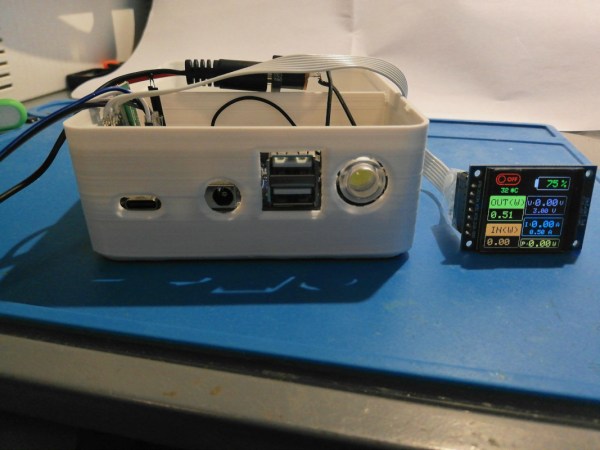
Battery management is a tedious but necessary problem that becomes more of a hassle with lithium-ion technology. As we’re all very aware, such batteries need a bit of care to be utilized safely, and as such, a huge plethora of ICs are available to perform the relevant duties. Hackaday.IO user [Erik] clearly spent some time dropping down the same old set of ICs to manage a battery in their applications, so they created a drop-in castellated PCB to manage all this.

Continue reading “Hardware Reuse: The PMG001 Integrated Power Management Module”

Ryobi Battery Pack Gives Up Its Secrets Before Giving Up The Ghost

Remember when dead batteries were something you’d just toss in the trash? Those days are long gone, thankfully, and rechargeable battery packs have put powerful cordless tools in the palms of our hands. But when those battery packs go bad, replacing them becomes an expensive proposition. And that’s a great excuse to pop a pack open and see what’s happening inside.

The battery pack in question found its way to [Don]’s bench by blinking some error codes and refusing to charge. Popping it open, he found a surprisingly packed PCB on top of the lithium cells, presumably the battery management system judging by the part numbers on some of the chips. There are a lot of test points along with some tempting headers, including one that gave up some serial data when the battery’s test button was pressed. The data isn’t encrypted, but it is somewhat cryptic, and didn’t give [Don] much help. Moving on to the test points, [Don] was able to measure the voltage of each battery in the series string. He also identified test pads that disable individual cells, at least judging by the serial output, which could be diagnostically interesting.  [Don]’s reverse engineering work is now focused on the charge controller chip, which he’s looking at through its I2C port. He seems to have done quite a bit of work capturing output and trying to square it with the chip’s datasheet, but he’s having trouble decoding it.

This would be a great place for the Hackaday community to pitch in so he can perhaps get this battery unbricked. We have to admit feeling a wee bit responsible for this, since [Don] reports that it was our article on reverse engineering a cheap security camera that inspired him to dig into this, so we’d love to get him some help.

Magnesium And Copper Makes An Emergency Flashlight

Many of us store a flashlight around the house for use in emergency situations. Usually, regular alkaline batteries are fine for this task, as they’ll last a good few years, and you remember to swap them out from time to time. Alternatively, you can make one that lasts virtually indefinitely in storage, and uses some simple chemistry, as [JGJMatt] demonstrates.

The flashlight uses 3D printing to create a custom battery using magnesium and copper as the anode and cathode respectively. Copper tape is wound around a rectangular part to create several cathode plates, while magnesium ribbon is affixed to create the anodes. Cotton wool is then stuffed into the 3D-printed battery housing to serve as a storage medium for the electrolyte—in this case, plain tap water.

The custom battery is paired with a simple LED flashlight circuit in its own 3D-printed housing. The idea is that when a blackout strikes, you can assemble the LED flashlight with your custom battery, and then soak it in water. This will activate the battery, producing around 4.5 V and 20 mA to light the LED.

It’s by no means going to be a bright flashlight, and realistically, it’s probably less reliable than just keeping a a regular battery-powered example around. Particularly given the possibility of your homebrew battery corroding over the years unless it’s kept meticulously dry. But that’s not to say that water-activated batteries don’t have their applications, and anyway it’s a fun project that shows how simple batteries really are at their basic level. Consider it as a useful teaching project if you have children interested in science and electricity!

Better Battery Design Through Science

Before the age of lithium batteries, any project needing to carry its own power had to rely on batteries that were much less energy-dense and affordable. In many ways, we take modern lithium technology for granted, and can easily put massive batteries in our projects by the standards of just a few decades ago. While the affordability of lithium batteries has certainly decreased the amount of energy we need to put in to our projects to properly size batteries, there’s still a lot of work to be done if you’re working on a bigger project or just want to get the maximize the efficiency and effectiveness of your DIY battery pack.

The main problem with choosing a battery, as [ionworks] explains, is that batteries can’t be built for both high energy and high power, at least not without making major concessions for weight or cost. After diving in to all of the possible ways of customizing a battery, the battery guide jumps in to using PyBaMM to perform computational modeling of potential battery designs to hopefully avoid the cumbersome task of testing all of the possible ways of building a battery. With this tool virtually all of a battery’s characteristics can be simulated and potential problems with your setup can be uncovered before you chose (or start production of) a specific battery system.

While customizing a battery pack to this extent might not be a consideration for most of us unless the project is going to be big enough to run something like an electric car or a whole-house generator, it’s a worthwhile tool to know about as even smaller projects like ebikes can benefit from choosing the right cell for the application. Some of the nuances of battery pack design can be found in this guide to building packs from the standard 18650 cells.

Header: Lead holder, CC BY-SA 3.0 .

New Battery Has No Anode

Conventional batteries have anodes and cathodes, but a new design from the University of Chicago and the University of California San Diego lacks an anode. While this has been done before, according to the University, this is the first time a solid-state sodium battery has successfully used this architecture.

Sodium is abundant compared to lithium, so batteries that use sodium are attractive. According to the University of Chicago’s news release:

Anode-free batteries remove the anode and store the ions on an electrochemical deposition of alkali metal directly on the current collector. This approach enables higher cell voltage, lower cell cost, and increased energy density…

Continue reading “New Battery Has No Anode”

Reverse-Engineering Makita Batteries To Revive Them

Modern lithium-ion battery packs for cordless power tools contain an incredible amount of energy, which necessitates that they come with a range of safeties. Although it’s good when the battery management system (BMS) detects a fault and cuts power to prevent issues, there exist the possibility of false positives. Having an expensive battery pack brick itself for no good reason is rather annoying, as is being unable to reuse a BMS in for example a re-manufactured battery. This was the reasoning that led [Martin Jansson] down the path of reverse-engineering Makita batteries for starters.

After that initial reverse-engineering attempt involving a firmware dump of the NEC (Renesas) F0513 MCU, [Martin] didn’t get back to the project until recently, when he was contacted by [Romain] who donated a few BMS boards to the cause. One of these features an STM32 MCU, which made the task much easier. Ultimately [Martin] was able to determine the command set for the Maxim OneWire-based communication protocol, as was a hidden UART mode.

Due to the critical timing required, off-the-shelf programmers didn’t work, so an Arduino Uno-based programmer (ArduinoOBI) was created instead, which can be found on GitHub along with the Open Battery Information desktop application which provides access to these BMS features after connecting to the battery pack. Although only Makita is supported right now, [Martin] would like to see support for other brands being added as well.

PCB Design Review: A 5V UPS With LTC4040

Do you have a 5 V device you want to run 24/7, no matter whether you have electricity? Not to worry – Linear Technology has made a perfect IC for you, the LTC4040; with the perfect assortment of features, except perhaps for the hefty price tag.

[Lukilukeskywalker] has shared a PCB for us to review – a LTC4040-based stamp you can drop onto your PCB whenever you want a LTC4040 design. It’s a really nice module to see designed – things like LiFePO4 support make this IC a perfect solution for many hacker usecases. For instance, are you designing a custom Pi HAT? Drop this module to give your HAT the UPS capability for barely any PCB effort. if your Pi or any other single-board computer needs just a little bit of custom sauce, this module spices it up alright!

Continue reading “PCB Design Review: A 5V UPS With LTC4040”