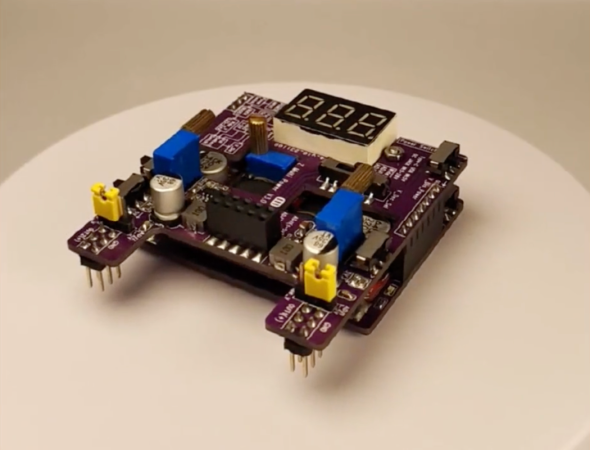
Ultimate Power: Lithium-Ion Packs Need Some Extra Circuitry

A LiIon pack might just be exactly what you need for powering a device of yours. Whether it’s a laptop, or a robot, or a custom e-scooter, a CPAP machine, there’s likely a LiIon cell configuration that would work perfectly for your needs. Last time, we talked quite a bit about the parameters you should know about when working with existing LiIon packs or building a new one – configurations, voltage notations, capacity and internal resistance, and things to watch out for if you’re just itching to put some cells together.

Now, you might be at the edge your seat, wondering what kind of configuration do you need? What target voltage would be best for your task? What’s the physical arrangement of the pack that you can afford? What are the safety considerations? And, given those, what kind of electronics do you need?

Picking The Pack Configuration

Pack configurations are well described by XsYp:X serial stages, each stage having Y cells in parallel. It’s important that every stage is the same as all the others in as many parameters as possible – unbalanced stages will bring you trouble.

To get the pack’s nominal voltage, you multiply X (number of stages) by 3.7 V, because this is where your pack will spend most of its time. For example, a 3s pack will have 11.1 V nominal voltage. Check your cell’s datasheet – it tends to have all sorts of nice graphs, so you can calculate the nominal voltage more exactly for the kind of current you’d expect to draw. For instance, the specific cells I use in a device of mine, will spend most of their time at 3.5 V, so I need to adjust my voltage expectations to 10.5 V accordingly if I’m to stack a few of them together.


Now, where do you want to fit your pack? This will determine the voltage. If you want to quickly power a device that expects 12 V, the 10.5 V to 11.1 V of a 3s config should work wonders. If your device detects undervoltage at 10.5V, however, you might want to consider adding one more stage.

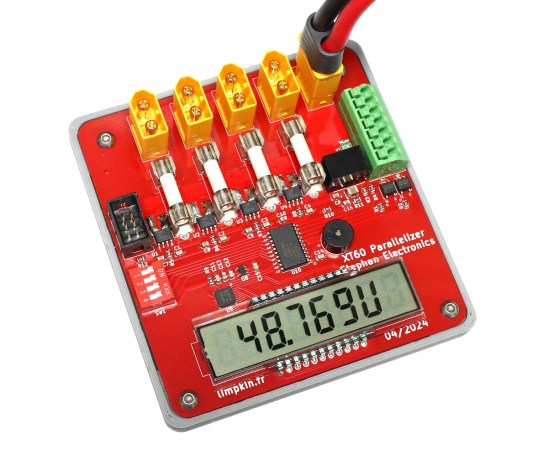
How much current do you want to draw? For the cells you are using, open their spec sheet yet again, take the max current draw per cell, derate it by like 50%, and see how many cells you need to add to match your current draw. Then, add parallel cells as needed to get the capacity you desire and fit the physical footprint you’re aiming for. Continue reading “Ultimate Power: Lithium-Ion Packs Need Some Extra Circuitry”

Ultimate Power: Lithium-Ion Batteries In Series

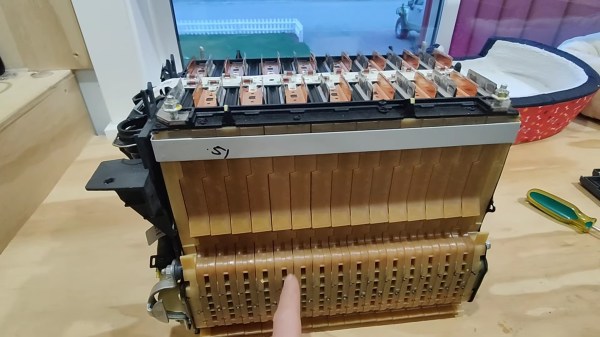
At some point, the 3.6 V of a single lithium ion battery just won’t do, and you’ll absolutely want to stack LiIon cells in series. When you need high power, you’ve either got to increase voltage or current, and currents above say 10 A require significantly beefed up components. This is how you’re able to charge your laptop from your USB-C powerbank, for instance.

Or maybe you just need higher voltages, and don’t feel like using a step-up converter, which brings along with it some level of inefficiency. Whatever your reasons, it’s time to put some cells into series. Continue reading “Ultimate Power: Lithium-Ion Batteries In Series”

Lithium-Ion Batteries Power Your Devboards Easily

Last summer, I was hanging out with a friend from Netherlands for a week, and in the middle of that week, we decided to go on a 20 km bike trip to a nearby beach. Problem? We wanted to chat throughout the trip, but the wind noise was loud, and screaming at each other while cycling wouldn’t have been fun. I had some walkie-talkie software in mind, but only a single battery-powered Pi in my possession. So, I went into my workshop room, and half an hour later, walked out with a Pi Zero wrapped in a few cables.

I wish I could tell you that it worked out wonders. The Zero didn’t have enough CPU power, I only had single-core ones spare, and the software I had in mind would start to badly stutter every time we tried to run it in bidirectional mode. But the battery power solution was fantastic. If you need your hack to go mobile, read on.

Continue reading “Lithium-Ion Batteries Power Your Devboards Easily”

Bringing Modern Technology To A Sled

Street sledding, a popular pastime in Norway, is an activity that is slowly dwindling in popularity, at least as far as [Justin] aka [Garage Avenger] has noticed. It used to be a fun way of getting around frozen lakes and roads during winter, and while some still have their sleds [Justin] wanted to see if there was a way to revitalize one of these sleds for the modern era. He’s equipped this one with powerful electric turbines than can quickly push the sled and a few passengers around the ice.

Since this particular sled is sized for child-sized passengers, fuel-burning jet engines have been omitted and replaced with electric motors that can spin their turbine blades at an impressive 80,000 rpm. The antique sled first needed to be refurbished, including removing the rust from the runners and reconditioning the wood. With a sturdy base ready to go, the sled gets a set of 3D printed cowlings for the turbines, a thumb throttle on the upgraded handlebars, and a big battery with an Arduino to bring it all together.

With everything assembled and a sheet of ice to try it out on, the powerful sled easily gets its passengers up to the 20-30 kph range depending on passenger weight and size. There’s a brake built on an old ice skate for emergency stops, and the sled was a huge hit for everyone at the skating pond. There are plenty of other ways to spruce up old sleds, too, like this one which adds a suspension for rocketing down unplowed roads.

Continue reading “Bringing Modern Technology To A Sled”

Resistor Swap Gives Honda Insights More Power

A common complaint around modern passenger vehicles is that they are over-reliant on electronics, from overly complex infotainment systems to engines that can’t be fixed on one’s own due to the proprietary computer control systems. But even still, when following the circuits to their ends you’ll still ultimately find a physical piece of hardware. A group of Honda Insight owners are taking advantage of this fact to trick the computers in their cars into higher performance with little more than a handful of resistors.

The relatively simple modification to the first-generation Insight involves a shunt resistor, which lets the computer sense the amount of current being drawn from the hybrid battery and delivered to the electric motor. By changing the resistance of this passive component, the computer thinks that the motor is drawing less current and allows more power to be delivered to the drivetrain than originally intended. With the shunt resistor modified, which can be done with either a bypass resistor or a custom circuit board, the only other change is to upgrade the 100 A fuse near the battery for a larger size.

With these two modifications in place, the electric motor gets an additional 40% power boost, which is around five horsepower. But for an electric motor which can output full torque at zero RPM, this is a significant boost especially for a relatively lightweight car that’s often considered under-powered. It’s a relatively easy, inexpensive modification though which means the boost is a good value, although since these older hybrids are getting along in years the next upgrade might be a new traction battery like we’ve seen in the older Priuses.

Thanks to [Aut0l0g1c] for the tip!

Upgrading At Least One Component Of A TI Calculator

Even though Texas Instruments were the first company to produce an integrated circuit and a microprocessor, their success as a company in the 60s and 70s was not guaranteed. At the time there wasn’t much demand for previously non-existent products like these, so to drive some business they built the first hand-held calculator, a venture that they are still famous for today. Since then, though, they’ve become a bit of a punchline for producing calculators with decades-old technology but with modern price tags, so while this business model was quite successful if you want a calculator with a few modern features you’ll have to take a DIY approach like this calculator retrofitted with a LiPo battery.

The modern battery pack, with a lithium polymer battery at its core, includes all of the circuitry needed to integrate it seamlessly into the TI-59 calculator, which is all available on the project’s GitHub page. This calculator originally used a 9V battery, so the new battery pack includes a boost converter to match the 3.7V from the new battery to the needs of the old calculator. It doesn’t stop there, though. The pack is rechargeable from an included USB-C port, has a built-in charge controller, and is housed in its own custom-built case that fits neatly into the calculator where the old battery would sit.

While this wouldn’t be a drop-in replacement for more modern calculators like the TI-83/84 and TI-89, a new case and a different boost converter would solve the problem of the AAA batteries dying during exams. It might make the calculators non-compliant with various standardized testing requirements, though (which TI was also instrumental in developing) so you may want to verify with your testing standard of choice before modifying a calculator you need for an exam. But if all the rules are off, why not add Wi-Fi to it too?

Two researchers, a white woman and dark-skinned man look at a large monitor with a crystal structure displayed in red and white blocks.

AI On The Hunt For Better Batteries

While certain dystopian visions of the future have humans power the grid for AIs, Microsoft and Pacific Northwest National Laboratory (PNNL) set a machine learning system on the path of better solid state batteries instead.

Solid state batteries are the current darlings of battery research, promising a step-change in packaging size and safety among other advantages. While they have been working in the lab for some time now, we’re still yet to see any large-scale commercialization that could shake up the consumer electronics and electric vehicle spaces.

With a starting set of 32 million potential inorganic materials, the machine learning algorithm was able to select the 150 most promising candidates for further development in the lab. This smaller subset was then fed through a high-performance computing (HPC) algorithm to winnow the list down to 23. Eliminating previously explored compounds, the scientists were able to develop a promising Li/Na-ion solid state battery electrolyte that could reduce the needed Li in a battery by up to 70%.

For those of us who remember when energy materials research often consisted of digging through dusty old journal papers to find inorganic compounds of interest, this is a particularly exciting advancement. A couple more places technology can help in the sciences are robots doing the work in the lab or on the surgery table.

Continue reading “AI On The Hunt For Better Batteries”