Hoverboard Reborn For Electric Rollerblading

Rollerblading is fun, but who needs all that pesky exercise? Wouldn’t strapping on the blades be so much more tempting if you had an electric pusher motor to propel you along your way?
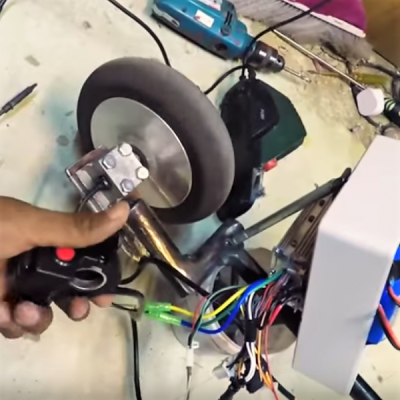
We have to admit that we raised a wary eyebrow as we first watched [MakerMan]’s video below. We thought it was going to be just another hoverboard hack at first, but as we watched, there were some pretty impressive fabrication skills on display. Yes, the project does start with tearing into a defunct hoverboard for parts, primarily one wheel motor and the battery pack. But after that, [MakerMan] took off on a metalworking tear. Parts of the hoverboard chassis were attached to a frame built from solid bar stock — we’ll admit never having seen curves fabricated in quite that way before. The dead 18650 in the battery pack was identified and replaced, and a controller from an e-bike was wired up. Fitted with a thumb throttle and with a bit of padding on the crossbar, it’s almost a ride-upon but not quite. It seems to move along at quite a clip, even making allowances for the time-compression on the video.

We’ve seen lots of transportation hacks before, from collapsible longboards to steam-powered bicycles, but this one is pretty unique.

Continue reading “Hoverboard Reborn For Electric Rollerblading”
Smooth And Steady Cuts With An Improvised Power Feeder

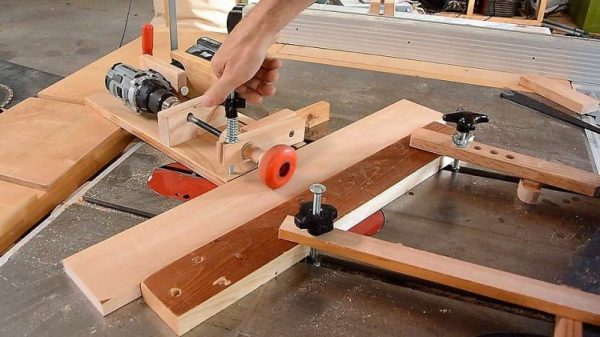
Some woodworking operations require stock to be fed at a smooth, steady rate, for which purpose a power feeder is usually employed. They’re expensive bits of gear, though, and their cost can usually be borne only by high-output production shops. But when you need one, you need one, and hacking a power feeder from a drill and a skate wheel is a viable option.

It should come as no surprise that this woodshop hack comes to us from [Matthias Wandel], who never seems to let a woodworking challenge pass him by. His first two versions of expedient power feeders were tasked with making a lot of baseboard moldings in his new house. Version three, presented in the video below, allows him to feed stock diagonally across his table saw, resulting in custom cove moldings. The completed power feeder may look simple — it’s just a brushless drill in a wooden jig driving a skate wheel — but the iterative design process [Matthias] walks us through is pretty fascinating. We also appreciate the hacks within hacks that always find their way into his videos. No lathe? No problem! Improvise with a drill and a bandsaw.

Surprised that [Matthias] didn’t use some of his famous wooden gears in this build? We’re not. A brushless motor is perfect for this application, with constant torque at low speeds. Want to learn more about BLDC motors? Get the basics with a giant demo brushless motor.

Continue reading “Smooth And Steady Cuts With An Improvised Power Feeder”

Open Source High Power EV Motor Controller

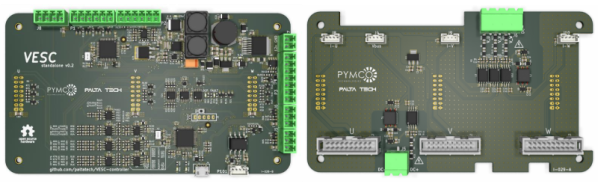
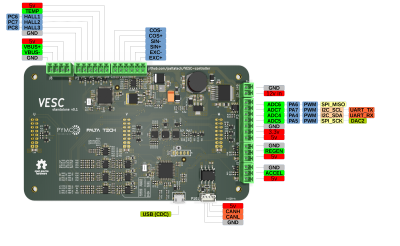
For anyone with interest in electric vehicles, especially drives and control systems for EV’s, the Endless-Sphere forum is the place to frequent. It’s full of some amazing projects covering electric skateboards to cars and everything in between. [Marcos Chaparro] recently posted details of his controller project — the VESC-controller, an open source controller capable of driving motors up to 200 hp.

[Marcos]’s controller is a fork of the VESC by [Benjamin Vedder] who has an almost cult following among the forum for “creating something that all DIY electric skateboard builders have been longing for, an open source, highly programmable, high voltage, reliable speed controller to use in DIY eboard projects”. We’ve covered several VESC projects here at Hackaday.

While [Vedder]’s controller is aimed at low power applications such as skate board motors, [Marcos]’s version amps it up several notches. It uses 600 V 600 A IGBT modules and 460 A current sensors capable of powering BLDC motors up to 150 kW. Since the control logic is seperated from the gate drivers and IGBT’s, it’s possible to adapt it for high power applications. All design files are available on the Github repository. The feature list of this amazing build is so long, it’s best to head over to the forum to check out the nitty-gritty details. And [Marcos] is already thinking about removing all the analog sensing in favour of using voltage and current sensors with digital outputs for the next revision. He reckons using a FPGA plus flash memory can replace a big chunk of the analog parts from the bill of materials. This would eliminate tolerance, drift and noise issues associated with the analog parts.

[Marcos] is also working on refining a reference design for a power interface board that includes gate drivers, power mosfets, DC link and differential voltage/current sensing. Design files for this interface board are available from his GitHub repo too. According to [Marcos], with better sensors and a beefier power stage, the same control board should work for motors in excess of 500 hp. Check out the video after the break showing the VESC-controller being put through its paces for an initial trial.

Continue reading “Open Source High Power EV Motor Controller”

Hackaday Prize Entry: Smart Electric Bike Controller

One of the more interesting yet underrated technological advances of the last decade or so is big brushless motors and high-capacity batteries. This has brought us everything from quadcopters to good electric cars, usable cordless power tools, and of course electric bicycles. For his Hackaday Prize project, [marcus] is working on a very powerful electric bicycle controller. It can deliver 1000 Watts, it’s got Bluetooth, and there’s even an Android app for some neat diagnostics.

The specs for this eBike controller are pretty much what you would expect. It’s able to deliver a whole Kilowatt, can use 48 V batteries, has regenerative braking, Hall sensors, and has a nifty Android app for settings, displaying speed, voltage and power consumption, diagnostics, and GPS integration.

How is the project progressing? [marcus] has successfully failed a doping test. He lives on the French Riviera, and the Col de la Madonne is a famous road cycling road and favorite test drive of [Lance Armstrong]. The trip from Nice to Italy was beautiful and ended up being a great test of the eBike controller.

3D-Printed Halbach Motor Part Two: Tuning, Testing

Building your own Halbach-effect brushless DC motor is one thing. Making sure it won’t blow up in your face another matter, and watching how [Christoph Laimer] puts his motor to the test is instructive.

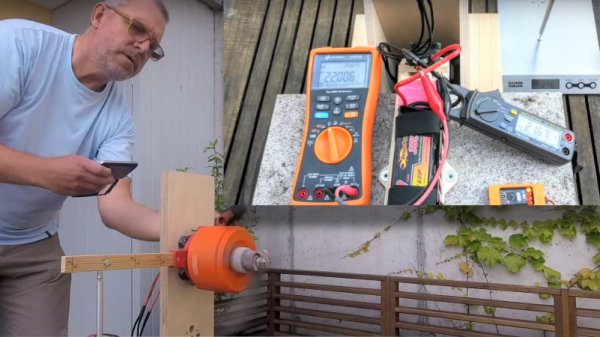
You’ll remember [Christoph]’s giant 3D-printed BLDC motor from a recent post where he gave the motor a quick test spin. That the motor held together under load despite not being balanced is a testament to the quality of his design and the quality of the prints. But not wishing to tempt fate, and having made a few design changes, [Christoph] wisely chose to perform a static balancing of the rotor. He also made some basic but careful measurements of the motor’s parameters, including the velocity constant (Kv) using an electric drill, voltmeter, and tachometer, and the torque using a 3D-printed lever arm and a kitchen scale. All his numbers led him to an overall efficiency of 80%, which is impressive.

[Christoph] is shipping his tested BLDC off to the folks at FliteTest, where he hopes they put it to good use. They probably will — although they might ask for three more for a helicarrier.

Continue reading “3D-Printed Halbach Motor Part Two: Tuning, Testing”

Fly Across The Water On A 3D-Printed Electric Hydrofoil

Paddleboards, which are surfboard-like watercraft designed to by stood upon and paddled around calm waters, are a common sight these days. So imagine the surprise on the faces of beachgoers when what looks like a paddleboard suddenly but silently lurches forward and rises up off the surface, lifting the rider on a flight over the water.

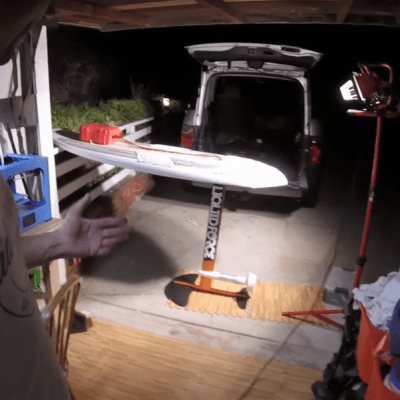
That may or may not be [pacificmeister]’s goal with his DIY 3D-printed electric hydrofoil, but it’s likely the result. Currently at part 12 of his YouTube playlist in which he completes the first successful lift-off, [pacificmeister] has been on this project for quite a while and has a lot of design iterations that are pretty instructive — we especially liked the virtual reality walkthrough of his CAD design and the ability to take sections and manipulate them. All the bits of the propulsion pod are 3D-printed, which came in handy when the first test failed to achieve liftoff. A quick redesign of the prop and duct gave him enough thrust to finally fly.
There are commercially available e-foils with a hefty price tag, of course; the header image shows [pacificmeister] testing one, in fact. But why buy it when you can build it? We’ve seen a few hydrofoil builds before, from electric-powered scale models to bicycle powered full-size craft. [pacificmeister]’s build really rises above, though.

[pacificmeister], if you’re out there, this might be a good entry in the Hackaday Prize Wheels, Wings, and Walkers round. Just sayin’.

Continue reading “Fly Across The Water On A 3D-Printed Electric Hydrofoil”

Hand-Wound Brushless Motors Revive Grounded Quad

You’re happily FPVing through the wild blue yonder, dodging and jinking through the obstacles of your favorite quadcopter racing course. You get a shade too close to a branch and suddenly the picture in your goggles gets the shakes and your bird hits the dirt. Then you smell the smoke and you know what happened – a broken blade put a motor off-balance and burned out a winding in the stator.

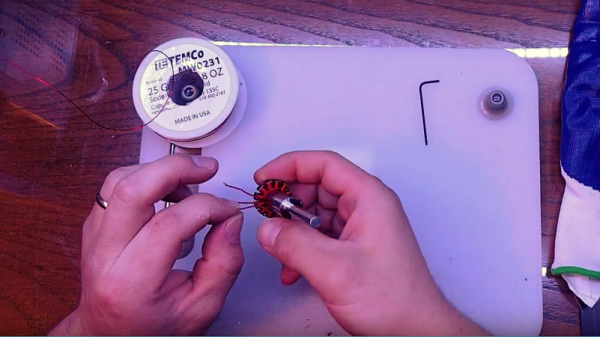
What to do? A sensible pilot might send the quad to the healing bench for a motor replacement. But [BRADtheRipper] prefers to take the opportunity to rewind his burned-out brushless motors by hand, despite the fact that new ones costs all of five bucks. There’s some madness to his method, which he demonstrates in the video below, but there’s also some justification for the effort. [Brad]’s coil transplant recipient, a 2205 racing motor, was originally wound with doubled 28AWG magnet wire of unknown provenance. He chose to rewind it with high-quality 25AWG enameled wire, giving almost the same ampacity in a single, easier to handle and less fragile conductor. Plus, by varying the number of turns on each pole of the stator, he’s able to alter the motor’s performance.

In all, there are a bunch of nice tricks in here to file away for a rainy day. If you need to get up to speed on BLDC motor basics, check out this primer. Or you may just want to start 3D printing your own BLDC motors.

Continue reading “Hand-Wound Brushless Motors Revive Grounded Quad”