Bunnie Weighs In On Tariffs

[Bunnie] has penned his thoughts on the new 25% tariffs coming to many goods shipped from China to the US. Living and working both in the US and China, [Bunnie] has a unique view of manufacturing and trade between the two countries. The creator of Novena and Chumby, he’s also written the definitive guide on Shenzen electronics.

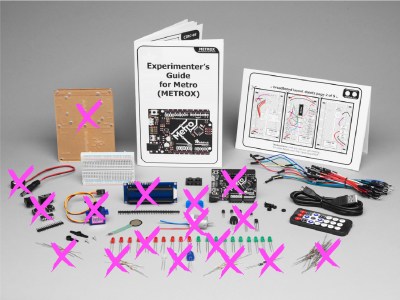
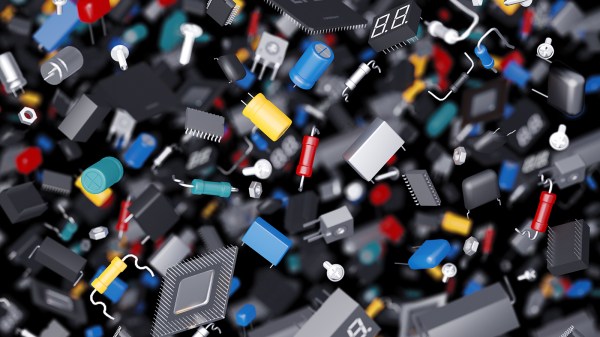
All the marked items are included in the new tariffs

The new US tariffs come into effect on July 6th. We covered the issue last week, but Bunnie has gone in-depth and really illustrates how these taxes will have a terrible impact on the maker community. Components like LEDs, resistors, capacitors, and PCBs will be taxed at the new higher rate. On the flip side, Tariffs on many finished consumer goods such as cell phone will remain unchanged.

As [Bunnie] illustrates, this hurts small companies buying components. Startups buying subassemblies from China will be hit as well. Educators buying parts kits for their classes also face the tax hike. Who won’t be impacted? Companies building finished goods. If the last screw of your device is installed in China, there is no tax. If it is installed in the USA, then you’ll pay 25% more on your Bill of Materials (BOM). This incentivizes moving assembly offshore.

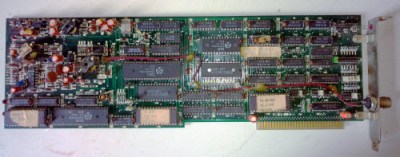
What will be the end result of all these changes? [Bunnie] takes a note from Brazil’s history with a look at a PC ISA network card. With DIP chips and all through-hole discrete components, it looks like a typical 80’s design. As it turns out the card was made in 1992. Brazil had similar protectionist tariffs on high-tech goods back in the 1980’s. As a result, they lagged behind the rest of the world in technology. [Bunnie] hopes these new tariffs don’t cause the same thing to happen to America.

[Thanks to [Robert] and [Christian] for sending this in]

Making Electronics Just Got 25% More Expensive In The US

As reported by the BBC, the United States is set to impose a 25% tariff on over 800 categories of Chinese goods. The tariffs are due to come into effect in three weeks, on July 6th. Thousands of different products are covered under this new tariff, and by every account, electronic designers will be hit hard. Your BOM cost just increased by 25%.

The reason for this tariff is laid out in a report (PDF) from the Office of the United States Trade Representative. In short, this tariff is retaliation for the Chinese government subsidizing businesses to steal market share and as punishment for stealing IP. As for what products will now receive the 25% tariff, a partial list is available here (PDF). The most interesting product, by far, is nuclear reactors. This is a very specific list; one line item is, ‘multiphase AC motors, with an output exceeding 746 Watts but not exceeding 750 Watts’.

Of importance to Hackaday readers is the list of electronic components covered by the new tariff. Tantalum capacitors are covered, as are ceramic caps. Metal oxide resistors are covered. LEDs, integrated circuits including processors, controllers, and memories, and printed circuit assemblies are covered under this tariff. In short, nearly every bit that goes into anything electronic is covered.

This will hurt all electronics manufacturers in the United States. For a quick example, I’m working on a project using half a million LEDs. I bought these LEDs (120 reels) two months ago for a few thousand dollars. This was a fantastic buy; half a million of the cheapest LEDs I could find on Mouser would cost seventeen thousand dollars. Sourcing from China saved thousands, and if I were to do this again, I may be hit with a 25% tariff. Of course; the price on the parts from Mouser will also go up — Kingbright LEDs are also made in China. Right now, I have $3000 worth of ESP-12e modules sitting on my desk. If I bought these three weeks from now, these reels of WiFi modules would cost $3750.

There are stories of a few low-volume manufacturers based in the United States getting around customs and import duties. One of these stories involves the inexplicable use of the boxes Beats headphones come in. But (proper) electronics manufacturing isn’t usually done by simply throwing money at random people in China or committing customs fraud. These tariffs will hit US-based electronics manufacturers hard, and the margins on electronics may not be high enough to absorb a 25% increase in the cost of materials.

Electronics made in America just got 25% more expensive to produce.

It’s Raining Chinese Space Stations: Tiangong-1

China’s first space station, Tiangong-1, is expected to do an uncontrolled re-entry on April 1st, +/- 4 days, though the error bars vary depending on the source. And no, it’s not the grandest of all April fools jokes. Tiangong means “heavenly palace”, and this portion of the palace is just one step of a larger, permanent installation.

But before detailing just who’ll have to duck when the time comes, as well as how to find it in the night sky while you still can, let’s catch up on China’s space station program and Tiangong-1 in particular.

Continue reading “It’s Raining Chinese Space Stations: Tiangong-1”

Hackaday Links Column Banner

Hackaday Links: February 18, 2018

Hacker uses pineapple on unencrypted WiFi. The results are shocking! Film at 11.

Right on, we’ve got some 3D printing cons coming up. The first is MRRF, the Midwest RepRap Festival. It’s in Goshen, Indiana, March 23-25th. It’s a hoot. Just check out all the coverage we’ve done from MRRF over the years. Go to MRRF.

We got news this was going to happen last year, and now we finally have dates and a location. The East Coast RepRap Fest is happening June 22-24th in Bel Air, Maryland. What’s the East Coast RepRap Fest? Nobody knows; this is the first time it’s happening, and it’s not being produced by SeeMeCNC, the guys behind MRRF. There’s going to be a 3D printed Pinewood Derby, though, so that’s cool.

జ్ఞ‌ా. What the hell, Apple?

Defcon’s going to China. The CFP is open, and we have dates: May 11-13th in Beijing. Among the things that may be said: “Hello Chinese customs official. What is the purpose for my visit? Why, I’m here for a hacker convention. I’m a hacker.”

Intel hit with lawsuits over security flaws. Reuters reports Intel shareholders and customers had filed 32 class action lawsuits against the company because of Spectre and Meltdown bugs. Are we surprised by this? No, but here’s what’s interesting: the patches for Spectre and Meltdown cause a noticeable and quantifiable slowdown on systems. Electricity costs money, and companies (server farms, etc) can therefore put a precise dollar amount on what the Spectre and Meltdown patches cost them. Two of the lawsuits allege Intel and its officers violated securities laws by making statements or products that were false. There’s also the issue of Intel CEO Brian Krzanich selling shares after he knew about Meltdown, but before the details were made public. Luckily for Krzanich, the rule of law does not apply to the wealthy.

What does the Apollo Guidance Computer look like? If you think it has a bunch of glowey numbers and buttons, you’re wrong; that’s the DSKY — the user I/O device. The real AGC is basically just two 19″ racks. Still, the DSKY is very cool and a while back, we posted something about a DIY DSKY. Sure, it’s just 7-segment LEDs, but whatever. Now this project is a Kickstarter campaign. Seventy bucks gives you the STLs for the 3D printed parts, BOM, and a PCB. $250 is the base for the barebones kit.

Sonoff Factory Tour Is A Lesson On Life In Shenzhen

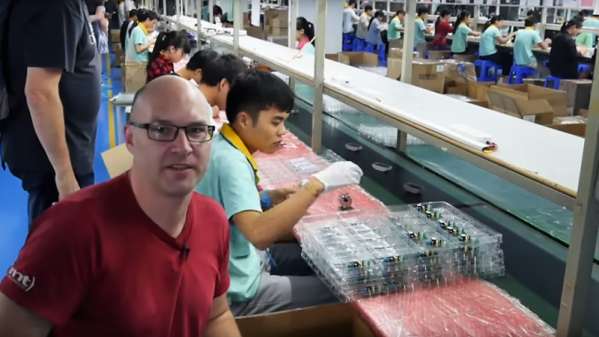
Judging by the popularity of “How It’s Made” and other shows of the genre, watching stuff being made is a real crowd pleaser. [Jonathan Oxer] from SuperHouse is not immune to the charms of a factory tour, so he went all the way to China to visit the factory where Sonoff IoT devices are made, and his video reveals a lot about the state of electronics manufacturing.

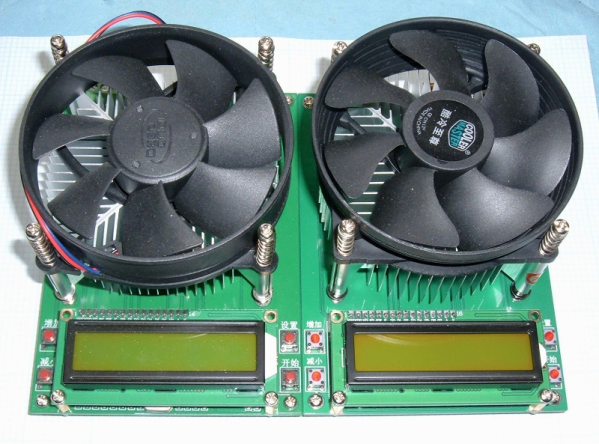
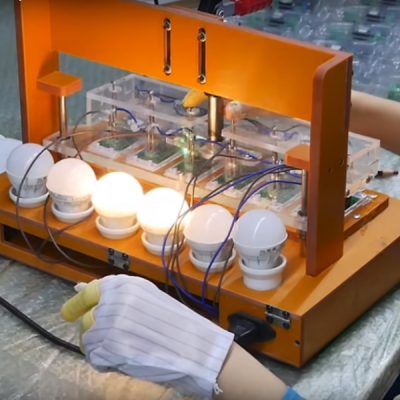
Test jig for six units at once

For those interested only in how Sonoff devices are manufactured, skip ahead to about the 7:30 mark. But fair warning — you’ll miss a fascinating discussion of how Shenzhen rose from a sleepy fishing village of 25,000 people to the booming electronics mecca of 25 million that it is today. With growth supercharged by its designation as a Special Economic Zone in the 1980s, Shenzhen is now home to thousands of electronics concerns, including ITEAD, the manufacturers of the Sonoff brand. [Jonathan]’s tour of Shenzhen includes a trip through the famed electronics markets where literally everything needed to build anything can be found.

At the ITEAD factory, [Jonathan] walks the Sonoff assembly line showing off an amazingly low-tech process. Aside from the army of pick and places robots and the reflow and wave soldering lines, Sonoff devices are basically handmade by a small army of workers. We lost count of the people working on final assembly, testing, and packaging, but suffice it to say that it’ll be a while before robots displace human workers in electronic assembly, at least in China.

We found [Jonathan]’s video fascinating and well worth watching. If you’re interested in Sonoff’s ESP8266 offerings, check out our coverage of reverse engineering them. Or, if Shenzhen is more your thing, [Akiba]’s whirlwind tour from the 2016 Superconference will get you started.

Continue reading “Sonoff Factory Tour Is A Lesson On Life In Shenzhen”

Lu Ban’s Axe And Working With Your Chinese Suppliers

It is nearly impossible to build any kind of hardware these days without at some point in the process dealing with China — Chinese suppliers, and so by extension Chinese culture. Difficulties can be as simple as the usual inconvenience of everything stopping for weeks up to and after Chinese New Year, or engineers that you know to be otherwise reasonably competent simply choosing not to bring up glaring and obvious problems. Having encountered my share of Western hardware entrepreneurs on the verge of a breakdown, and just as many flummoxed Chinese bosses completely unable to see exactly why they’re so upset, I thought I’d try to offer at least a little insight into one of the many issues that comes up.

Nearly any school child in the world will be able to tell you whom they were taught invented the lightbulb, the telephone, the radio transmitter. Those same children will usually be able to tell you of at least a few Chinese inventions as well — gunpowder, paper, the compass etc. But with one key difference, even the Chinese children are unlikely to be able to credit even a group of people for their invention let alone a single (usually misattributed) individual.

China does not really have an Edison, or Tesla, or Bell — oh we’ve had people as brilliant, but they are not celebrated in quite the same way for cultural reasons. If you were to do an alternate history of China where we went through the Industrial Revolution first, you’d want to split the timeline around Mozi (墨子). The Mohists (followers of Mozi) had advanced siege engine design, schools of logic, mathematics and theory for the physical sciences. much of the same foundation that set the West on its particular trajectory. In the end, Confucian ideals won out and China became a culture that celebrated scholarship over ingenuity (to vastly oversimplify things).

Even our respective terms for engineer reflect this. The word engineer (Latin ingeniator) is derived from the Latin words ingeniare (“to contrive, devise”) and ingenium (“cleverness”). Yet in Chinese 工程师, the first character for engineer in Chinese is the carpenters square 工. He or she is a simple worker (工人 literally “Work Person”). Even now, engineers are not held in anywhere near the same regard in China as they are in the West.

Continue reading “Lu Ban’s Axe And Working With Your Chinese Suppliers”

Friday Hack Chat: Making In Shenzhen

China is an amazing land of opportunity, and if you want to build anything, you can build it in Shenzhen. This city that was just a small fishing village a few decades ago has grown into a cyberpunk metropolis of eleven million and has become the manufacturing capital of the world. You’re probably reading this on a device made somewhere around Shenzhen.

For this week’s Hack Chat, we’re going to be talking about manufacturing in Shenzhen. We’re bringing in a very special guest for this one: [Naomi Wu] is a Cantonese DIY maker, professional web dev, transhumanist, electronics reviewer, occasional Hackaday contributor, vlogger, 3D printerer, advocate of women in STEM, SexyCyborg, and a riot on Twitter. [Naomi] also lives and works in Shenzhen, and is tapped into the DIY and maker culture there. She’s created 3D printed pen testing shoes, a Raspberry Pi cosmetics case, and infinity skirts.

This Friday (or Saturday, depending on which side of the date line you’re on), [Naomi] is going to be talking about manufacturing, making, DIY, and Shenzhen culture. Of particular interest will be electronics purchasing and manufacturing in Shenzhen, designing wearable projects with an emphasis on power and thermal design, documenting projects, and Shenzhen culture. This is basically an AMA, so if you have any questions you’d like to ask, throw them up in this spreadsheet.

Here’s How To Take Part:

join-hack-chatOur Hack Chats are live community events on the Hackaday.io Hack Chat group messaging. Hack Chats are usually at noon, Pacific time on Friday. This week we’re doing the Hack Chat a little later, because timezones. This week’s Hack Chat will be at 6 pm PDT Friday / 9 am CST Saturday. Confused? Here’s a time and date converter!

Click that speech bubble to the right, and you’ll be taken directly to the Hack Chat group on Hackaday.io

You don’t have to wait until Friday; join whenever you want and you can see what the community is talking about.