Adafruit Releases New TV-B-Gone Kit

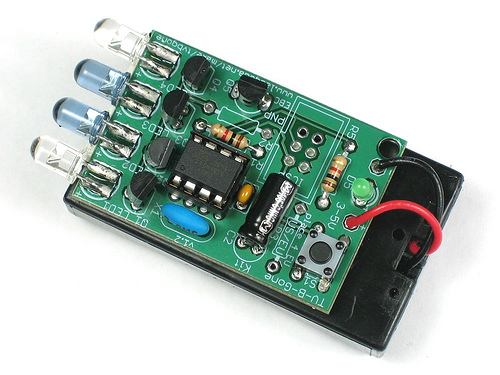
Recently, our friends over at Adafruit released a new version of their popular TV-B-Gone kit. Built in cooperation with [Mitch Altman], the inventor of the TV-B-Gone, the new kit sports four high power IR LEDs, two wide beam and two narrow beam. The four LEDs give the new TV-B-Gone increased range, with a maximum distance of over 150ft. One of the most impressive features of the kit is the fact that the new TV-B-Gone is universal and can now work in Europe and Asia in addition to the US. Users are able to select which region they want to use during the build process by soldering a resistor into the board at their region’s corresponding spot as seen in the picture above. The new TV-B-Gone kit is now available in the Adafruit store for $19.95 plus shipping.
Serial Hacking With An ATtiny2313

board

[Sprite_tm] automated a portion of serial hacking by sniffing out the baud rate using an ATtiny2313 and FT232 breakout board. The firmware assumes 8 data bits, no parity, and 1 stop bit (8N1). This is pretty much defacto among serial ports so it should work well, though some devices do use different settings. The auto detection routine can sniff rates as low as 110 baud and supports non standard rates. Released under GPLv3, the software is also supplied in hex format.  [Sprite_tm] has provided great project in past such as Working with VFDsControllable bristlebot, and AVR boost converter. Additional information regarding serial hacking after the break.

Continue reading “Serial Hacking With An ATtiny2313”

Custom Flex Sensors

flex

Flex sensors, like the ones used in the Nintendo Power Glove, are generally expensive and hard to find. However, [jiovine] demonstrates that they are easy enough to make from spare parts. He sandwiched a strip of plastic from ESD bags between pieces of copper foil, and wrapped the whole thing in heat shrink tubing. The sensor is able to detect bends in either direction, unlike the original power glove sensors. His version had a nominal resistance of about 20k ohms, but by choosing a different resistive layer you could create sensors that are more or less resistive.

Related: 5-cent tilt sensor

Pet-squirting Waterwall

waterwall

Sometimes, pets need to be trained to stay away from certain things. Over at sump.org, his cats needed to be kept out of his room. He used their natural fear of water by creating the waterwall, a motion-sensing device that sprays water. The project is incredibly simple and uses very few components. It is based around an IR intrusion detector and a windshield washer pump. Although that worked well enough, he also hooked it up to his computer via the parallel port so that he could take pictures as the cats (or people) are sprayed. Although the project is old, it shows how few components are really needed to achieve this kind of behavior.

Related: Motion detecting cat toy

[thanks todd]

Greenhouse Guard

pid

[Seth King] sent in his latest hack where he used an Arduino to regulate various aspects of a greenhouse. He has sensors for soil and air temperature as well as light and moisture. He built a custom circuit that uses relays to power fans, lights, and heaters. Using timers and the sensor data, the devices can be triggered to create the perfect environment for sprouts. He hopes to make the whole thing wireless by integrating XBees, but for now he ran a USB cord to his computer.

Related: Automatic grow light

Chainsaw Powered Bicycle

chainsawbike

We’ve covered weed whacker bicycles before and you can even buy 66cc conversion kits now. [geoff390] posted a few videos over on YouTube about another motor option. In the first video embedded below, he goes over the basic parts of his bike. The chainsaw motor is mounted to the side of the back tire and a metal drive wheel extending from the chainsaw shaft makes contact with it. The motor assembly is mounted on a hinge and the friction between the drive wheel and the back tire is adjusted with a turnbuckle. He posted a more detailed second video in which he goes over some of the finer details of the bike and some of the issues he’s had. Continue reading “Chainsaw Powered Bicycle”

Balloon Based Satellite

balloonsat

This project provides an opportunity to conduct near space experiments. The flight computer, BalloonSat Extreme, is controlled by a BASIC Stamp 2pe. The complete BOM with PCB artwork is provided. There is enough hardware to control cameras, servos, a Gps, and five digital I/O. The computer is also equipped with a 12 bit ADC to log experiment results. The device seems limited to 30KB of storage. Though the author suggests this memory limitation is more than adequate, we are wondering if an implementation of the Nyquist sampling theorem is in use at all. For further reading the author has provided information regarding Amateur Radio High Altitude Ballooning.

[via adafruit]