Skip to content
Logo

Hackaday

  • Home
  • Blog
  • Hackaday.io
  • Contests
  • Submit
  • About

haptic feedback

50 Articles

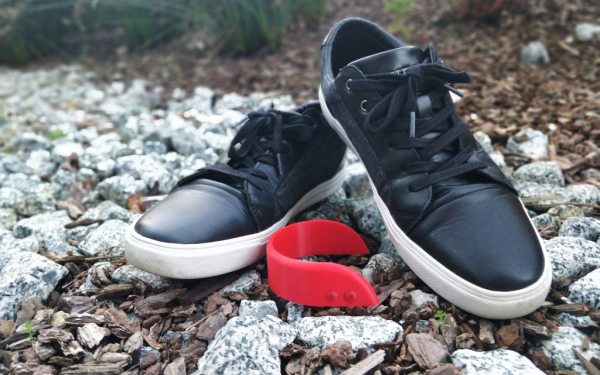
Shoes That Tell You Where To Go

April 14, 2018 by Kristina Panos 15 Comments

The worst thing about walking around while trying to follow directions is that you have to keep looking down at them to get the next turn. At best, you’ll miss out on the scenery; at worst, you might walk into traffic.

Wouldn’t it be great if you didn’t have to look down? Yes it would, and with Walkity, there’s no need to look down. Walkity is a set of cuffs that slip on the backs of your shoes, pairs with your phone, and uses haptic feedback to tell you where to go. Each one has an Arduino Mini Pro, an NRF24L01 to talk to its mate, a Bluetooth module, a vibration motor, and what must be the thinnest, most flexible LiPo currently available on Earth. The specified cell is PGEB0083559, a 65 mAH cell that is 0.8 mm thick!

Your smartphone will vibrate in your pocket during naviation but our experience has been that of still not knowing which way to turn. Walkity’s feedback is simple and intuitive. The left cuff vibrates to indicate a left turn, right for right, and both vibrate when you reach your destination. Going the wrong way? Walkity will vibrate vigorously to let you know it’s time to pull over. It’s a great example of a an entry for the Human Computer Interface Challenge of the Hackaday Prize!

We often see haptic feedback used for navigation, but it can also be used to teach new skills.

The HackadayPrize2018 is Sponsored by:

Microchip

Digi-Key

Supplyframe
Posted in The Hackaday Prize, Wearable HacksTagged 2018 Hackaday Prize, bluetooth, haptic feedback, haptic guide, navigation
HaptX haptic VR glove

What We Need To Try In Haptic Hacks

March 22, 2018 by Steven Dufresne 9 Comments

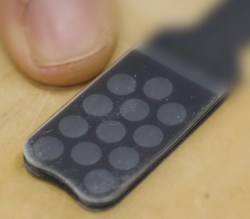
Looking for ideas for your haptics projects? [Destin] of the Smarter Every Day YouTube channel got a tour from the engineers at HaptX of their full-featured VR glove with amazing haptic feedback both with a very fine, 120-point sense of touch, force feedback for each finger, temperature, and motion tracking.

Inflatable bladders for touch

In hacks, we usually stimulate the sense of touch by vibrating something against the skin. With this glove, they use pneumatics to press against the skin. A single fingertip has multiple roughly 1/8 inch air bladders in contact with it. Each bladder is separately pneumatically controlled by pushing air into it. The air pressure can vary continuously so that the bladders can push lightly, harder or anywhere in between. The glove has 120 of these bladders spread out over the fingers and the palm. Unfortunately, they didn’t allow him to see the valves controlling the pneumatics, but if you are looking for a low-frequency, low-cost way to actuate valves you might consider using syringes. The engineers do tell [Destin] that if your VR scene shows something pressing against your virtual finger, as long as your haptics push against your real finger within around 1/8th of a second, your brain won’t notice the delay.

They’re also working on using hot and cold fluids to give a sense of temperature within a glove. This is demonstrated in the first video below when [Destin] feels heat while a dragon in the VR world breathes fire on his hand. Fortunately one of the engineers mentions that our sense of temperature is one of the slower ones, it can handle longer latencies than even touch. We can see implementing this in a hack using a bladder pressing against the skin while tubes circulate different temperature fluids through it. But maybe there’s a way to do it electrically, possibly with thermoelectric modules as is done with this drinks cooler? Though safety issues might prohibit that.

Other features mentioned are force feedback for each finger, and their custom motion tracking which uses both magnetic and optical means to track fingertips. But we’ll leave the rest to the videos below. The first is the technical tour and the second is the glove being used in the VR world.

Continue reading “What We Need To Try In Haptic Hacks” →

Posted in Virtual RealityTagged haptic feedback, haptics, Pneumatics, virtual reality, VR glove

Find Your Way With Tiny Laser Beams

December 31, 2017 by Kristina Panos 10 Comments

For their final project in embedded microcontroller class, [Aaheli, Jun, and Naomi] turned their focus toward assistive technology and created an Electronic Travel Aid (ETA) for the visually impaired that uses haptic feedback to report the presence of obstacles.

We have seen a few of these types of devices in the past, and they almost always use ultrasonic sensors to gauge distance. Not so with this ETA; it uses six VL53L0X time-of-flight (ToF) sensors mounted at slightly different angles from each other, which provides a wide sensing map. It is capable of detecting objects in a one-meter-wide swath at a range of one meter from the sensors.

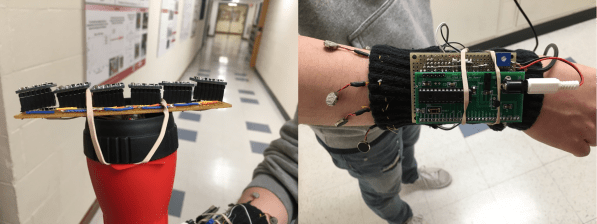
The device consists of two parts, a wayfinding wand and a feedback module. The six ToF sensors are strapped across the end of a flashlight body and wired to an Arduino Mini inside the body. The Mini receives the sensor data over UART and sends it to the requisite PIC32, which is attached to a sleeve on the user’s forearm. The PIC decodes these UART signals into PWM and lights up six corresponding vibrating disc motors that dangle from the sleeve and form a sensory cuff bracelet around the upper forearm.

We like the use of ToF over ultrasonic for wayfinding. Whether ToF is faster or not, the footprint is much smaller, so its more practical for discreet assistive wearables. Plus, you know, lasers. You can see how well it works in the demo video after the break.

This device is intended to augment the traditional white cane, not replace it. This virtual cane we saw a few years ago is another story.

Continue reading “Find Your Way With Tiny Laser Beams” →

Posted in Microcontrollers, Wearable HacksTagged assistive technolgy, friggin lasers, haptic, haptic feedback, spatial, time of flight, vibration motor, wayfinding

Hackaday Prize Entry: Digital White Cane

October 9, 2017 by Rich Hawkes 7 Comments

If you are blind or your vision is impaired, moving around in a new space can be a harrowing experience. A cane helps, but only samples one point at a time, and can’t help that much above a certain height. The Digital White Cane is a haptic feedback device that uses Time of Flight components to detect surrounding objects.

The Digital White Cane uses a type of LIDAR known as Time of Flight (ToF) sensing. Rather than a point by point scan by a laser, ToF sensors capture an entire scene with each pulse. These sensors are actually somewhat new and designed for the latest generation of robotics and hand detection for soap dispensers. The good news is that they’re small and cheap, just what you want for a wearable.

The sensors allow detection of objects within 2m (about 6 feet) from all directions. Haptic feedback allows the wearer to determine where the object is around the wearer. Because it’s head-mounted, it detects objects at head height as well as floor height. A Teensy LC is used as the main processor and is connected to the ToF sensors as well as small motor board for the haptic feedback.

This project has a lot of potential to help people with vision impairment and is a great entry into the 2017 Hackaday Prize. Check out the video after the break to see it in action. If you’re looking for some more applications of this small, cheap ToF sensor, check out this cat food dispenser, and here’s a ball-balancing robot  – both pretty cool projects in their own right.

Continue reading “Hackaday Prize Entry: Digital White Cane” →

Posted in The Hackaday PrizeTagged 2017 Hackaday Prize, digital cane, haptic feedback, lidar, Teensy LC, Time of Flight Sensor

Hackaday Prize Entry: A Bracelet For The Blind

August 15, 2017 by Kristina Panos 9 Comments

The World Health Organization estimates that around 90% of the 285 million or so visually impaired people worldwide live in low-income situations with little or no access to assistive technology. For his Hackaday Prize entry, [Tiendo] has created a simple and easily reproducible way-finding device for people with reduced vision: a bracelet that detects nearby objects and alerts the wearer to them.

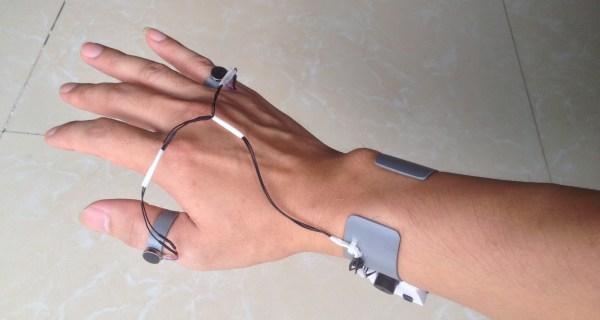
It does its job using an ultrasonic distance sensor and an Arduino Pro Mini. The bracelet has two feedback modes: audio and haptic. In audio mode, the bracelet will begin to beep when an object is within 2.5 meters. And it behaves the way you’d expect—get closer to the object and the beeping increases; back away and it decreases. Haptic mode involves two tiny vibrating disk motors attached to small PVC cuffs that fit on the thumb and pinky. These motors will buzz differently based on the person’s proximity to a given object.  If an object is 1 to 2.5 meters away, the pinky motor will vibrate. Closer than that, and it switches over to the thumb motor.

To add to the thriftiness of this project, [Tiendo] re-used other objects where he could. The base of the bracelet is a cuff made from PVC. The nylon chin strap and plastic buckle from a broken bike helmet make it adjustable to fit any wrist. To keep the PVC cuff from chafing, he slipped small pieces from an old pair of socks on to the sides.

It’s easy to see why this project is a finalist in our Best Product contest. It’s a simple, low-cost assistive device made from readily available and recycled materials, and it can be built by anyone who knows a little bit about electronics. Add in the fact that it’s lightweight and frees up both hands, and you have a great product that can help a lot of people. Watch it beep and buzz after the break. Continue reading “Hackaday Prize Entry: A Bracelet For The Blind” →

Posted in The Hackaday Prize, Wearable HacksTagged 2017 Hackaday Prize, arduino pro mini, assistive technolgy, haptic feedback, ultrasonic distance sensor, visually impaired

Hackaday Prize Entry: One-Handed, No-Look Keying

July 12, 2017 by John Baichtal 3 Comments

Chorded keysets can be found all over. For instance, Braille writers and court stenographers both use them. These chorded keyboards create each letter by pressing a combination of keys rather just one, making for much smaller keyboards [Christine] got the idea to create wearable rig that uses an accelerometer and vibe motor attached to each finger to serve as a one-handed, no-look, silent keyer. Forget small keyboards, this project does away with it altogether, relying on the accelerometers to keep track of your fingers.

[Christine]’s prototype consists of a Bluno BLE controller, a GSM module, and a few accelerometers and motors. The vibration motors not only provide haptic feedback so you know you tapped something, but also replays the chords so you can double-check what you’re writing.

Typically one-handed keyboards rely on button presses, with no-look use dependent on memorizing the layout—think of a 10-key pad. [Christine]’s project lets you type on any surface or none at all, making it handy for typing while you work with the other hand. It also has great potential for vision impaired users.

The HackadayPrize2017 is Sponsored by:
Digi-Key
Supplyframe
Microchip
Texas Instruments
Posted in The Hackaday PrizeTagged 2017 Hackaday Prize, bluetooth, haptic feedback, keyboard

Tele-Haptic Proto-Sculpting: Using Robots To Teach

December 18, 2015 by James Hobson 7 Comments

Is it possible to effectively communicate tactile pedagogical messages in a heuristic tele-haptic proto-sculpting environment? Let’s try rephrasing that. What if you could use a robot to help teach someone a creative skill? Imagine guiding someone’s hand with a paintbrush. Now imagine guiding a bunch of peoples’ hands with paintbrushes, using a series of linked robots.

From [Morgan Rauscher] comes Art-Bot 2.0 — a creative learning tool that provides an entirely new way to teach painting, sculpting, or pretty much anything requiring dexterity or a tool. We covered Art-Bot 1.0 a few years ago, but in case you’ve forgotten, it was an eight-foot tall chainsaw wielding robot inside of an enclosure. Even children, using the remote, could play with chainsaws.

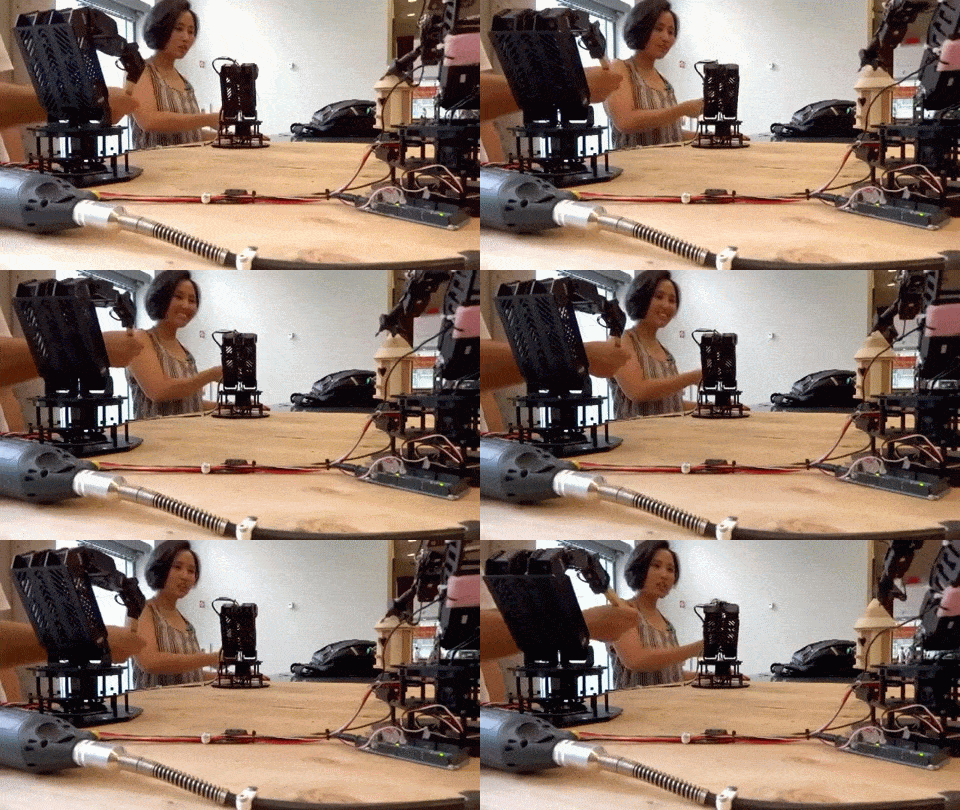
Constructed with the help of the Hexagram Institute, Art-Bot 2.0 is made up of three rugged servo driven robot arms. One is for the teacher, to guide movements, one performs those same movements on a work-piece, and a third robot arm allows a student to feel what is happening.

Continue reading “Tele-Haptic Proto-Sculpting: Using Robots To Teach” →

Posted in Robots HacksTagged art bot, haptic feedback, haptic robot feedback

Posts navigation

← Older posts
Newer posts →

Search

Never miss a hack

Follow on facebook Follow on twitter Follow on youtube Follow on rss Contact us

Subscribe

If you missed it

  • Ultra-Long Range Flights To Ease Australian Air Travel

    15 Comments
  • Know Your Food: Organic Production

    32 Comments
  • UDP Broadcasting And Easily Finding Network Services

    21 Comments
  • How Airspeed Sensors Work

    28 Comments
  • The Teenage Angst Of 3D Printing: Solidoodle, Printrbot, And Bridges

    40 Comments
More from this category

Our Columns

  • Hackaday Europe 2026: Is Your Blood Pressure Monitor Lying To You?

    16 Comments
  • Hackaday Links: July 5, 2026

    7 Comments
  • Yesterday’s Technology, Re-engineered Today

    12 Comments
  • Hackaday Podcast Episode 376: Modern Retro Projects, Retro Modern Projects, And The Teen Years For 3D Printing

    2 Comments
  • This Week In Security: Windows 10 Gets Another Year, SmartTV Botnets, Hiding Payloads, And LastPass Customer Leak

    6 Comments
More from this category

Search

Never miss a hack

Follow on facebook Follow on twitter Follow on youtube Follow on rss Contact us

Subscribe

If you missed it

  • Ultra-Long Range Flights To Ease Australian Air Travel

    15 Comments
  • Know Your Food: Organic Production

    32 Comments
  • UDP Broadcasting And Easily Finding Network Services

    21 Comments
  • How Airspeed Sensors Work

    28 Comments
  • The Teenage Angst Of 3D Printing: Solidoodle, Printrbot, And Bridges

    40 Comments
More from this category

Categories

Our Columns

  • Hackaday Europe 2026: Is Your Blood Pressure Monitor Lying To You?

    16 Comments
  • Hackaday Links: July 5, 2026

    7 Comments
  • Yesterday’s Technology, Re-engineered Today

    12 Comments
  • Hackaday Podcast Episode 376: Modern Retro Projects, Retro Modern Projects, And The Teen Years For 3D Printing

    2 Comments
  • This Week In Security: Windows 10 Gets Another Year, SmartTV Botnets, Hiding Payloads, And LastPass Customer Leak

    6 Comments
More from this category

Recent comments

  • Joshua on The Bit79 Was A Famicom Clone That Took The “Family Computer” Name Seriously
  • ialonepossessthetruth on Ultra-Long Range Flights To Ease Australian Air Travel
  • George Richards on The Bit79 Was A Famicom Clone That Took The “Family Computer” Name Seriously
  • Truth on Hackaday Europe 2026: Is Your Blood Pressure Monitor Lying To You?
  • Zangar the Pangarian on Settling The Debate On Soldered Versus Crimped High-Current Connectors
  • Zangar the Pangarian on Settling The Debate On Soldered Versus Crimped High-Current Connectors
  • Srsly? on Ultra-Long Range Flights To Ease Australian Air Travel
  • Tim Williams on Ultra-Long Range Flights To Ease Australian Air Travel
  • Srsly? on Ultra-Long Range Flights To Ease Australian Air Travel
  • Ject on Hackaday Europe 2026: Is Your Blood Pressure Monitor Lying To You?
Logo
  • Home
  • Blog
  • Hackaday.io
  • Video
  • Submit A Tip
  • About
  • Contact Us

Never miss a hack

Follow on facebook Follow on twitter Follow on youtube Follow on rss Contact us

Subscribe to Newsletter

Copyright © 2026 | Hackaday, Hack A Day, and the Skull and Wrenches Logo are Trademarks of Hackaday.com | Privacy Policy | Terms of Service | Digital Services Act | Do not sell or share my personal informationCookie Management
Powered by WordPress VIP

Loading Comments...