Skip to content
Logo

Hackaday

  • Home
  • Blog
  • Hackaday.io
  • Contests
  • Submit
  • About

haptic feedback

50 Articles

A Gaming Mouse With Recoil Feedback

September 8, 2020 by Zoe Skyforest 21 Comments

Rumble first hit the gaming mainstream back in the mid-1990s, and has become de rigeur for console players using gamepads ever since. It’s less prevalent on the PC, because most players rely on keyboards and mice that are rumble-free. However, innovation is possible, and [ilge] put together a modified mouse for shooters that has an excellent recoil feedback device. 

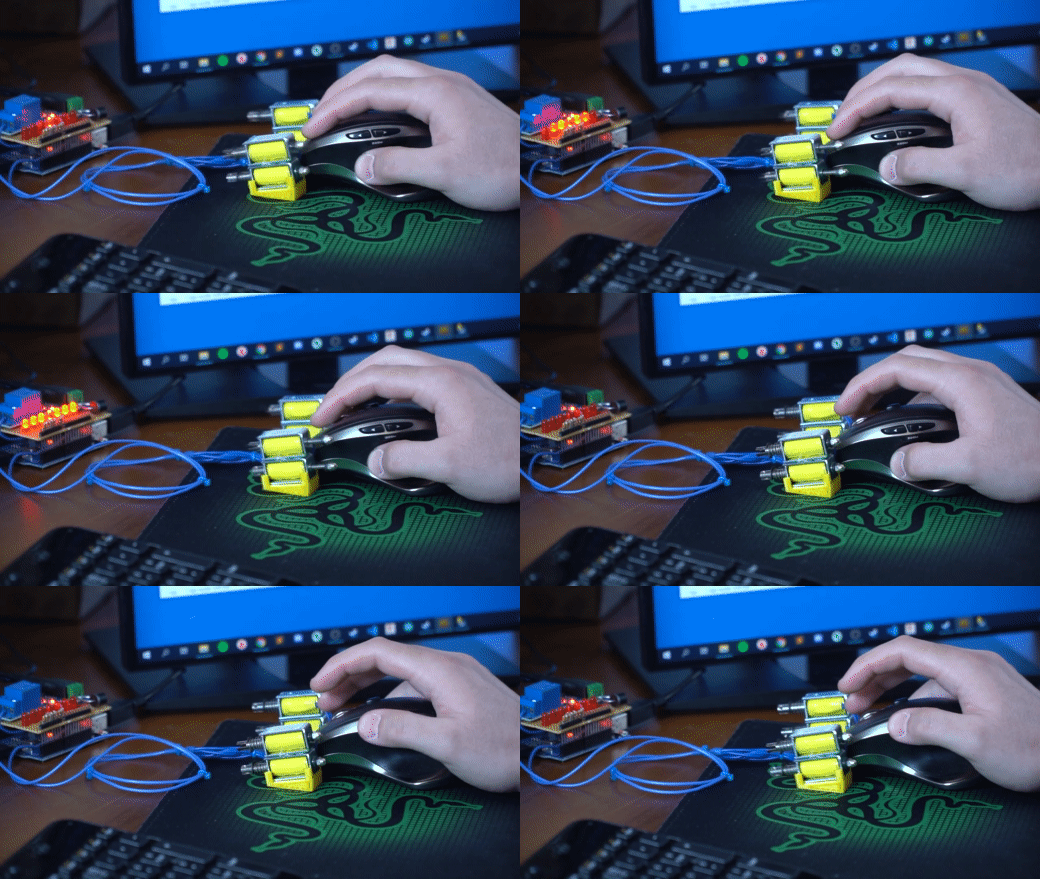
The feedback effect is run by an Arduino, which receives serial data from a Python program running on the host computer. When the mouse is clicked, the Python program notifies the Arduino, which then fires a bank of four solenoids repeatedly back-and-forth to generate the feedback effect. The solenoids are triggered by a relay, which is an easy way to switch such a load, though we suspect it may not hold up well over time due to the rapid fire rate and the likelihood of spark damage over time from high inrush current to the solenoids.

It’s a simple build that nonetheless adds a great haptic feedback effect to the otherwise humble computer mouse. While we don’t expect to see pros using the device anytime soon, it’s a great concept that does add to the shooter experience. Similar hardware could likely be put to great use in a VR context, too. The state of the art of haptic technology continues to move at a rapid pace, and we can’t wait to see what comes next. Video after the break.

Continue reading “A Gaming Mouse With Recoil Feedback” →

Posted in Peripherals HacksTagged haptic, haptic feedback, haptics, mouse

Hands-Free Haptic Braille Display Is Making Waves

June 7, 2020 by Kristina Panos 9 Comments

In the last few months, most of the world’s population has shied away from touching as many public things as possible. Unfortunately, anyone with low vision who relies on Braille signs, relief maps, and audio jacks doesn’t have this luxury — at least not yet.

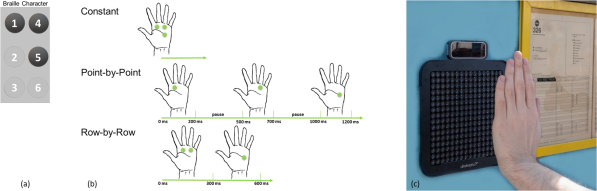
A group of researchers at Bayreuth University in Germany are most of the way to solving this problem. They’re developing HaptiRead, a mid-air haptic feedback system that can be used as a touchless, refreshable display for Braille or 3D shapes. HaptiRead is based on a Stratos Explore development kit that has a field of 256 ultrasonic transducers. When a person approaches the display, a Leap motion sensor can detect their hand from up to 2.5 feet away and start providing information via sound waves. Each focus point is modulated with a different frequency to help differentiate between them.

HaptiRead can display information three ways: constant, which imitates static Braille displays, point by point, and row by row. The researchers claim up to 94% accuracy in trials, with the point by point method in the lead. The system is still a work in progress, as it can only do four cells’ worth of dot combination and needs to do six before it’s ready. Check out the brief explainer video after the break, or read the group’s paper [PDF download].

Want to play with refreshable Braille systems? This open-source display uses Flexinol wire to actuate the dots.

Continue reading “Hands-Free Haptic Braille Display Is Making Waves” →

Posted in Lifehacks, Misc HacksTagged braille, braille display, haptic feedback, leap motion controller, refreshable Braille display, transducer, ultrasonic transducer

In Pursuit Of Haptics For A Better VR Experience

February 12, 2020 by Mike Szczys 6 Comments

Virtual reality holds the promise of an immersive experience that can satisfy our senses to a level comparable with… well, reality. The field has come a long way, but Sarah Vollmer makes a good point that many of the VR systems currently in use are bulky and difficult to transfer from person to person.

While headsets have become smaller and lighter and now feature improved motion tracking and resolution, their ability to affect the user’s other senses hasn’t seen nearly the same advancement. Haptic feedback systems need to catch up with headsets, and how to unobtrusively allow users feel simulated physical contact in VR is an area Sarah is researching as part of her PhD work. This is the topic of her 2019 Hackaday Superconference talk which you’ll find embedded below.

Continue reading “In Pursuit Of Haptics For A Better VR Experience” →

Posted in cons, Virtual Reality, Wearable HacksTagged 2019 Hackaday Superconference, erm, haptic feedback, haptics, lra, open sound control, vibration motor, virtual reality

Haptic Games Bring Fun To The Visually Impaired

November 12, 2019 by Kristina Panos 2 Comments

No matter what your parents might say, games are good for us. They teach us to manage resources and give us dopamine rewards just like eating and mating do. Even if you’re no good at games in general, they are still a fun distraction from life.

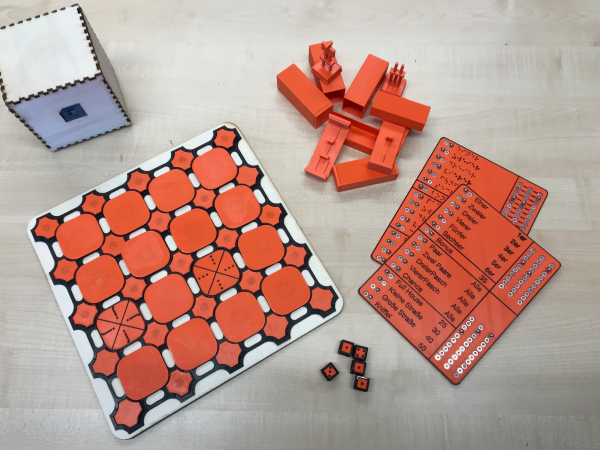
There are so many games out there that could be enjoyed by the visually impaired, except that they rely on visuals. For example, you can play Yahtzee with nothing more than five dice, a cup, pencil and paper, and knowledge of the rules and scoring. The biggest obstacles are differentiating the dice from each other and keeping score.

One of our esteemed 2019 Hackaday Prize Top 20 Finalists is [JanThar]’s Haptic Games. [JanThar]’s growing collection of games uses 3D printing, vibration motors, and RFID to replace visual cues with sensory feedback. Yahtzee-wise, there’s a set of printed dice and scorecards. The scorecards use spherical magnets and an abacus layout. [JanThar] is also working on a Memory game to teach Braille, though it could be adapted to pure Braille for the visually impaired. Each game piece contains an RFID chip, so players can hold it up to a reader to check what they have.

Our favorite might be the PONG game that’s built on [JanThar]’s 2017 Hackaday Prize entry, the HaptiVision vest. Through the magic of a 16×8 field of vibration motors, players can track the ball’s movement across their torso and control the paddles with a sliders. There’s a brief demo of the games after the break.

Continue reading “Haptic Games Bring Fun To The Visually Impaired” →

Posted in The Hackaday PrizeTagged 2019 Hackaday Prize, haptic feedback

Steering By Touch And Haptic Feedback

October 22, 2019 by Sharon Lin 10 Comments

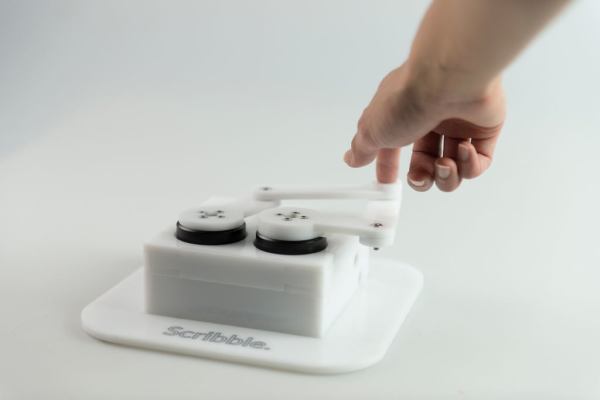
Scribble is a haptic interface lets you draw your way through traffic. In an environment where fully automated vehicles are becoming the expectation for the next step in transportation, Scribble provides a friendly alternative that allows you to guide your car around, while the automation makes decisions on how to actually steer the car around obstacles.

The driver is guided by haptic feedback that alerts them about the road conditions or obstacles ahead. The project was conceived by [Felix Ros] for his master’s thesis at Eindhoven University, featured a five bar linkage that moves with two lateral degrees of freedom, commonly used for drawing robots.

The code run on an Arduino DUE control over serial by a program made in Open Frameworks that communicates with a Unity 3D driving simulator over UDP. Fellow graduate student [Frank van Valeknhoef]’s Haptic Engines are used as the actuators, outputting the position and a variable force.

The forward kinematics algorithms were based on a clock and weather plotter by SAP, sharing the same servo and drawing arm assembly. The left and right actuators update based on the desired angle, calculating the proper angles needed to achieve the correct position.

While automated vehicles may be able to travel efficiently from one destination to the next, they can’t necessarily wander off course to explore new places. Scribble takes back some of that freedom and allows drivers to decide for themselves where they want to be. It’s an interesting take at inserting the human back into the driver’s seat in automated cars.

Continue reading “Steering By Touch And Haptic Feedback” →

Posted in Arduino HacksTagged arduino, driving, haptic feedback

Haptic Clock Lets You Keep Your Eyes Shut At Night

September 27, 2019 by Erin Pinheiro 37 Comments

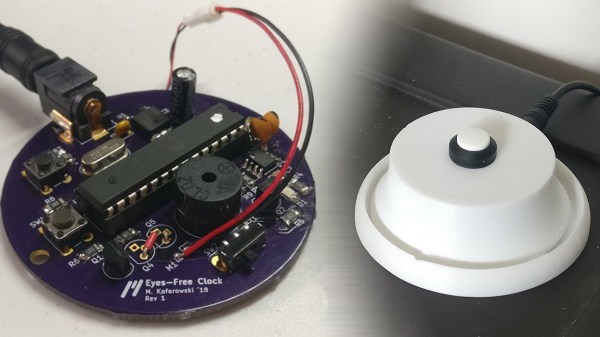
Picture this: You’re in your bed in the middle of the night, and you want to know what time it is. Bedside alarm clocks are a thing of the past and now you rely on your smartphone to tell the time. Only, if you turned the screen on, you’d find that looking at it in the dark is tantamount to staring at the sun without eye protection. [Michael] pictured the same thing and his solution for this scenario is a clever haptic-feedback clock.

The idea behind it is simple, a clock from which you can tell the time without having to use your eyes. This one gives you two options for that, the first one being a series of haptic pulses that let you tell the time simply by touching the device. The second, audibly telling the time with voice samples stored in a flash chip, was added in the second revision as [Michael] continues to refine his design. In addition to helping us assess the time in the dark, it’s also worth noting that this could be useful for those with visual impairments as well.

Until we can see the final product, you can help him out looking over the designs and sending pull requests over at the project’s GitHub page, or just watch his progress in the Hackaday.io page. We’ve seen some interesting ways to tell the time before, from a game of Tetris to a clock housed inside the shell of an old-school camera flash, but we’ve never seen one that uses haptic feedback before. We hope for the sake of our eyes that it catches on!

The HackadayPrize2019 is Sponsored by:

Supplyframe

Digi-Key

Microchip
Posted in clock hacks, The Hackaday PrizeTagged 2019 Hackaday Prize, accessibility, accessible, clock, haptic, haptic feedback, Unusual
Wind-Blaster haptic force feedback

Wind-Blaster: Haptic Feedback That’ll Make You Recoil

September 16, 2018 by Steven Dufresne 8 Comments

A big challenge in the VR world is getting haptic feedback no matter where you are. That’s not so much of a problem when you’re sitting in a chair, the hardware can be attached to the chair or to something near you, what’s referred to as grounded force-feedback. But with VR, we’ve gotten used to at least moving around a room. How then do you feel the recoil of a gun, the pressure against a shield, the inertia of a sword slicing through the air, or the pulsations of magic sword emitting lightning?

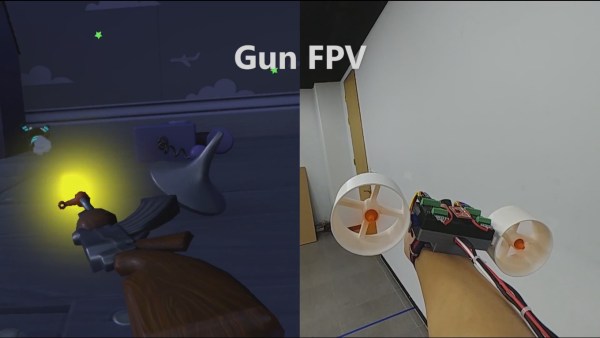
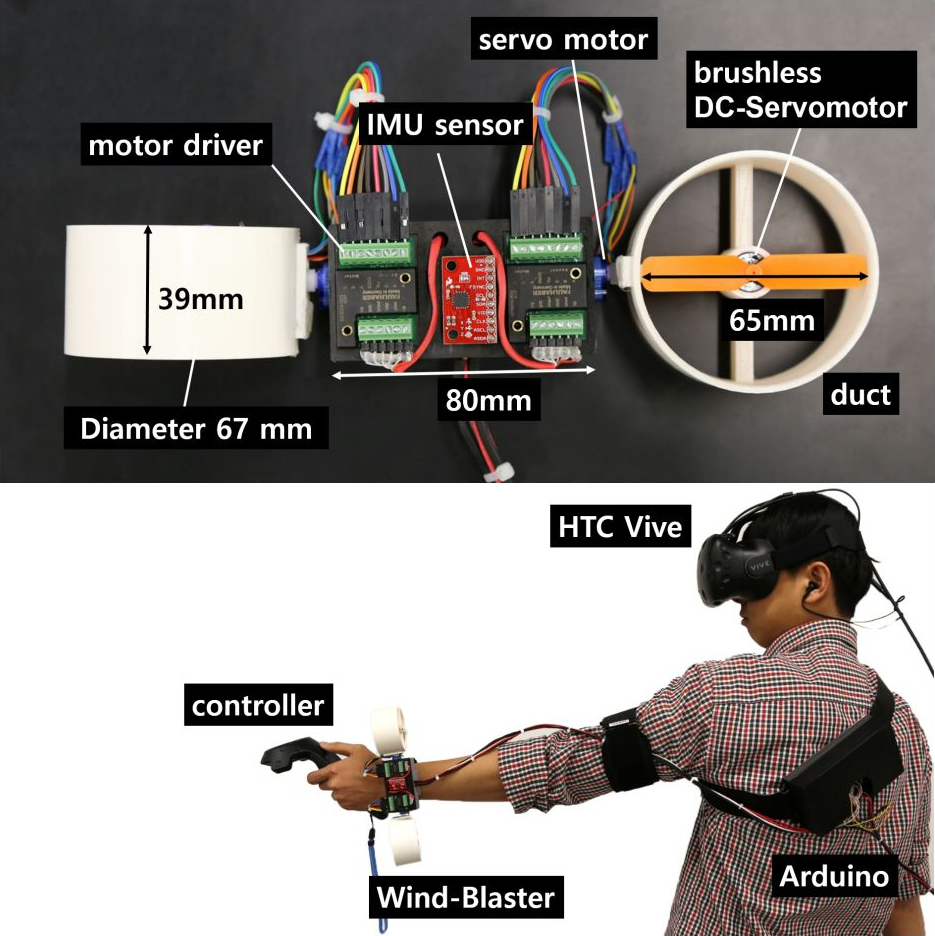
Wind-Blaster system diagramA team of researchers at the [MAKinteract Lab] at KAIST, a university in South Korea, have come up with a small device which straps to your wrist and provides all those types of feedback. It’s called the Wind-Blaster and consists of two ducted propellers which can provide up to 1.5N of force. Both propellers are mounted on servos, and with the help of an IMU, the propellers are oriented as needed. An Arduino doing PWM controls the motor speeds.

Fire a VR shotgun and the propellers quickly spin up to 33,000 RPM for just 250 ms, giving your lower arm a quick backward tug, providing the feel of a recoiling gun. Swing a VR sword through the air and the propellers rotate at 33,000 RPM for 400 ms and then linearly decelerate to a stop in 300 ms. Making the propellers move asynchronously with respect to each other causes rotation torque on your arm for a pulsating feeling for the magic lightning-emitting sword. A connected PC runs the games using the Unity game engine. As with drones, there is noise at around 41 dB but the user’s headphones block it out. Watch it in action in the videos below.

Here on Hackaday, we’ve covered few more ungrounded haptic feedback systems. There’s one which responds to light, another which lets you feel textures, and a glove which gets feedback as it controls a robotic gripper.

Continue reading “Wind-Blaster: Haptic Feedback That’ll Make You Recoil” →

Posted in Virtual RealityTagged haptic feedback, haptics, virtual reality

Posts navigation

← Older posts
Newer posts →

Search

Never miss a hack

Follow on facebook Follow on twitter Follow on youtube Follow on rss Contact us

Subscribe

If you missed it

  • Ultra-Long Range Flights To Ease Australian Air Travel

    5 Comments
  • Know Your Food: Organic Production

    32 Comments
  • UDP Broadcasting And Easily Finding Network Services

    21 Comments
  • How Airspeed Sensors Work

    27 Comments
  • The Teenage Angst Of 3D Printing: Solidoodle, Printrbot, And Bridges

    40 Comments
More from this category

Our Columns

  • Hackaday Europe 2026: Is Your Blood Pressure Monitor Lying To You?

    10 Comments
  • Hackaday Links: July 5, 2026

    6 Comments
  • Yesterday’s Technology, Re-engineered Today

    12 Comments
  • Hackaday Podcast Episode 376: Modern Retro Projects, Retro Modern Projects, And The Teen Years For 3D Printing

    2 Comments
  • This Week In Security: Windows 10 Gets Another Year, SmartTV Botnets, Hiding Payloads, And LastPass Customer Leak

    5 Comments
More from this category

Search

Never miss a hack

Follow on facebook Follow on twitter Follow on youtube Follow on rss Contact us

Subscribe

If you missed it

  • Ultra-Long Range Flights To Ease Australian Air Travel

    5 Comments
  • Know Your Food: Organic Production

    32 Comments
  • UDP Broadcasting And Easily Finding Network Services

    21 Comments
  • How Airspeed Sensors Work

    27 Comments
  • The Teenage Angst Of 3D Printing: Solidoodle, Printrbot, And Bridges

    40 Comments
More from this category

Categories

Our Columns

  • Hackaday Europe 2026: Is Your Blood Pressure Monitor Lying To You?

    10 Comments
  • Hackaday Links: July 5, 2026

    6 Comments
  • Yesterday’s Technology, Re-engineered Today

    12 Comments
  • Hackaday Podcast Episode 376: Modern Retro Projects, Retro Modern Projects, And The Teen Years For 3D Printing

    2 Comments
  • This Week In Security: Windows 10 Gets Another Year, SmartTV Botnets, Hiding Payloads, And LastPass Customer Leak

    5 Comments
More from this category

Recent comments

  • targetdrone on Ultra-Long Range Flights To Ease Australian Air Travel
  • Cheese Whiz on Time Never Moves Slowly With This Clock
  • arifyn on A New Challenger Approaches The Open Source Vehicle
  • El Gru on Gluing 8192 MCUs Together To Make A GPU
  • Paul G on Ultra-Long Range Flights To Ease Australian Air Travel
  • David on Ultra-Long Range Flights To Ease Australian Air Travel
  • Gary Bergstrom on Hackaday Europe 2026: Is Your Blood Pressure Monitor Lying To You?
  • DOugl on Demonstrating LFP Battery Safety In Case Of BMS Failure
  • Petercat on Hackaday Europe 2026: Is Your Blood Pressure Monitor Lying To You?
  • Dude on A New Challenger Approaches The Open Source Vehicle
Logo
  • Home
  • Blog
  • Hackaday.io
  • Video
  • Submit A Tip
  • About
  • Contact Us

Never miss a hack

Follow on facebook Follow on twitter Follow on youtube Follow on rss Contact us

Subscribe to Newsletter

Copyright © 2026 | Hackaday, Hack A Day, and the Skull and Wrenches Logo are Trademarks of Hackaday.com | Privacy Policy | Terms of Service | Digital Services Act | Do not sell or share my personal informationCookie Management
Powered by WordPress VIP

Loading Comments...