Necroprinting Isn’t As Bad As It Sounds

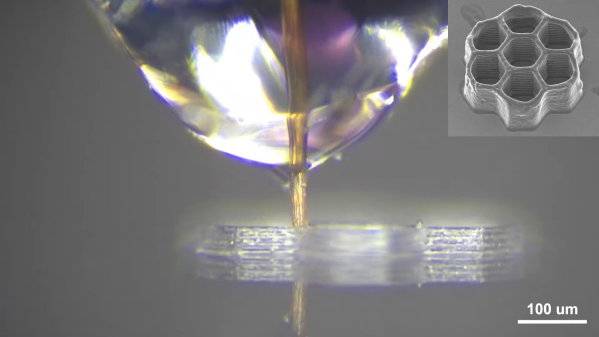
A mosquito has a very finely tuned proboscis that is excellent at slipping through your skin to suck out the blood beneath. Researchers at McGill University recently figured that the same biological structure could also prove useful in another was—as a fine and precise nozzle for 3D printing (via Tom’s Hardware).
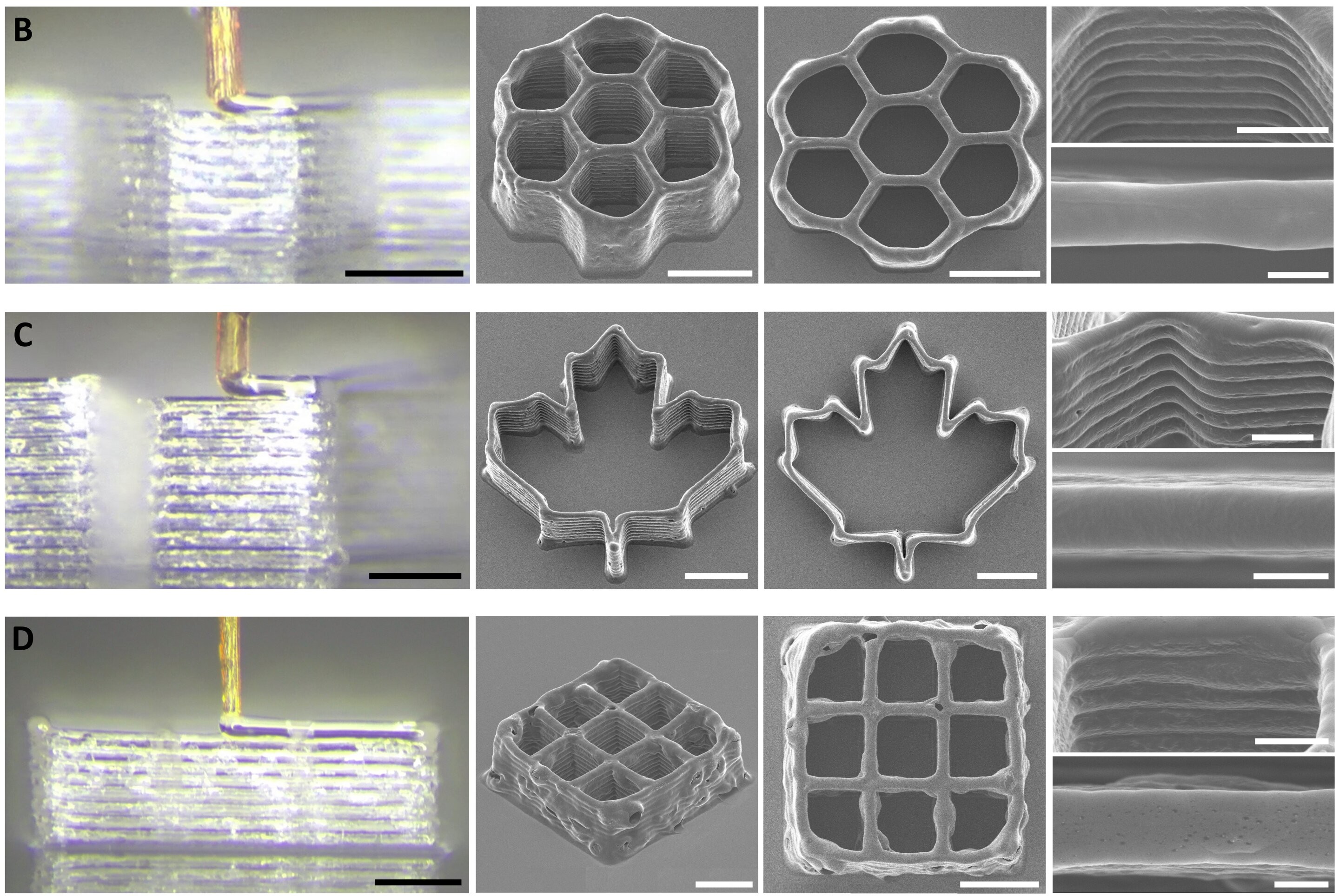
Small prints made with the mosquito proboscis nozzle. Credit: research paper

To achieve this feat, the research team harvested the proboscis from a female mosquito, as only the female of the species sucks blood in this timeline. The mosquito’s proboscis was chosen over other similar biological structures, like insect stingers and snake fangs. It was prized for its tiny size, with an inside diameter of just 20 micrometers—which outdoes just about any man-made nozzle out there. It’s also surprisingly strong, able to resist  up to 60 kPa of pressure from the fluid squirted through it.

Of course, you can’t just grab a mosquito and stick it on your 3D printer. It takes very fine work to remove the proboscis and turn it into a functional nozzle; it also requires the use of 3D printed scaffolding to give the structure additional strength. The nozzle is apparently used with bio-inks, rather than molten plastic, and proved capable of printing some basic 3D structures in testing.

Amusingly, the process has been termed 3D necroprinting, we suspect both because it uses a dead organism and because it sounds cool on the Internet. We’ve created a necroprinting tag, just in case, but we’re not holding our breath for this to become the next big thing. At 20 um, more likely the next small thing.

Further details are available in the research paper. We’ve actually featured quite a few mosquito hacks over the years. Video after the break.
Continue reading “Necroprinting Isn’t As Bad As It Sounds”

Augmented Arthropod Gets A Self-Balancing Ride

There are many people who find being around insects uncomfortable. This is understandable, and only likely to get worse as technology gives these multi-legged critters augmented bodies to roam around with. [tech_support], for one, welcomes our new arthropod overlords, and has even built them a sweet new ride to get around in.

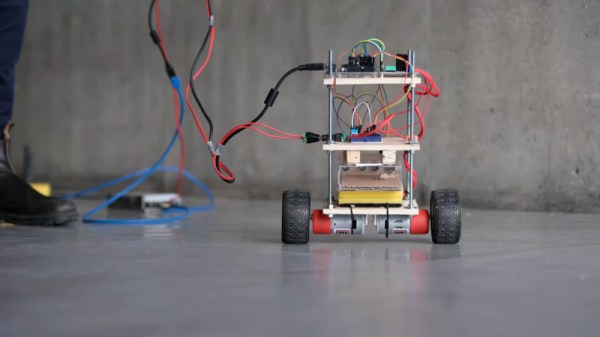
The build follows the usual hallmarks of a self-balancing bot, with a couple of interesting twists. There’s twin brushed motors for drive, an an Arduino Uno running the show. Instead of the more usual pedestrian IMUs however, this rig employs the Bosch BNO055 Absolute Orientation Sensor. This combines a magnetometer, gyroscope, and accelerometer all on a single die, and handles all the complicated sensor fusion maths onboard. This allows it to output simpler and more readily usable orientation data.

The real party piece is even more interesting, however. Rather than radio control or a line following algorithm, this self-balancer instead gets its very own insect pilot. The insect is placed in a small chamber with ultrasonic sensors used to determine its position. The insect may then control the movement of the bot by moving around this chamber itself. The team have even developed a variety of codes to dial in the sensor system for different types of insect.

It’s not the first time we’ve seen insects augmented with robotic hardware, and we doubt it will be the last. If you’re working on a mad science project of your own, drop us a line. Video after the break.

Continue reading “Augmented Arthropod Gets A Self-Balancing Ride”

Watch The Snappy, Insect-like Moves Of This DIY Quadruped Robot

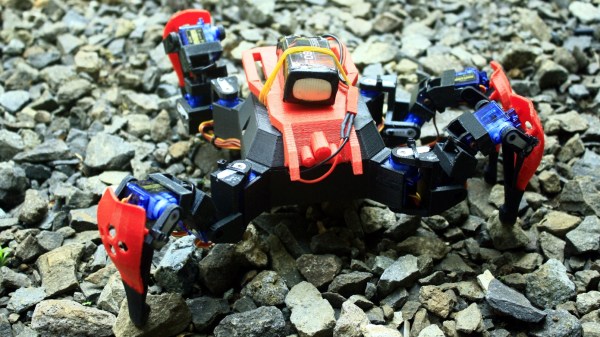
Some legged robots end up moving with ponderous deliberation, or wavering in unstable-looking jerks. A few unfortunates manage to do both at once. [MusaW]’s 3D Printed Quadruped Robot, on the other hand, moves in rapid motions that manage to look sharp and insect-like instead of unstable. Based on an earlier design he made for a 3D printable quadruped frame, [MusaW] has now released this step-by-step guide for building your own version. All that’s needed is the STL files and roughly $50 in parts from the usual Chinese resellers to have the makings of a great weekend project.

The robot uses twelve SG90 servos and an Arduino nano with a servo driver board to control them all, but there’s one additional feature: Wi-Fi control is provided thanks to a Wemos D1 Mini (which uses an ESP-8266EX) acting as a wireless access point to serve up a simple web interface through which the robot can be controlled with any web browser.

Embedded below is a brief video. The first half is assembly, and the second half demonstrates the robot’s fast, sharp movements.

Continue reading “Watch The Snappy, Insect-like Moves Of This DIY Quadruped Robot”

This Drone Can Fly, Swim, And Explode….. Wait, What?

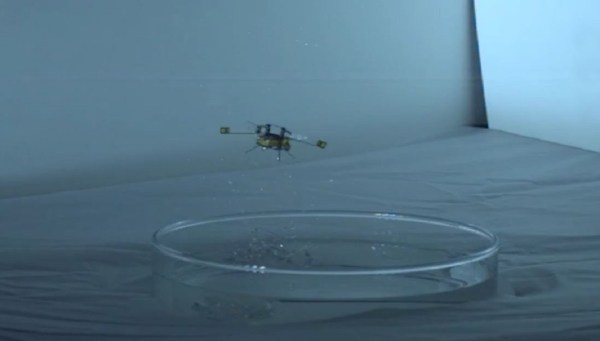
You’ve probably heard of micro-drones, perhaps even nano-drones, but there research institutions that shrink these machines down to the size of insects. Leading from the [Wiss Institute For Biologically Inspired Engineering] at Harvard University, a team of researchers have developed a miniscule robot that — after a quick dip — literally explodes out of the water.

To assist with the take off, RoboBee has four buoyant outriggers to keep it near the water’s surface as it uses electrolysis to brew oxyhydrogen in its gas chamber. Once enough of the combustible gas has accumulated — pushing the robot’s wings out of the water in the process– a sparker ignites the fuel, thrusting it into the air. As yet, the drone has difficulty remaining in the air after this aquatic takeoff, but we’re excited to see that change soon.

Looking like a cross between a water strider and a bee, the team suggest this latest version of the RoboBee series  — a previous iteration used electrostatic adhesion to stick to walls — could be used for search and rescue, environmental monitoring, and biological studies. The capacity to transition from aerial surveyor, to underwater explorer and back again would be incredibly useful, but in such a small package, it is troublesome at best. Hence the explosions.

Continue reading “This Drone Can Fly, Swim, And Explode….. Wait, What?”

JumpRoaCH Is Kind Of Cute, Kind Of Creepy

There’s a theory that the fear of scurrying things is genetic. Likewise, a similar theory arose about the tendency for humans to find helpless things cute. After all, our useless babies do best in a pest free environment. This all could explain why we found this robotic roach to be both a little cute and a little creepy.

The university sponsored project, JumpRoaCH, is a collaboration between South Korea’s SNU Biorobotics Lab and Berkeley’s Biomimetic Millisystems Lab. Imitating insects has been a popular avenue for robotic research, and often results in very interesting experiments.

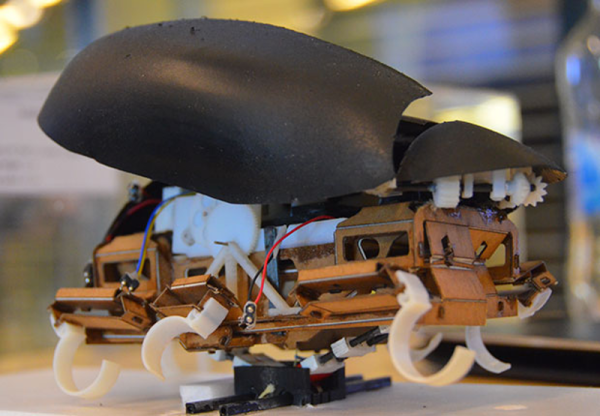
This robot looks like a ladybug going through its rebellious teen phase. It runs on six hook shaped legs which allow it to traverse a wider array of surfaces than wheels would, at the expense of speed and higher vibrations. The robot does a very convincing, if wobbly, scurry across the surface of its test table.

It also has a secret attack in the form of a single Rockem Sockem Robot arm located on its belly. With a powerful burst, the arm can launch the robot up a few feet to a higher surface. If the robot lands on its wheels the researchers high-five. If the robot lands on its back, it can use its ,”wings,” to flip itself right-side-up again.

The resulting paper (PDF file) has a nice description of the robot and its clever jumping mechanism. At least if these start multiplying like roaches, hackers will never short for tiny motors for their projects. Video after the break.

Continue reading “JumpRoaCH Is Kind Of Cute, Kind Of Creepy”

Robots And Crickets

If you watch science fiction movies, the robots of the future look like us. The truth is, though, many tasks go better when robots don’t look like us. Sometimes they are unique to a particular job or sometimes it is useful to draw inspiration from something other than a human being. One professor at Johns Hopkins along with some students decided to look at spider crickets as an inspiration for a new breed of jumping robots.

Continue reading “Robots And Crickets”

roach robot

Robotic Cockroach Built By Russian University

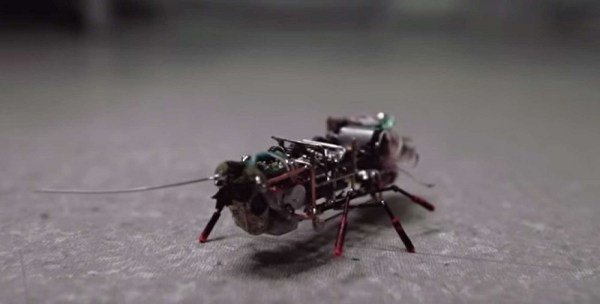
It’s name is Blaberus Cranifer, or Death’s Head for short. Light has now been shed on this once secret project built by the Immanuel Kant Baltic Federal University for a “vague” Russian organization. The little guy has a 20 minute battery life and can carry a 10 gram payload. Which comes in handy when you want to sneak a camera into hard to reach places. Other requirements were for it to look and behave like a real live insect.

It’s an impressive project considering it was built from scratch in only seven months time. Its intricate gears and other mechanical features would require the hands of a skilled watch maker to construct. Alternatively, one can control live insects such as controlling a roach’s brain or hooking up some radio controls to a live beetle. But building robotic insects is still pretty cool.

Be sure to check out the well made video detailing some of the project’s build process.

Continue reading “Robotic Cockroach Built By Russian University”