Ask Hackaday: I Love The Smell Of Burnt Hair In The Morning

At the end of the 19th century, [King Camp Gillette] had the idea of creating a disposable razor blade that didn’t need sharpening. There was one problem with this idea: metallurgy was not yet advanced enough to produce paper-thin carbon steel blades and sharpen them for a close shave. In 1901, [William Nickerson] solved this problem, and the age of disposable razors began.

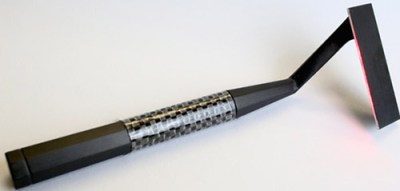
The Skarp laser razor. Source
The Skarp laser razor

This Kickstarter would have you believe there is a new era of beard technology dawning. It’s a laser razor called Skarp, and it’s on track to become one of the most funded Kickstarters of all time. The only problem? Even with relatively good documentation on the Kickstarter campaign, a demo video, a patent, and an expert in the field of cosmetic lasers, only the creators can figure out how it works.

Instead of using technology that has been tried and tested for thousands of years, the Skarp uses a laser to shave hairs off, right at the surface of the skin. You need only look at a billboard for laser hair removal to realize this is possible, but building a laser razor is something that has eluded us for decades. This patent from 1986 at the very least demonstrates the beginnings of the idea – put a laser beam in a handheld package and plunge it into a beard. This patent from 2005 uses fiber optics to send a laser beam to a handheld razor. Like anything out of the sci-fi genre, a laser razor is a well-tread idea in the world of invention.

But Skarp thinks it has solved all of the problems which previously block lasers from finding a place in your medicine cabinet.

Continue reading “Ask Hackaday: I Love The Smell Of Burnt Hair In The Morning”

Neato Botvac LiDAR Repair Includes Juicy Pics And A Tool Hack

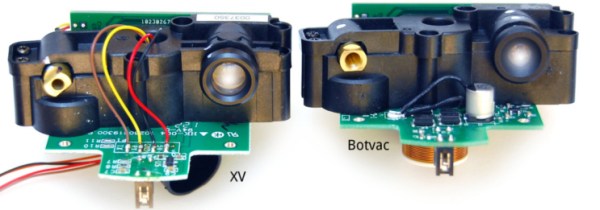
It seems second nature to us and it’s one of the ways we hackers are different from the larger population… sometimes we absolutely insist on buying something that is already broken. Which is where we join [Anton] as he reverse engineers, debugs, and repairs a broken Neato Botvac’s LiDAR system all in the name of having clean floors at a fraction of the cost.

Now keep your head on a swivel ’cause along the way [Anton] has the all-too familiar point in his repair where he puts the original project on hold while he makes a specialized tool he needs to finish the job. It’s hard to tell which is more impressive: turning a laptop webcam into a camera capable of clearly viewing bond wires and (wait for it!) where they are attached on the Silicon, or that he (yeah, we were making a comparison…member?) went straight back to solving the original problem. [Anton] did split this project into two separate blog posts, the first one is linked above and it’s not until the second post that he fixes the original problem. Perhaps there was a bit of scope creep, which was the reason for the separate blog entries? At any rate, [Anton] does a great job documenting the process along with what he calls some ‘juicy pictures’ and you can see a few of them after the break.

It’s been a while since we’ve seen a Neato hack (there’s pun in there somewhere, commenters below us will surely wipe the floor with it). LiDar on the other hand has been covered more recently in a Police LiDAR Tear Down and another post relating more directly to [Anton’s] repair.

Continue reading “Neato Botvac LiDAR Repair Includes Juicy Pics And A Tool Hack”

Sinterit Pulls SLS 3D Printer Entry Level Price Down To Just $8k

Almost exactly two years ago, news of a great revolution in 3D printing carried itself through blogs and tech columns. Patents were expiring, and soon the ‘squirting filament’ printers would be overtaken by a vastly better method: selective laser sintering. In the last two years, the market has been markedly silent on the possibilities of SLS technology, until now, at least. Today, Sinterit is launching their first printer. It’s an SLS printer that builds objects by fusing nylon powder with a laser, producing things with much better quality than filament-based printers.

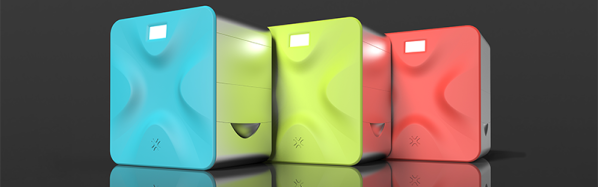
The Sinterit Lisa is a true laser sintering printer, able to create objects by blasting nylon powder with a 5W laser diode. Inside this box that’s about the same size as a laser printer is a CoreXY mechanism to move the laser diode around, heated pistons, cylinders, feed bed and print bed for keeping the print volume at the right temperature and the top layer perfectly flat. The layer thickness of the printer goes down to 0.06 mm, and the maximum print size is 13 x 17 x 13 cm. Material choice is, for now, limited to black PA12 nylon but other materials are being tested.

Continue reading “Sinterit Pulls SLS 3D Printer Entry Level Price Down To Just $8k”

CO2 Laser Decapping To Fix Soldering Mistake

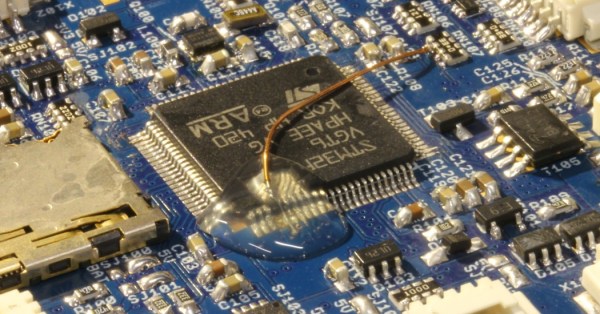
[Carsten] messed up. He was soldering an ARM CPU onto a quadcopter board in haste, failed to notice that the soldering iron was turned up to eleven, and pulled some of the traces up off the PCB. In the process of trying to fix that, he broke three pins off of the 100-pin CPU. The situation was going from bad to worse.

Instead of admitting defeat, or maybe reflowing the CPU off of the board, [Carsten] lasered the epoxy case off of the chip down to the lead frame and worked a little magic with some magnet wire. A sweet piece of work, to be sure!

Continue reading “CO2 Laser Decapping To Fix Soldering Mistake”

Fast ADC Uses Old School Scope Hack For 48 MSPS

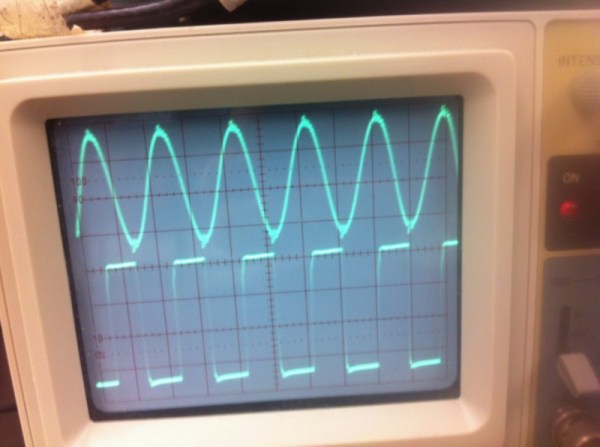
[Carlos] needed an ADC with a 50 nanosecond sample period for his laser lab, that’s 20Msps! (20 million samples a second). While in recent years, commodity ADCs reaching into the low GSPS have become available, integrated acquisition systems are still somewhat expensive. So [Carlos] decided to do what every good hacker does, and built his own solution. His project post pretty much just links to a whitepaper he wrote (PDF) so we’ll try and boil it down for you:

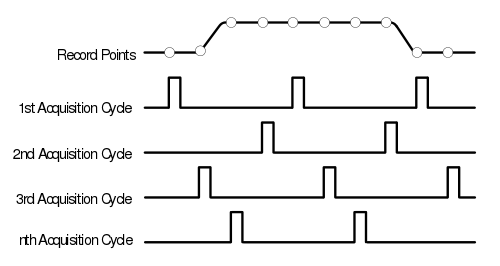
In order to simplify development [Carlos] borrowed a technique commonly used in the first era of digital oscilloscopes, Equivalent Sampling Time.

est

The figure to the right is from the TDS460 manual. While it may seem counter intuitive to those only familiar with modern scopes, the TDS460 achieved a 400MHz bandwidth using a 100MSPS ADC. In order to achieve this the scope acquires a single trace in multiple cycles, each time offsetting the acquisitions as shown and combining the result.

In this way, early digital scope developers could sidestep the limitations of the available ADCs to achieve a higher effective bandwidth. However there is of course one catch: the technique only works for periodic signals.

This was fine for [Carlos] who implemented a technique on a Cypress PSoC 4, which provides analog FPGA-like functionality. By offsetting the ADC trigger he has able to achieve an EST of 48MHz using a ADC sampling at 1MHz. If you want a little help getting into PSOC 4 yourself, check out the guide that [Bil Herd] made.

Neat hack [Carlos] and we hope to hear more about your laser lab in the future.

Optics Laboratory Made From LEGO

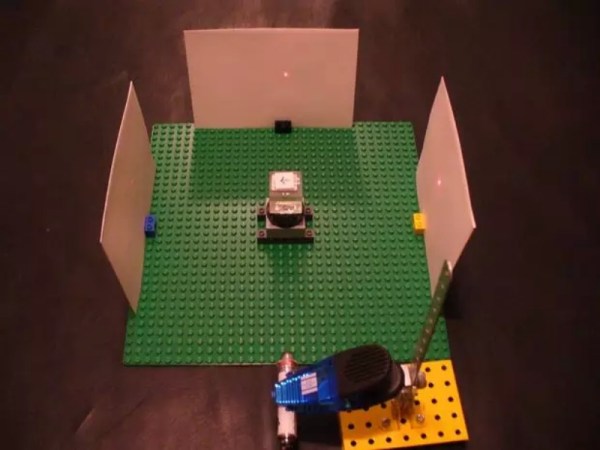
16A lot of engineers, scientists, builders, makers, and hackers got their start as children with LEGO. Putting those bricks together, whether following the instructions or not, really brings out the imagination. It’s not surprising that some people grow up and still use LEGO in their projects, like [Steve] who has used LEGO to build an optics lab with a laser beam splitter.

[Steve] started this project by salvaging parts from a broken computer projector. Some of the parts were scorched beyond repair, but he did find some lenses and mirrors and a mystery glass cube. It turns out that this cube is a dichroic prism which is used for combining images from the different LCD screens in the projector, but with the right LEGO bricks it can also be used for splitting a laser beam.

The cube was set on a LEGO rotating piece to demonstrate how it can split the laser at certain angles. LEGO purists might be upset at the Erector set that was snuck into this project, but this was necessary to hold up the laser pointer. This is a great use of these building blocks though, and [Steve] finally has his optics lab that he’s wanted to build for a while. If that doesn’t scratch your LEGO itch, we’ve also featured this LEGO lab which was built to measure the Planck constant.

Solar-Cell Laser Communication System

Forget the soup cans connected by a piece of string. There’s now a way to communicate wirelessly that doesn’t rely on a physical connection… or radio. It’s a communications platform that uses lasers to send data, and it’s done in a way that virtually anyone could build.

This method for sending information isn’t exactly new, but this project is one of the best we’ve seen that makes it doable for the average tinkerer. A standard microphone and audio amplifier are used to send the signals to the transmitter, which is just a typical garden-variety laser that anyone could find for a few dollars. A few LEDs prevent the laser from receiving too much power, and a solar cell at the receiving end decodes the message and outputs it through another amplifier and a speaker.

Of course you will need line-of-sight to get this communications system up and running, but as long as you have that taken care of the sky’s the limit. You can find incredibly powerful lasers lying around if you want to try to increase the communication distance, and there are surprisingly few restrictions on purchasing others that are 1W or higher. You could easily increase the range, but be careful not to set your receiving station (or any animals, plants, buildings, etc) on fire!

Continue reading “Solar-Cell Laser Communication System”