Chroma – Mesmerizing LED Driven Fractal Display

chroma in action

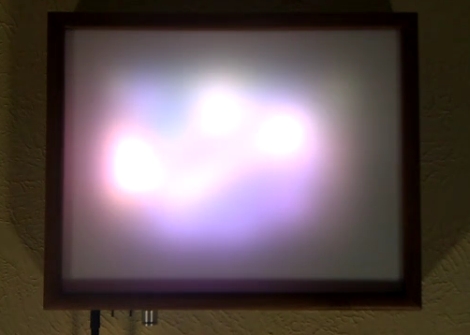
A big fan of generative art, [Andrew Magill] wanted to build an LED display for his wall that constantly displayed images from the Electric Sheep project.  After discounting the possibility of generating these fractals on the fly, he settled on using prerecorded video clips gathered over a year’s time by Electric Sheep users.  With thousands of video clips in hand, he wrote some custom software that enabled him to sequence these 5-second video clips into just over 6 hours of video, which he later downsampled to fit his 24×16 pixel display.

Now that he had some impressive video put together, [Andrew] began designing the LED panels he would use to show off his creation.  After choosing TI TLC5947 drivers to control the LED arrays, he got to work on designing the PCBs, soldering in all of the components, and testing the displays.  Initial testing completed, he wrote some more custom software to direct the individual LED boards from a master controller, and mounted everything in a frosted-glass adorned picture frame.

Be sure to check out mesmerizing video of Chroma in action after the break.

Continue reading “Chroma – Mesmerizing LED Driven Fractal Display” →
A Charlieplex Display And A Board Layout Tip

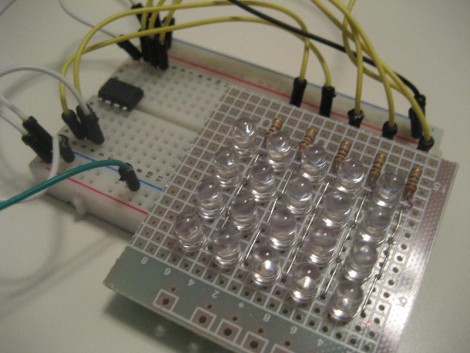
[Ben] is getting himself up to speed with microcontrollers. He jumped into the deep end by taking on this Charlieplex LED matrix build. As you can see after the break, he not only made the display work, but coded Conway’s game of life to run on the ATtiny85 that drives the device. What you see above is the prototype version that [Ben] used to make sure he had the hardware just right. He’s seeing the project through to a manufactured board and this is where the layout tip comes from. In order to make sure he had enough space for all of his components he printed out the board artwork, taped it to some Styrofoam, and then inserted all of the through-hole parts. Now he can be sure that physically the design works, we’ll keep our fingers crossed that everything is also kosher electrically.

Continue reading “A Charlieplex Display And A Board Layout Tip” →

More 555 Projects To Enjoy

We love all of the projects that are coming out for the 555 design contest, so we thought we would share a couple more that have caught our collective eye.  Have a 555 project of your own? Be sure to share it with us, and keep an eye out for the contest submission dates. Read on for a few of our project picks.

Continue reading “More 555 Projects To Enjoy” →

8×8 LED Infinity Mirror

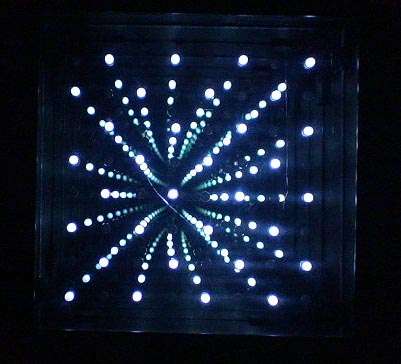
[chromationsystems] put out a couple instructibles on building infinity mirrors. One with an 8×8 array of LEDs and one with a 32 LED ring. These are very well  documented covering the construction of the mirror enclosure as well as the circuit and code. The effect is quite nice. The 8×8 array is interesting, we haven’t seen that before. These would make a fine addition to any geek cave/electronics lab. While it looks like these were basically advertisements for a product he sells, you can definitely make your own from his instructions. We like this kind of advertising.

Triggering A DSLR Shutter With An Audio Clip

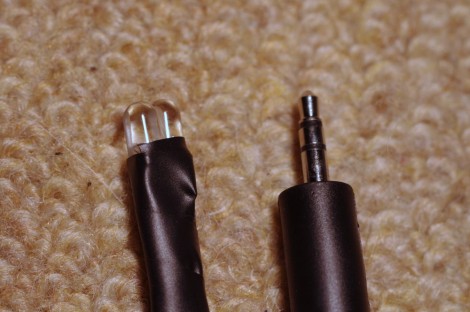
Apparently Pentax DSLR cameras have a remote shutter option that used infrared signals. [Pies for you] gathered up several different hacks and built a method of triggering the camera using custom audio. He put together the dongle above, just a headphone extension cord and two IR LEDs, which plugs into the headphone jack of any audio device like an iPod or an Android phone. When you play back a file the audio signals drive the IR LEDs. This is completely worthless unless you craft your own audio file using the correct frequency, duty cycle, and bit encoding. [Pies for you] did just that and got things up and running. Looks like the system doesn’t do so well with MP3 compression, but take a look at the waveform analysis that he posted and then make sure you’re using a lossless format.

See-through LED Display

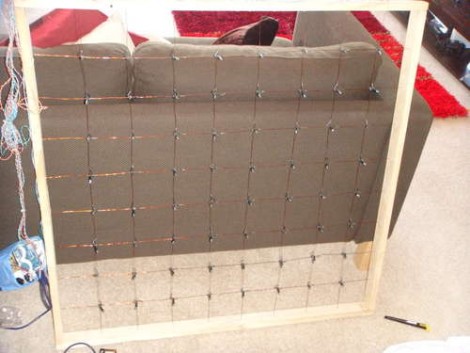
[Ndsit] is having a party and wanted to liven up the place with some blinky lights. He’s a bit new when it comes to hobby electronics, and although we’d highly recommend inviting some resistors to participate, the LED matrix that he built is very nice. It’s 8×8, it’s big, and (as shown in the clip after the break) the lights seem to hover in midair. That’s because he didn’t use a substrate to make the display. A grid of enameled wire is strung between the four sides of the wooden frame. LEDs were gathered from a string of Christmas lights which means they’re in a holder and have insulated wires already connected. Each one was tied on at a junction point of the grid, then connected to a portion of the wire where enamel had been scraped off.

It works but there’s already one light that is out. We hope some current protection is added so that this can be used again and again.

Continue reading “See-through LED Display” →

Out Engineering A Sneaky Cat

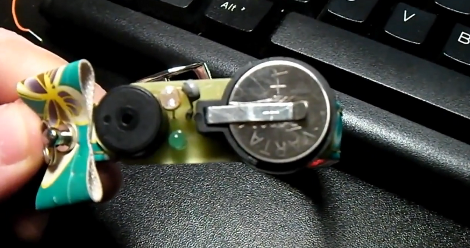
Cats do what they want, which rarely coincides with what their owner wants them to do. In [Dumitru]’s case, his girlfriend’s cat [Pufu] tended to make it outside into the cold more often than desired. Rather than settle with the normal bell which gets obnoxious even when the cat isn’t misbehaving, he decided to put together a custom Cat Finding collar. He used a PIC microcontroller as the brains, and temperature and light sensors to decide whether the cat had snuck into the cold, dark night. Once the cat has been marked as being outside, a buzzer and LED are set to go off at regular intervals until returned into the safety of the indoors.

[Dumitru]’s website along with his YouTube videos are in Romanian, though the schematics and source code provided speak for themselves. He does a wonderful job walking through the entire design process, including time spend in the IDE as well as EAGLE designing the board. YouTube has managed to subtitle the majority of the details, but we imagine this post will be a real treat to any Romanian speaking hobbyists out there. Be sure to catch both videos after the break.

Continue reading “Out Engineering A Sneaky Cat” →