You might be surprised at how many pop songs are exactly the same. Cat Scratch Fever is the exact same song as Smoke on the Water. Even one of Yeezy’s songs is strikingly similar to a weird 90s French electronic group. Musically, though, there are an incredible number of songs that follow a I-V-vi-IV progression. Let it Be is one of them, as is Beast of Burden. Lady Gaga’s Poker Face is another. Now, finally, we have automated most of the pop songs you know and love. [Sven] has created a small MIDI device that only plays a I-V-vi-IV progression, and it’s everything you could ever imagine.
The idea for this build comes from an Axis of Awesome routine demonstrating the fact that hundreds of pop songs follow the same progression. After the idea, the implementation, like the music all those millennials are listening to, is simple.
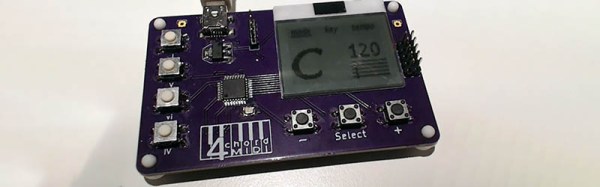
The 4chord MIDI is a small board with an old Nokia display, buttons, a single USB port, and an ATMega328 microcontroller. Using MIDI over USB, it plays the I-V-vi-IV progression in any key. It plays in chord mode, arpeggiated mode, or mixed mode at any sensible tempo.
You can check out a video of the 4chord playing several hundred songs simultaneously below.