Simple Clock Uses RTC Chip And Character Display

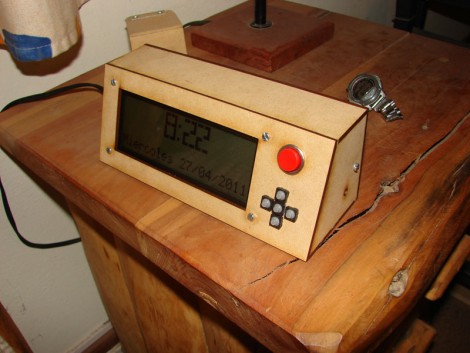
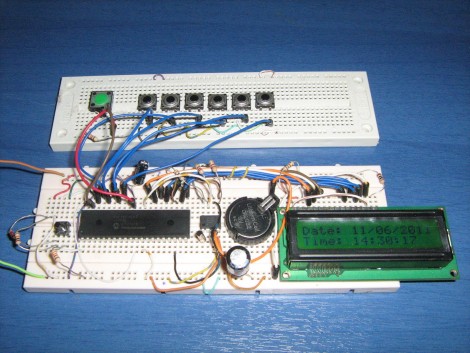
[Giorgos Lazaridis] just finished building a simple clock on a breadboard. It uses a common real time clock chip, the DS1307. This is less expensive that its full-featured older brother, the DS3232. The difference between the two is that the 1307 requires an external 32.768 kHz crystal and it is not temperature compensated. This means it will not be quite as accurate over the long-haul (it may wander as much as one minute per month), but it still blows the accuracy of using a microcontroller as an RTC out of the water and includes a backup battery which will keep time when the rest of the circuit is switched off.

This design uses a PIC 16F1937 to display the time and date on a 16×2 character LCD screen. Six buttons are dedicated to incrementing one specific chunk of data (ie: one button changes the year, another the day, etc.). A seventh button can be held down when using the other six in order to decrement the setting. We’re always interested in how the button code is written. [Giorgos] did share his code, but he wrote it in assembly so it’s of little use to us as we tend to stick to C code.

See the walk through video after the break.

Continue reading “Simple Clock Uses RTC Chip And Character Display”
Washing Machine Mechanical Timer Replaced With Microcontroller

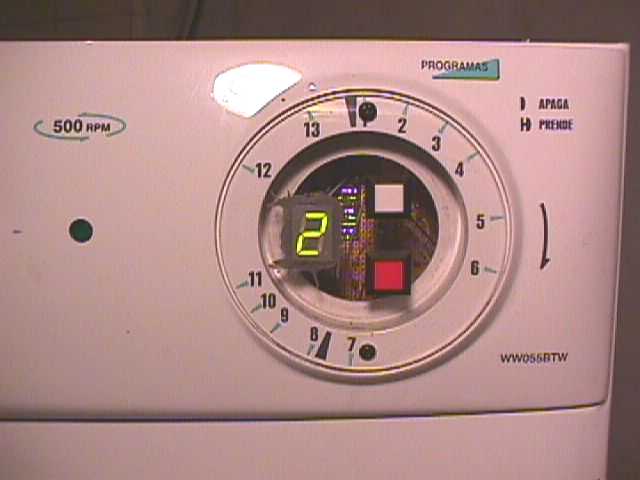
After the electromechanical timer on [Paul Canello’s] washing machine broke for the third time he decided he needed to stop repairing it and find a more permanent fix. He decided to build his own microcontroller-based system for washing his clothes (translated). Caution: The image links on [Paul’s] page seem to be broken and will unleash a never-ending storm of empty pop-up windows if you click on them. We’ve embedded all of the images after the break to save you some hassle.

The controller on a washing machine is nothing more than a mechanical alarm clock. It starts the cycle, then moves through various modes based on the passage of time. [Paul] started his hack by observing how long the delay between cycles was meant to be, and recording which parts of the machine were switched on and off at each stage.

It turns out that when the mechanical knob is turned, it reroutes how water flows through the detergent chamber. Since that knob won’t be in the new system [Paul] came up with a way for the microcontroller to handle this by using a servo motor. The rest of the control involves relays to control the motor, and solenoid valves for the water. There are also pressure switches that give feedback for the level of the water in the machine. A PIC 16F872 serves as the new controller, with the help of a 7 segment display, a buzzer, and a pair of buttons as the user interface.

This is an older project, but after reading about the Arduino controlled dishwasher [Ramiro] sent us a link. Thanks! Continue reading “Washing Machine Mechanical Timer Replaced With Microcontroller”

ChipKIT Uno32: First Impressions And Benchmarks

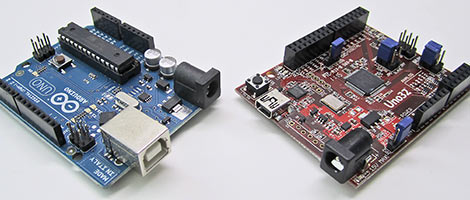
Following Maker Faire, we’ve had a few days to poke around with Digilent’s 32-bit Arduino-compatible chipKIT boards and compiler. We have some initial performance figures to report, along with impressions of the hardware and software.

Continue reading “ChipKIT Uno32: First Impressions And Benchmarks”

Great Junk-yard Find Leads To A Reclaimed Control Panel Project

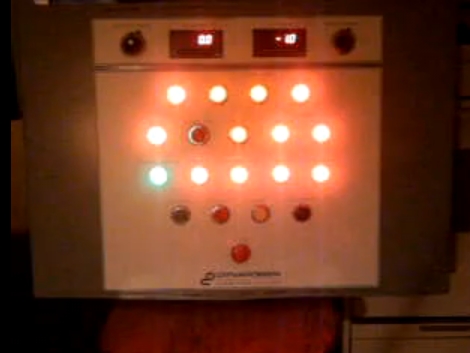
Having the “can you believe somebody threw this away?” mentality has gotten us into some trouble through the years, but look what [Joshua] found at the scrap yard! It’s a door from a power conversion station and it contains fourteen indicator lights and a lot of other doodads. But since this is just the door, he needed a way to monitor the controls and drive the indicators. At the heart of the hack he used to get this up and running is a PIC 18F2550. It has no trouble driving the indicators thanks to a pair of ULN2803 darlington arrays which switch the higher 24 volt levels.

His writeup doesn’t mention the method used, but the panel also has a couple of meters at the top. In the video after the break you can clearly see that he’s got them both working. We’d bet there’s a plan for each of the buttons as well, since this will be prominently featured in their alien-invasion themed Halloween display this year.

Continue reading “Great Junk-yard Find Leads To A Reclaimed Control Panel Project”

BAMF2011: ChipKIT Is Arduino To The Power Of 32

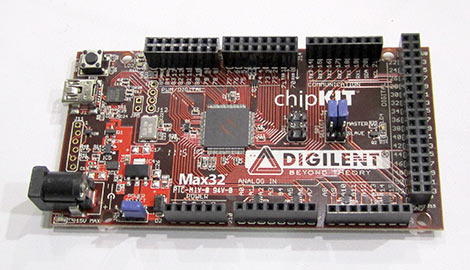
If you’ve been hungry for more power for your microcontroller projects, but reluctant to dump your investment in Arduino shields or the libraries and community knowledge that go with them all, Digilent has you covered. Their new chipKIT boards are built around the Microchip PIC32 MCU…a powerful 32-bit chip that until recently was left out of the cross-platform scene. A majority of code and quite a number of Arduino shields will work “out of the box” with the chipKIT, and the familiar development tools are available for all three major operating systems: Windows, Mac and Linux.

We first mentioned these a couple weeks ago, but the software was unavailable at the time. Seeing the development tools in action was quite unexpected…

Continue reading “BAMF2011: ChipKIT Is Arduino To The Power Of 32”

A Computer-controlled Shutter For Polaroid Packfilm Cameras

[Georg] wanted to modify his old Polaroid land camera so he could have control over the exposure time. The resulting project is a neat hack, if we say so ourselves.

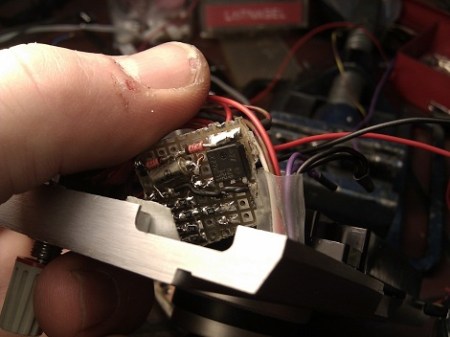
The stock electronics in Polaroid 100-series Packfilm cameras were a simple analog computer that integrates current through a light-sensitive resistor. This is a simple, low tech way to make sure the exposure time is correct. The usual mod would be to replace photoresistor with a potentiometer, but [Georg] had little success with this modification. After tearing the old hack out of the camera, [Georg] replaced the ancient electronics with a a PIC microcontroller, and is now able to control the shutter in increments down to 1/512th of a second.

Shutter timing is read by a PIC12F629 μC with a BCD encoder. [Georg] kept the shutter magnet setup, and also added a ‘BULB’ routine that holds the shutter open as long as the button is held down. The test photos are quite nice, even if from a 1960s Polaroid Land Camera. Check out the video of [Georg] running though the shutter settings after the break.

Continue reading “A Computer-controlled Shutter For Polaroid Packfilm Cameras”

An Alarm For Every Day Of The Week

If you don’t have a 9-to-5 type of job you might find yourself constantly resetting your alarm clock as your calendar commitments change. [Lucas] finally got fed up with the nightly ritual and decided to build his own alarm clock which has unique settings for each day of the week (translated).

The display itself is an LM044L 20×4 character display. This provides a viewing area that is about 3″x1″ and since it’s an HD44780 compliant LCD screen, writing data to it takes very little effort (and RAM) compared to a graphic LCD. A PIC 18F2550 drives the device, taking input from a half-dozen buttons, driving the display, and turning on the enclosed buzzer when it’s time to get up. There’s a backup battery which will keep the settings when power is lost. The daily alarms, current time, and back light brightness can all be adjusted from the four screens that make up the settings menus. The only thing that it’s missing is a precision timekeeper, but that should be easy to add either by measuring the frequency of the mains or by using an RTC chip.