How-to: Program PICs Using Linux

Arguably, Microchip’s PIC microcontrollers do not get enough posts here. One of the drawbacks for some of us is that Linux support for PICs is not very well known. The information is out there, but no one has laid out the process of going from writing C code to programming a chip. Written for Linux users that are familiar with microcontrollers, basic circuits, the C programming language, and can read a datasheet, this how-to should get you up and programming a PIC quickly with Linux.

Continue reading “How-to: Program PICs Using Linux”

PC Game Controller With A Touch Of Class

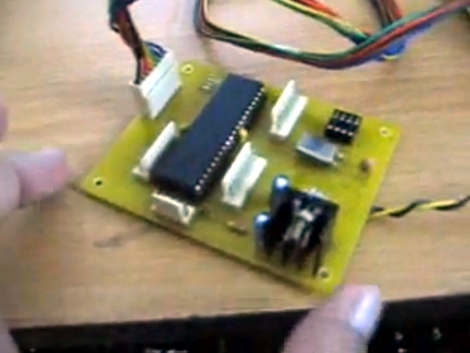
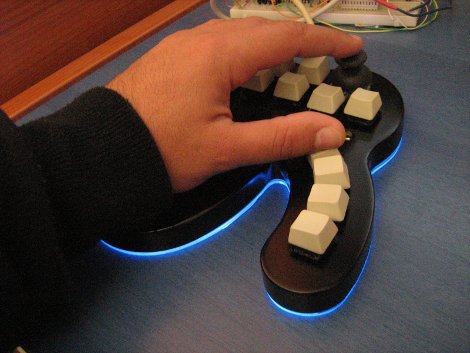
The above is a specially designed game controller made by [Giorgos] solely for the RTS game Men Of War (now that’s dedication to a game). [Giorgos] started off with a rough breadboard and 11 buttons. Slowly overtime he included a joystick, countdown timers, and the wonderfully lit case. Under the hood is a couple of PIC microcontrollers multiplexing the switches, LEDs, timers, and also interfacing with the computer via how is it not dead yet PS/2 port. The build log is a very detailed read and well worth it, even if you’re not planning on making a custom controller. [Ben Heck] better watch out, there is a new controller making enthusiast on the loose.

Lightsaber Color Selector

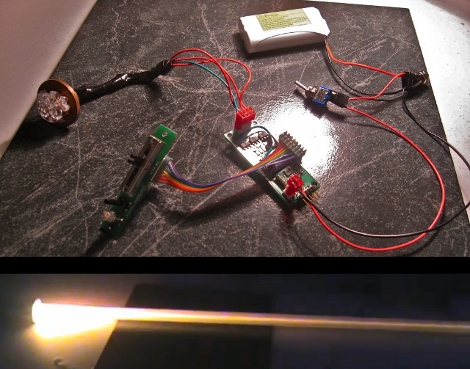
[George Hadley] developed a nice setup to control the color of a replica Lightsaber. A small PCB houses a PIC 18F2221 and three switching transistors for the colors. A powerful LED resides in the tip of the handle, lighting up the diffuser that makes up the blade. But our favorite part is the control scheme. He’s embedded a small RGB LED in the handle, giving feedback as to which color of light can currently be adjusted (red, green, or blue). One button scrolls through the colors and a slide potentiometer adjusts that them.

We wouldn’t go as far as calling this a Halloween prop, we think it’s better suited for serious replica builds. But it would make an amazing addition to the little one’s costume. See it in action after the break.

Continue reading “Lightsaber Color Selector”

Halloween Props: Dancing Spider

[Isaac] grabbed the motor from an old printer and used it to make a spider run up and down the wall for Halloween. A PIC 12F683 uses a MOSFET to drive the motor. The program loop has a little bit of dramatic flare to it, raising the arachnid with a bit of a jerky motion to give it some life, then wait for a time before quietly lowering the spider (hopefully onto an unsuspecting party-goer).  The driver board is set up for two motors, making it easy to reuse in future projects. This is quite effective, and the only addition we might suggest is to add a couple of red LEDs as some glowing eyes.

Take a look at the finished product after the break.

Continue reading “Halloween Props: Dancing Spider”

PIC Programmable Power Supply

This programmable power supply is the perfect addition to your bench tools. [Debraj Deb], who previously built a whole house power monitor, designed this build around a PIC 18F4520 microcontroller. The desired voltage is set with an attached keypad, resulting in a digital output on the 8-bits of port D. The port connects to another protoboard with an R-2R digital-to-analog converter resulting in the target voltage. A set of transistors amplifies the current and a power transistor then takes care of the final output. After the break you’ll find two videos, the first walks us through the hardware and the second demonstrates the device in action, along with measurements of its performance. This certainly provides a lot more functionality than an ATX power-supply conversion.

Update: A big thanks to [Debraj] who sent us a code package as well as the schematic (PDF) used during testing. We’re having trouble getting the code package up for download right now. Check back later, hopefully we’ll have it up soon.

Continue reading “PIC Programmable Power Supply”

IR Receiver As USB Keyboard

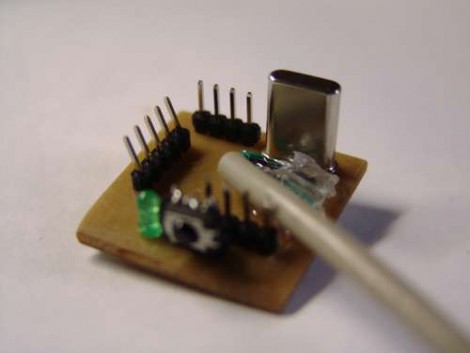
[Arthur] built an IR receiver to use with XBMC. Because it’s software specific he identifies the device on USB as a keyboard, and passes the IR commands as keystrokes used by the popular media platform.

Normally, homebrew IR receivers would use LIRC, the Linux Infrared Remote Control software. But this method doesn’t require you to have that running. In fact, it doesn’t need any setup on the PC end of things. Any remote that uses the Sony SIRC protocol will work off the bat.

[Arthur] chose a PIC 18f2550 for the project. It is a popular microcontroller because it has built-in USB handling. We’re a bit skeptical of the hardware design though. We didn’t see specifically which IR receiver he’s using, but many require some type of filtering so check the suggested layout in the datasheet for your module.

PS3 Sixaxis Controller Now Houses Exploit

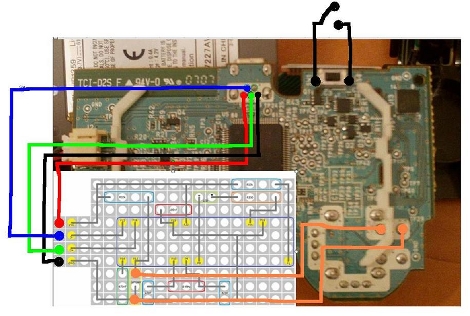
[Hasuky] posted a guide for turning a PlayStation 3 Sixaxis controller into a PSGroove exploit device (translated). Unfortunately you’ve got to crack open the controller and add some parts to get it working. The hack requires a PIC 18F2550 (a chip we’ve already seen used as a standalone PSGroove device), a crystal, and various resistors and capacitors to connect to the controller’s PCB. From there you connect the USB cable between the controller and the game console and boot using the exploit.

[Thanks Craig via DCEmu]