Go Portable With GameCube Advance SP

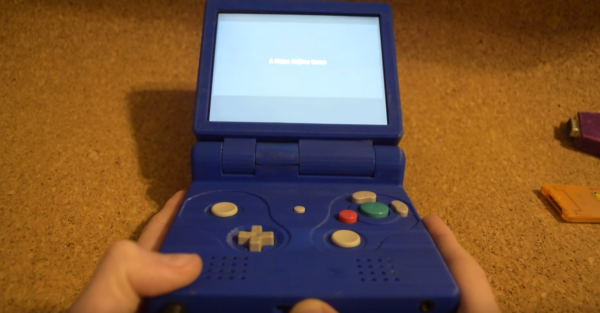
Off the hop, we love portable consoles. To be clear, we don’t just mean handhelds like the 3DS, or RetroPie builds, but when a maker takes a home console from generations past and hacks a childhood fantasy into reality — that’s amore. So, it’s only natural that [Bill Paxton]’s GameCube re-imagined as a Game Boy Advance SP has us enthralled.
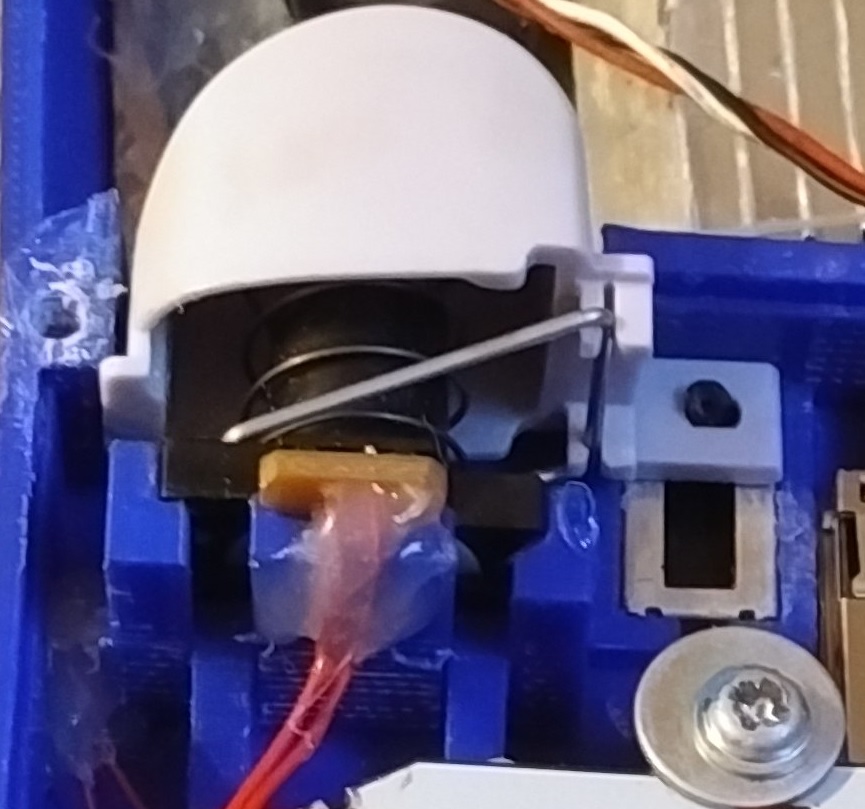
Originally inspired by an early 2000’s imagined mockup of a ‘next-gen’ Game Boy Advance, [Paxton] first tried to wedge a Wii disk drive into this build. Finding it a bit too unwieldy, he opted for running games off of SD cards using a WASP Fusion board instead. Integrating the controller buttons into the 3D printed case took several revisions. Looking at the precise modeling needed to include the L and R shoulder buttons, that is no small feat.

Sadly, this GameCube SP doesn’t have an on-board battery, so you can’t go walking about with Windwaker. It does, however, include a 15 pin mini-din VGA-style port to copy game saves to the internal memory card, a switching headphone jack, amp, and speakers. Check it out after the break!
Continue reading “Go Portable With GameCube Advance SP”

Portable Bluetooth Speaker Reacts To Sound

[IanMeyer123] should be working on his senior design project. Instead, he’s created a sound-reactive Bluetooth speaker that may not earn him an A grade but will at least keep the team entertained.

[Ian] started with the amp and power. The amp is a 15 watt, 12 volt model based on the popular TDA7297 chip. Power comes from a portable laptop battery rated at 185 Wh. [Ian] himself said that is absolute overkill for this project. While [Ian] hasn’t run any longevity tests on his setup, we’re guesstimating it would be rated in days.

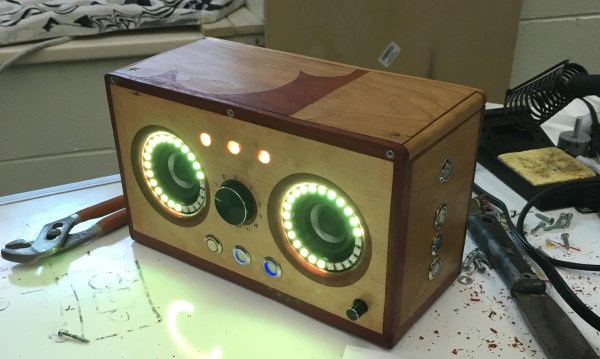
Every Bluetooth speaker needs a sweet light show, right? [Ian] wrapped his 2″ full range speakers in Neopixel rings from Adafriut. The WS2812’s are driven by an Arduino. When music is playing, MSGEQ7 allows the Arduino to play a light show in time to the beat. When the stereo is off, a DS3231 real-time clock module allows the Arduino to display the time on the two rings. If you’re curious about the code for this project, [Ian] posted it on his Reddit thread. Reddit isn’t exactly a great code repository, so please, [Ian] setup a GitHub account, and/or drop your project on Hackaday.io!

[Ian] didn’t realize how many wires would be flying around inside the speaker. That may be why the wiring looks a bit scary. All the chaos is hidden away, underneath a well-built wooden case.

If you want to see another take on a Bluetooth speaker with a Neopixel display, check [Peter’s] project here. Interested in more portable power units? This one’s for you!

Continue reading “Portable Bluetooth Speaker Reacts To Sound”

Portable RetroPie Suitcase For Multiplayer On The Go!

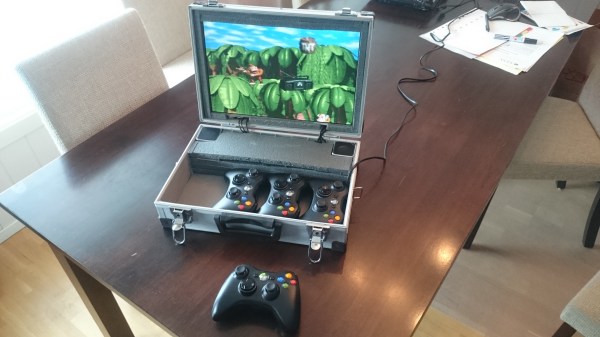
Portable gaming — and gaming in general —  has come a long way since the days of the original Game Boy. With a mind towards portable multiplayer games, Redditor [dagcon] has assembled a RetroPie inside a suitcase — screen and all!

This portable console has almost everything you could need. Four controllers are nestled beside two speakers. Much of the power cabling is separated and contained by  foam inserts. The screen fits snugly into the lid with a sheet of rubber foam to protect it during transport.

Tucked behind the monitor rests the brains of this suitcase console: a Raspberry Pi and the associated boards. [Dagcon] resorted to using a dedicated sound card for the speakers, diverting the output from the HDMI port. An LCD screen controller was also necessary as the screen had been re-purposed from its previous life as a laptop screen. [Dagcon] offers some tips on how to go about accomplishing this yourself and a helpful Instructables link.

Continue reading “Portable RetroPie Suitcase For Multiplayer On The Go!”

Portable RetroPie Builds On The Shoulders Of Giants

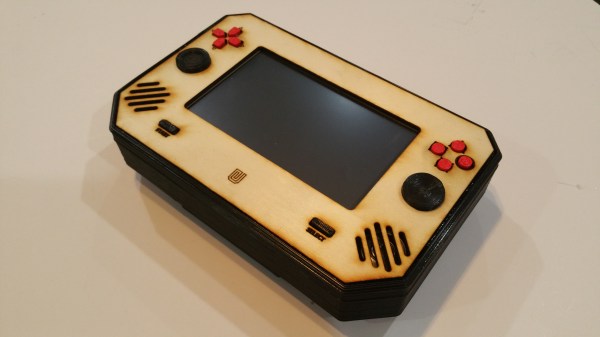
For anyone wanting to get that shot of nostalgia without the hassle of finding an NES Classic, the Retropie project is a great starting point. Of course, it’s not too noteworthy to grab a Raspberry Pi, throw a pre-built distribution on it, and plug in an SNES to USB converter. What is noteworthy, however, is building a Retropie that’s portable and that has the quality and polish of the latest build from [fancymenofcornwood].

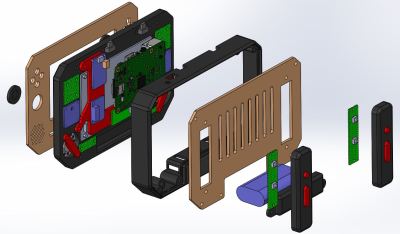
render-blowup-of-retropieFor starters, the laser cut wood case was custom-made. From there, all of the PCBs were fitted including specific ones to handle each set of buttons (complete sets of D-pads, shoulder buttons, and joysticks) and another for the 5″ HDMI screen. It has stereo speakers and its own headphone jack (to the envy of all new iPhone owners), and is powered from a Raspberry Pi 2 running Retropie 4.1. The battery pack shouldn’t leave you stranded, either, especially not if you grew up playing the Sega Game Gear.

The quality of the build here is outstanding, and its creator made a design choice to make it easily replicable, so if you’ve wanted to play N64 or PS1 games while on the go, this might be what you’ve been waiting for. There are lots of other options for getting some fun from a Retropie going though, from building one into a coffee table to re-purposing that infamous Game Gear.

Obligatory clip of this portable playing Doom is found after the break.

Continue reading “Portable RetroPie Builds On The Shoulders Of Giants”

Battery Powered Fog Machine Just In Time For Halloween

[makendo] needed a portable fog machine for an upcoming project. It seemed like the kind of a thing a liberal application of money on the Internet could fix in no time. But quality fog machines are too expensive, and the cheap machines are just, well, cheap. Stuck between $800 and quickly broken crap, he decided instead to fashion his own.

Fortunately for him, a recent fad has made it so that a certain segment of the populace absolutely require dramatic clouds of scented drug fog or they get cranky. The market saw an opportunity, cost optimized, and now there are many portable fog machines just waiting to be born in the form of an e-cigarette. However, an e-cigarette needs interaction from a person’s lungs to provide an annoying cloud. So he modeled up a 3D printable case that would blow air into the intake of the e-cigarette. Instead of filling a person’s lungs with a cloud of eye drops and nicotine, it would let out a steady stream of fog.

This device does burn through emitters, because the e-cigarette was not designed for this kind of heavy duty. Even reading the Amazon comments for the $800 dollar version, this is fairly normal for these things. So now [makendo] is able to produce a nice cloud of smoke whenever he needs and it only set him back around $40 US dollars.

Portable Lightweight Foundry

[Makercise] is getting ready for Maker Faire. One of the things he’d really like to do is some casting demonstrations. However, he has no desire to take his expensive and heavy electric kiln based foundry to Maker Faire. So, he made his own.

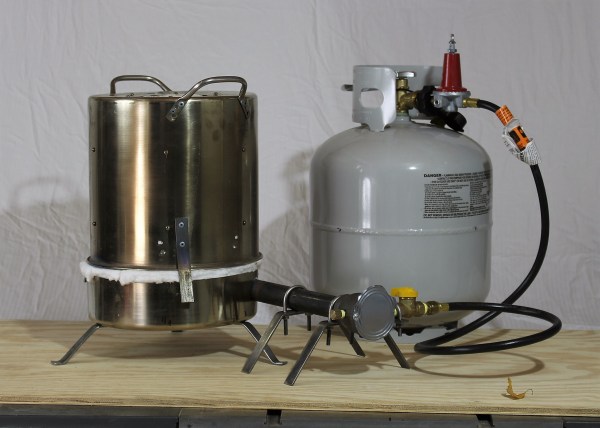
He got into metal casting during his excellent work on his Gingery lathe series. He started off by modeling his plan in Fusion 360. He’d use a 16qt cook pot turned upside down as the body for his foundry. The top would be lined with ceramic fiber insulation and the lid made out of foundry cement. He uses a Reil style burner, which he also modeled as an exercise. This design is light and even better, allows him to lift the top of foundry off, leaving the crucible completely exposed for easy removal.

All went well with the first iteration. He moved the handles from the top to the bottom of the pot and filled it with insulation. He built legs for the lid and made a nice refractory cement bowl on the bottom. However, when he fired it up the bowl completely cracked along with his crucible. The bowl from design flaw, the crucible from age.

A bit put off, but determined to continue, he moved forward in a different direction. The ceramic insulation was doing so well for the top of the foundry that he decided to get rid of the cement altogether and line the bottom with it as well. The lid, however, would be pretty bad for this, so he purchased another pot and cut the top portion of it off, giving him a steel bowl that matched the top.

The foundry fires up and has worked well through multiple pours. He made some interesting objects to hopefully sell at Makerfaire and to test the demonstrations he has planned. The final foundry weighs in at a mere 15lbs not including the fuel cylinder, which is pretty dang light. Video after the break.

Continue reading “Portable Lightweight Foundry”

Portable Workbench Crams An Entire Workspace Into One Box

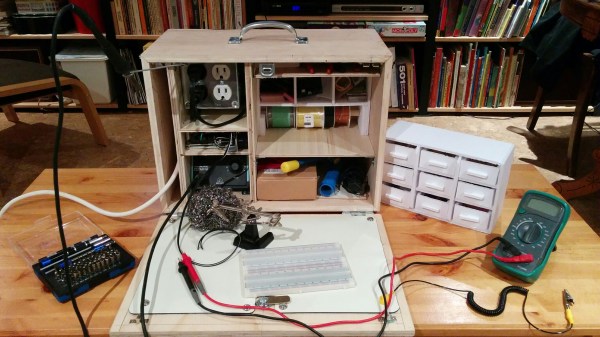
Making on the go is sometimes required in today’s busy lives, and if you find yourself traveling — say, off to university like [ZSNRA] — then a convenient solution is required. To that end, a portable electronics workbench was built in the shape of a relatively nondescript plywood box.

Plywood and foam-core are the main materials used in building this maker’s bug-out box, with two fir runners along the bottom so the case is not resting on the hinges. Inside, [ZSNRA] has packed a staggering amount of hardware which results in an 11kg suitcase.

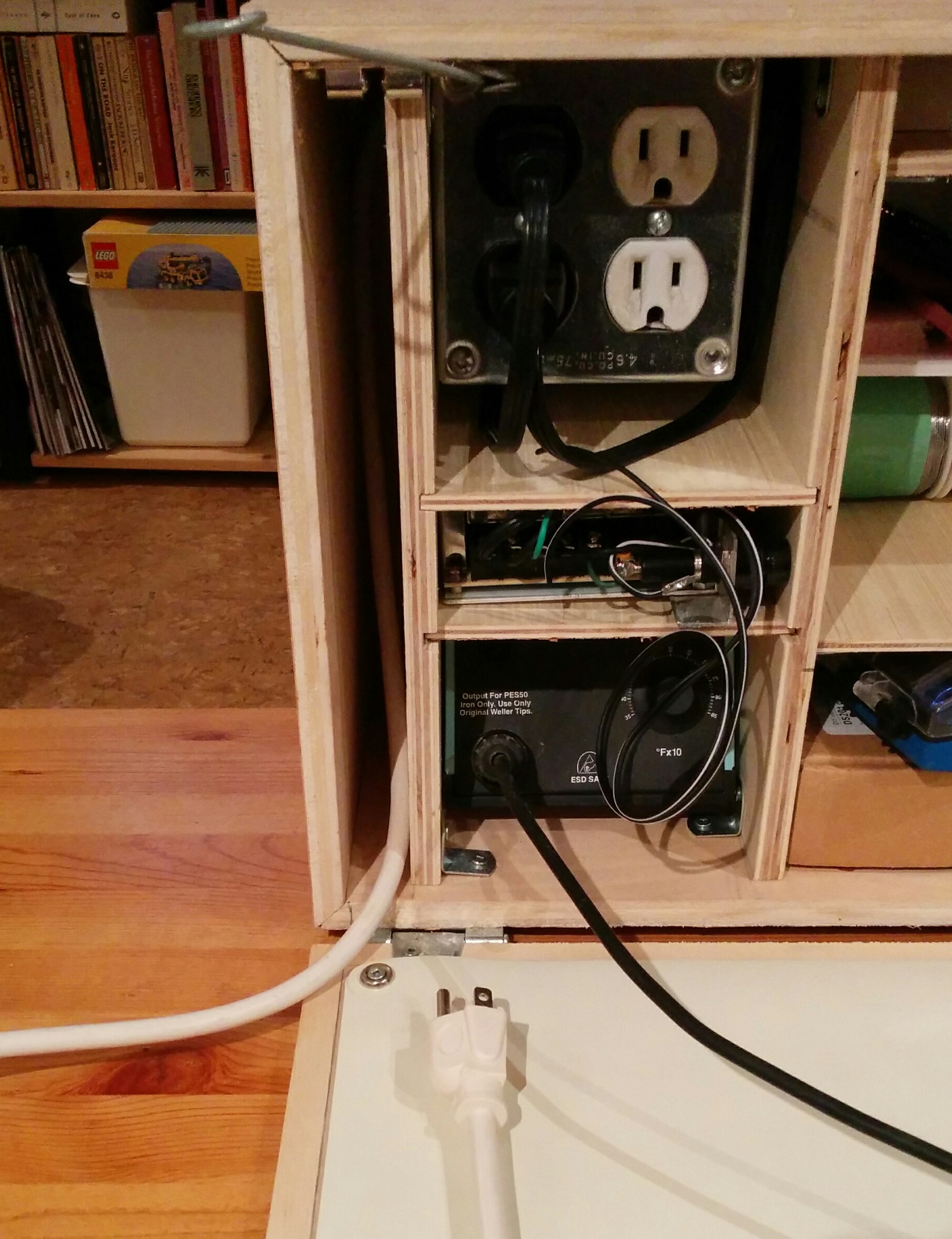
Power StackHere goes — deep breath now: wires, solder, resistors, transistors, capacitors, diodes, clips, switches, logic chips, non-logic chips, an Arduino, ATmegas, fuses, pliers, wire strippers and cutters, angle cutters, tweezers, a 66-piece screwdriver set, a desoldering pump, 12 needle files, a hacksaw blade, a multi meter, oscilloscope, power source, four outlets built into the case(!), steel wool, a third hand, a soldering station, two handbooks, and a breadboard.

Whew.


The work surface is an ESD mat on the inside of the case’s front face that is comfortable enough to work with, though we are surprised that it doesn’t also fold out somehow to create an even larger work-space.

For an elegant — if slightly less mobile — workbench solution, check out The Tempel. Now if you’re looking for ideas on how and what to carry we still think [Kenji Larsen] has the ultimate hacking kit.

[Thanks for the tip, Zaphod! via /r/electronics]