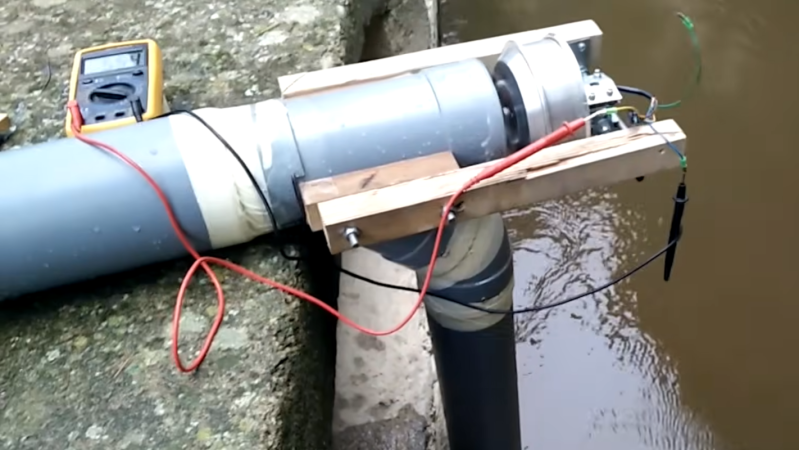
LoRa Repeater Lasts 5 Years On PVC Pipe And D Cells

Sometimes it makes sense to go with plain old batteries and off-the-shelf PVC pipe. That’s the thinking behind [Bertrand Selva]’s clever LoRaTube project.

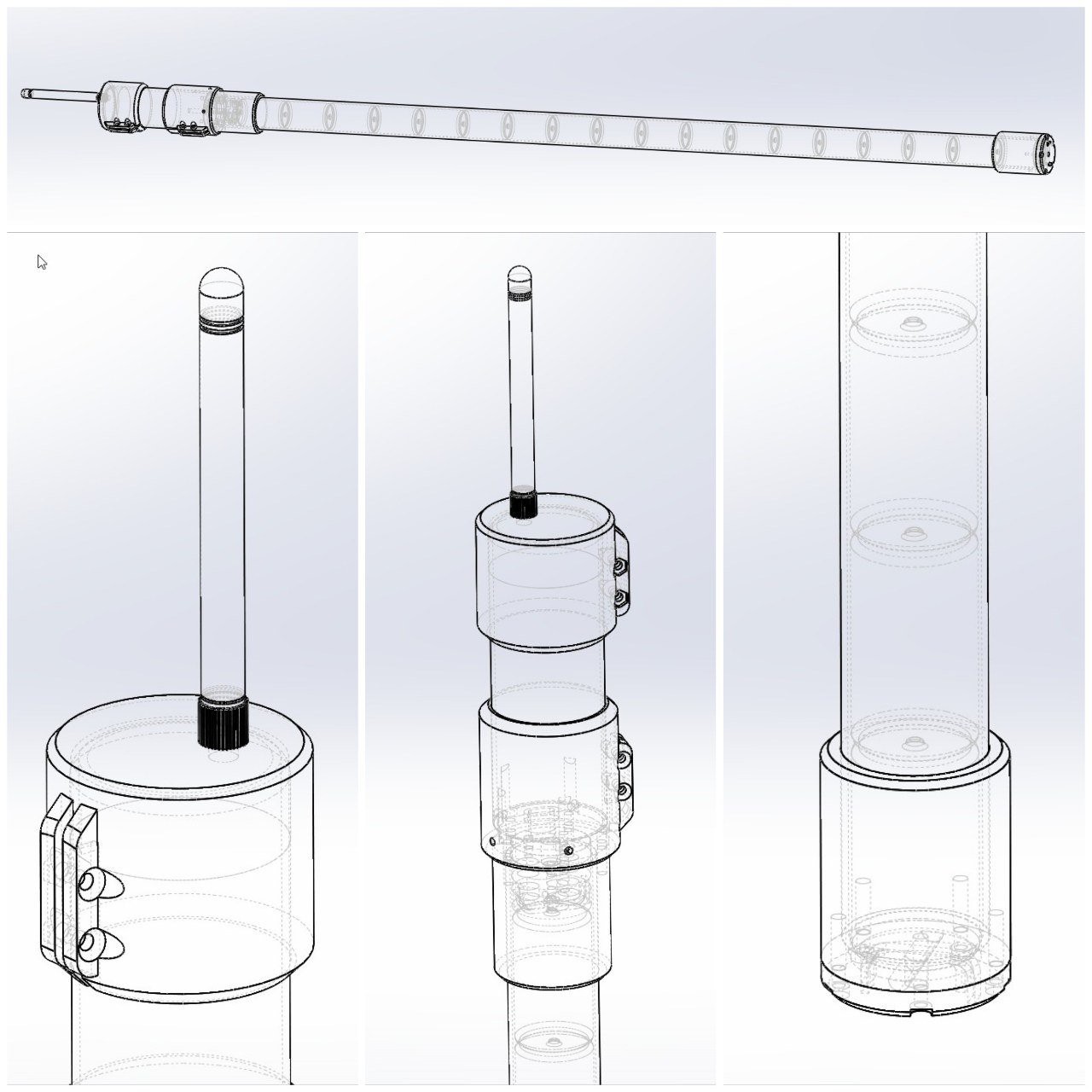
PVC pipe houses a self-contained LoRa repeater, complete with a big stack of D-size alkaline cells.

LoRa is a fantastic solution for long-range and low-power wireless communication (and popular, judging by the number of projects built around it) and LoRaTube provides an autonomous repeater, contained entirely in a length of PVC pipe. Out the top comes the antenna and inside is all the necessary hardware, along with a stack of good old D-sized alkaline cells feeding a supercap-buffered power supply of his own design. It’s weatherproof, inexpensive, self-contained, and thanks to extremely low standby current should last a good five years by [Bertrand]’s reckoning.

One can make a quick LoRa repeater in about an hour but while the core hardware can be inexpensive, supporting electronics and components (not to mention enclosure) for off-grid deployment can quickly add significant cost. Solar panels, charge controllers, and a rechargeable power supply also add potential points of failure. Sometimes it makes more sense to go cheap, simple, and rugged. Eighteen D-sized alkaline cells stacked in a PVC tube is as rugged as it is affordable, especially if one gets several years’ worth of operation out of it.

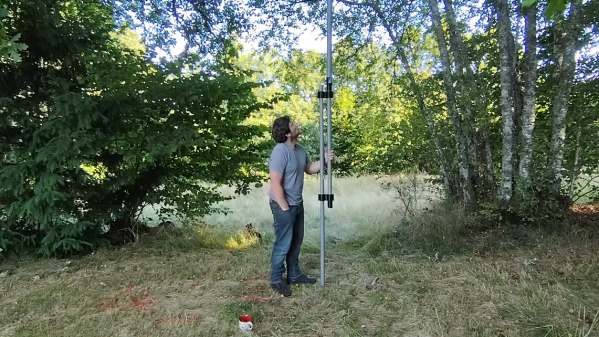
You can watch [Bertrand] raise a LoRaTube repeater and do a range test in the video (French), embedded below. Source code and CAD files are on the project page. Black outdoor helper cat not included.

Continue reading “LoRa Repeater Lasts 5 Years On PVC Pipe And D Cells”

PVC Pipe Structure Design That Skips Additional Hardware

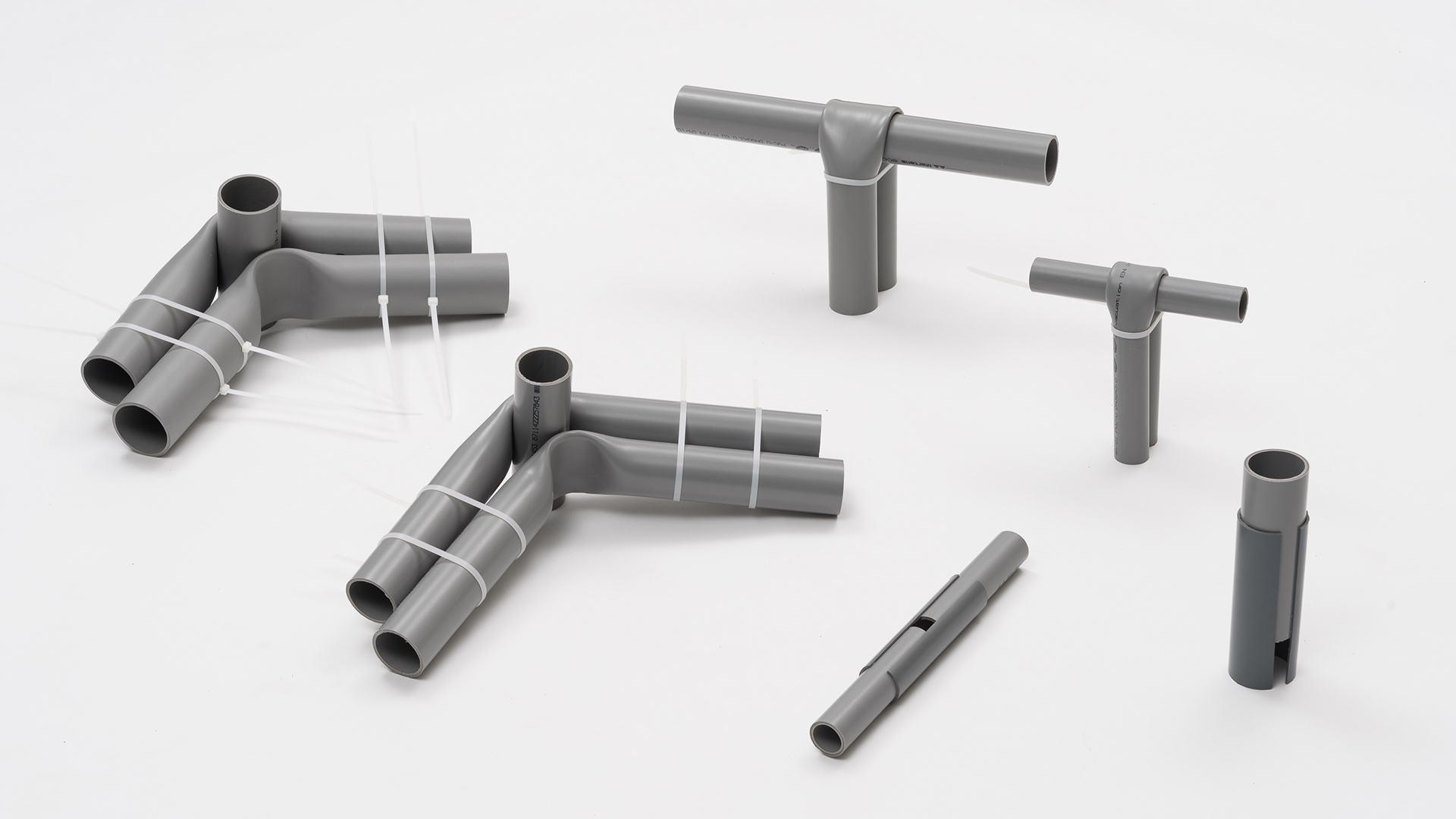
[Baptiste Marx] shares his take on designing emergency structures using PVC pipe in a way that requires an absolute minimum of added parts. CINTRE (French, English coverage article here) is his collection of joint designs, with examples of how they can be worked into a variety of structures.

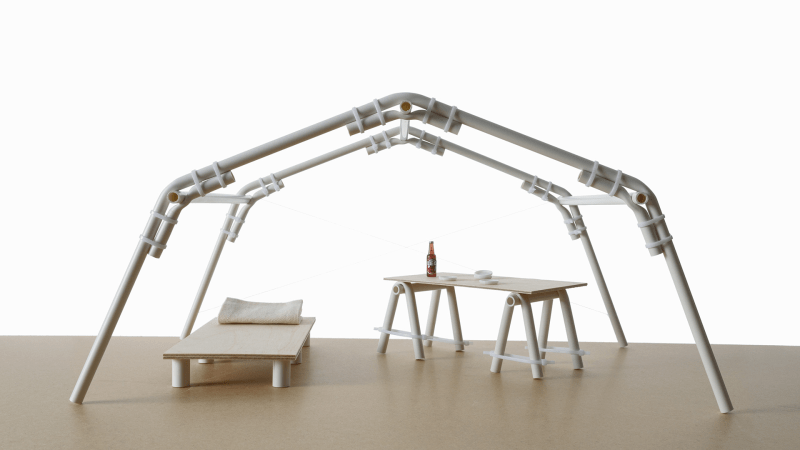
Basic joints have many different applications.

PVC pipe is inexpensive, widely available, and can often be salvaged in useful quantities even in disaster areas because of its wide use in plumbing and as conduits in construction. It can be cut with simple tools, and once softened with heat, it can be re-formed easily.

What is really clever about [Baptiste]’s designs is that there is little need for external fasteners or hardware. Cable ties are all that’s required to provide the structural element of many things. Two sawhorse-like assemblies, combined with a flat surface, make up a table, for example.

Continue reading “PVC Pipe Structure Design That Skips Additional Hardware”

All-Sky Camera Checks For Aurora

The aurora borealis (and its southern equivalent, the aurora australis) is a fleeting and somewhat rare phenomenon that produces vivid curtains of color in the sky at extreme latitudes. It’s a common tourist activity to travel to areas where the aurora is more prevalent in order to catch a glimpse of it. The best opportunities are in the winter though, and since most people don’t want to spend hours outside on a cold night night in high latitudes, an all-sky camera like this one from [Frank] can help notify its users when an aurora is happening.

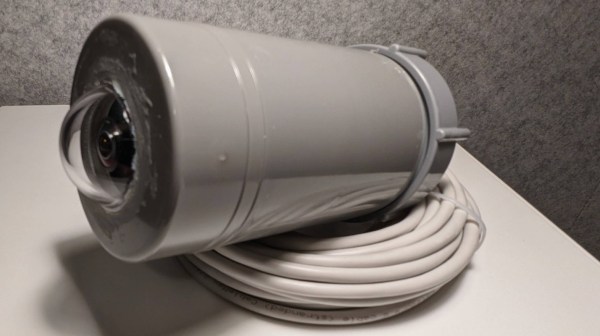
Because of the extreme temperatures involved, this is a little more involved than simply pointing a camera at the sky and hoping for the best. The enclosure and all electronics need to be able to withstand -50°C and operate at at least -30. For the enclosure, [Frank] is going with PVC tubing with a clear dome glued into a top fits to the end of the pipe, providing a water-resistant enclosure. A Raspberry Pi with a wide-angle lens camera sits on a 3D printed carriage so it can easily slide inside. The electronics use power-over-ethernet (PoE) rather than a battery due to the temperature extremes, which conveniently provides networking capabilities for viewing the images.

This is only part one of this build — in part two [Frank] is planning to build a system which can use this camera assembly to detect the aurora automatically and send out notifications when it sees it. Watching the night sky from the comfort of a warm house or sauna isn’t the only reason for putting an all-sky camera to use, either. They can also be used to observe meteors as they fall and then triangulate the position of the meteorites on the ground.

Building A Simple Compressed Air Cannon Is Easy

The world of warfare was revolutionized by the development of black powder, fireworks, cannons, and the like. You don’t need any of that chemical nonsense to just have fun, though, as this compressed air cannon from [OtisLiu153] demonstrates.

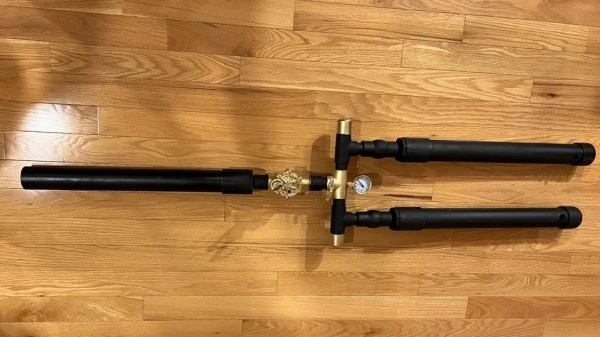
The build uses PVC pipes for both the barrel and the air tank. In the case of the latter, avoiding over-pressurization is key to avoiding injury, though some will say you should simply never build a PVC pipe pressure vessel at all. In this case, [OtisLiu153] strictly recommends 150 psi as a limit, which is nicely within the 280 PSI rating of the 2″ Schedule 40 PVC being used. Though, as they note, the connections in the design aren’t necessarily up to the same rating.

Off-the-shelf couplings are used to piece everything together, with the twin-reservoir design also acting as a useful shoulder mount. Charging the cannon is done via a Schrader valve, as you might find on a bike’s inner tube, and firing is achieved via a ball valve.

Of course, if you build such an air cannon yourself, just be careful with your aim. Video after the break.

Continue reading “Building A Simple Compressed Air Cannon Is Easy”

Re-imagining The Water Supply

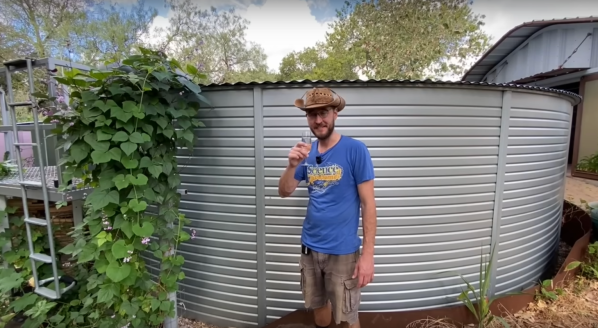
Getting freshwater supplied across cities and towns in a reliable and safe way is no simple task. Not only is a natural freshwater reservoir or other supply needed, but making sure the water is safe to drink and then shipping it out over a dense network of pumps and pipes can cost a surprising amount of time and money. It also hinges on a reliable power grid, which is something Texas resident [Suburban Biology] doesn’t have. But since fresh water literally falls out of the sky for free, he decided to take this matter into his own hands.

The main strategy with a system like this is to keep the rainwater as clean as possible before storage so that expensive treatment systems are less necessary. That means no asphalt shingles, a way to divert the first bit of rain that washes dust and other contaminants off the roof away, and a safe tank. This install uses a 30,000 gallon tank placed above ground for storage, but that’s not the only thing that goes into a big rainwater catchment system like this. A system of PVC pipes are needed both for sending rainwater from the roofs of the buildings into the tank and for pumping it into the home for use. With all of that in place it’s both a hedge against climate change, unstable electric grids, and even separates the user from the local aquifer which may or may not have its own major issues depending on where you live.

While Texas legally protects the rights of citizens to collect and store rainwater, the same isn’t true for all areas. For example, Colorado only just passed a law allowing the collection and storage of a meager 110 gallons of rainwater and forbade it entirely beforehand. There are some other considerations for a project like this too, largely that above-ground systems generally won’t work in cold climates. On the other hand, large systems like these are really only needed where rainfall is infrequent; in more tropical areas like south Florida a much smaller storage system can be used

Continue reading “Re-imagining The Water Supply”

Homebrew Tire Inflator Pushes The Limits Of PVC Construction

Let’s just clear something up right from the start with this one: there’s literally no reason to build your own tire inflator from scratch, especially when you can buy a perfectly serviceable one for not a lot of money. But that’s missing the point of this build entirely, and thinking that way risks passing up yet another fascinating build from PVC virtuoso [Vang Hà], which would be a shame

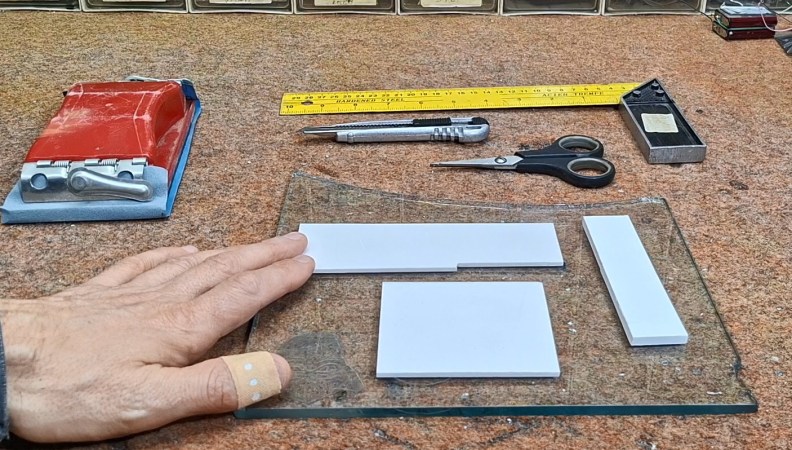
The chances are most of you will recall [Vang Hà]’s super-detailed working PVC model excavator, and while we’re tempted to say this simple air pump is a step toward more practical PVC builds, the fact remains that the excavator was a working model with a completely homebrew hydraulic system. As usual, PVC is the favored material, with sheet stock harvested from sections of flattened pipe. Only the simplest of tools are used, with a hand drill standing in for a lathe to make such precision components as the compressor piston. There are some great ideas here, like using Schrader tire valves as the intake and exhaust valves on the pump cylinder. And that’s not to mention the assembly tips, like making a hermetic seal between the metal valves and the PVC manifold by reaming out a hole with a heated drill bit.

We’re not sure how much abuse a plastic compressor like this will stand up to, but then again, we’ve seen some commercially available tire inflators with far, far less robust internals than this one.

Continue reading “Homebrew Tire Inflator Pushes The Limits Of PVC Construction”

Scratch-Built RC Excavator Is A Model Making Tour De Force

Some projects just take your breath away with their level of attention to detail. This scratch-built RC-controlled model excavator is not only breathtaking in its detail, but also amazing for the materials and tools used to create it.

We’ve got to be honest, we’ve been keeping an eye on the progress [Vang Hà] has been making on this build for a few weeks now. The first video below is a full tour of the finished project, which is painstakingly faithful to the original, a Caterpiller 390F tracked excavator. As impressive as that is, though, you’ve got to check out the build process that starts with fabricating the tracks in the second video below. The raw material for most of the model is plain gray PVC pipe, which is sliced and diced into flat sheets, cut into tiny pieces using a jury-rigged table saw, and heat formed to create curved pieces. Check out the full playlist for a bounty of fabrication delights, like tiny hinges and working latches.

We can’t possibly heap enough praise onto [Vang Hà] for his craftsmanship, but that’s not all we love about this one. There are tons of helpful tips here, and plenty of food for thought for more practical builds. We’re thinking about that full set of working hydraulic cylinders that operates the boom, the dipper, and the bucket, as well as the servo-operated hydraulic control valves. All of it is made from scratch, of course, and mostly from PVC. Keep that in mind for a project where electric motors or linear actuators just won’t fill the bill.

If this construction technique seems familiar to you, it could because we featured a toolbox made out of similarly processed PVC pipes back in June.

Continue reading “Scratch-Built RC Excavator Is A Model Making Tour De Force”