A Cheap And Cheerful Geiger Counter Build

Hackers often have broad interests across the sciences, of which nuclear topics are no exception. The Geiger counter remains a popular build, and could be a handy tool to have in a time of rising tensions between nuclear powers. [Leonora Tindall] had tinkered with basic units, but wanted a better idea of actual radiation levels in her area. Thus began the build!

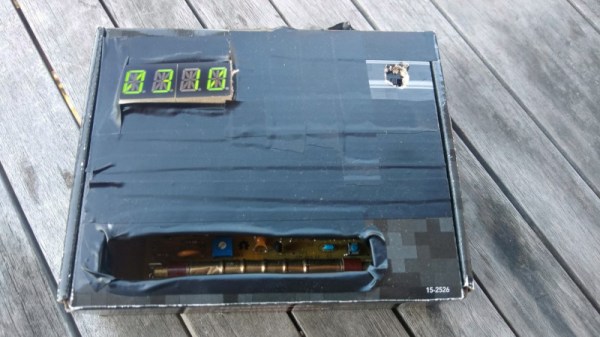
The project began by leveraging the Geiger counter kit from the Mighty Ohm. [Leonora] had built one of these successfully, but wished for a visual readout to supplement the foreboding ticking noises from the device. This was achieved by installing a Metro Mini microcontroller along with a 4-character, 14-segment alphanumeric display. This, along with the cardboard enclosure, makes the build look like a prop from an 80s hacker movie. Very fitting for the Cold War-era technology at work.

By using a pre-built kit and upgrading it with display hardware, [Leonora] now has readings at a glance without having to reinvent the wheel and design her own board from scratch. Of course, if you’re thinking of taking on a more complex build, you might consider a scintillation detector instead.

Echos Of The Cold War: Nuclear-Powered Missiles Have Been Tried Before

On August 8th, an experimental nuclear device exploded at a military test facility in Nyonoksa, Russia. Thirty kilometers away, radiation levels in the city of Severodvinsk reportedly peaked at twenty times normal levels for the span of a few hours. Rumors began circulating about the severity of the event, and conflicting reports regarding forced evacuations of residents from nearby villages had some media outlets drawing comparisons with the Soviet Union’s handling of the Chernobyl disaster.

Today, there remain more questions than answers surrounding what happened at the Nyonoksa facility. It’s still unclear how many people were killed or injured in the explosion, or what the next steps are for the Russian government in terms of environmental cleanup at the coastal site. The exceptionally vague explanation given by state nuclear agency Rosatom saying that the explosion “occurred during the period of work related to the engineering and technical support of isotopic power sources in a liquid propulsion system”, has done little to assuage concerns.

The consensus of global intelligence agencies is that the test was likely part of Russia’s program to develop the 9M730 Burevestnik nuclear-powered cruise missile. Better known by its NATO designation SSC-X-9 Skyfall, the missile is said to offer virtually unlimited flight range and endurance. In theory the missile could remain airborne indefinitely, ready to divert to its intended target at a moment’s notice. An effectively unlimited range also means it could take whatever unpredictable or circuitous route necessary to best avoid the air defenses of the target nation. All while traveling at near-hypersonic speeds that make interception exceptionally difficult.

Such incredible claims might sound like saber rattling, or perhaps even something out of science fiction. But in reality, the basic technology for a nuclear-powered missile was developed and successfully tested nearly sixty years ago. Let’s take a look at this relic of the Cold War, and find out how Russia may be working to resolve some of the issues that lead to it being abandoned. Continue reading “Echos Of The Cold War: Nuclear-Powered Missiles Have Been Tried Before”

Fail Of The Week: Spinning The Pripyat Ferris Wheel

This multifaceted fail comes to us straight from the Chernobyl Exclusion Zone, where a group of friends apparently decided that a fun weekend project would be trying to turn over the iconic ferris wheel in the Pripyat Amusement Park. The [Kreosan] crew documented their admittedly very creative attempt at suicide in the video after the break, but we can save you some time by telling you right up front that the decades-old ferris wheel never actually rotates more than a few degrees. Though that’s hardly the key failure of this endeavour.

Even if you don’t understand anything they’re saying (we certainly don’t), it’s not too hard to follow along with this harebrained scheme.

Under cover of darkness, the troupe gains access to the mechanisms below the towering Soviet-era ride, and removes the brake unit mounted next to the motor. With the wheel now free spinning, the team is elated to see the mechanical advantage is such that spinning the shaft by hand is enough to cause a very slight rotation of the pulley and cables attached to the wheel.

Realizing they need more speed, the group then spends the rest of the night and apparently a good deal of the following day attempting to spin the mechanism using the rear wheel of one of their electric bicycles. But a rubber wheel held by hand against a rusty shaft, rather unsurprisingly, turns out to be a fairly poor mechanical linkage. They get a couple partial rotations on the pulleys, but still no serious movement.

One of the guys was working on the next phase of the inexplicably misguided plan, removing some heavy counterweights hanging under the ferris wheel, when a young woman shows up with a dosimeter and starts taking some measurements. Eventually, one of these moonlighting ferris wheel engineers uses the meter to observe the elevated radiation levels of the dirt and rust accumulated on his bare hands. This swiftly brings the operation to a close, and they all ride off on their bikes.

This was, without question, a monumentally stupid thing to do. Even if this was just a run-of-the-mill ferris wheel that had been abandoned and exposed to the elements for over thirty years, climbing on the thing and trying to get it to spin would be dangerous. But when you combine that with the fact it’s common knowledge to those who explore the Exclusion Zone that there are parts of the ferris wheel still emitting radiation at hundreds of times the normal background dose, this misadventure is a strong contender for the 2019 Darwin Award.

We’re lucky the remnants of Chernobyl’s number four reactor are locked away inside the Chernobyl New Safe Confinement, or else some up-and-coming Internet celebrity might try to get in there and spin up the turbines for a laugh. We’ve seen some pretty crazy stunts from [Kreosan], and we’d like to see more. So please, stay safe(r) guys!

Continue reading “Fail Of The Week: Spinning The Pripyat Ferris Wheel”

DIY Scintillation Detector Is Mighty Sensitive

Geiger counters are a popular hacker project, and may yet prove useful if and when the nuclear apocalypse comes to pass. They’re not the only technology out there for detecting radiation however. Scintillation detectors are an alternative method of getting the job done, and [Alex Lungu] has built one of his own.

Scintillation detectors have several benefits over the more common Geiger-Muller counter. They work by employing crystals which emit light, or scintillate, in the presence of ionizing radiation. This light is then passed to a photomultiplier tube, which emits a cascade of electrons in response. This signal represents the level of radioactivity detected. They can be much more sensitive to small amounts of radiation, and are more sensitive to gamma radiation than Geiger-Muller tubes. However, they’re typically considered harder to use and more expensive to build.

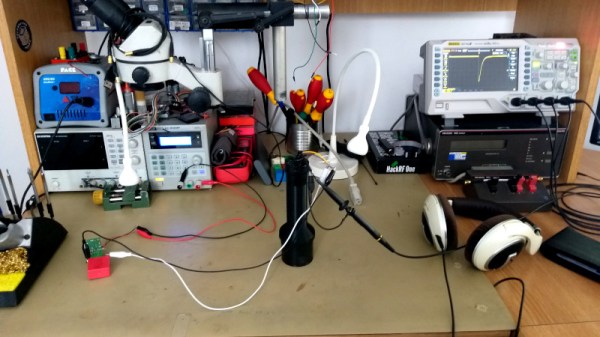
[Alex]’s build uses a 2-inch sodium iodide scintillator, in combination with a cheap photomultiplier tube he scored at a flea market for a song. [Jim Williams]’s High Voltage, Low Noise power supply is used to run the tube, and it’s all wrapped up in a tidy 3D printed enclosure. Output is via BNC connectors on the rear of the device.

Testing shows that the design works, and is significantly more sensitive than [Alex]’s Geiger-Muller counter, as expected. If you’re interested in measuring small amounts of radiation accurately, this could be the build for you. We’ve seen this technology used to do gamma ray spectroscopy too.

Radiation Detector Eschews Tubes, Uses Photodiode

When the topic is radiation detection, thoughts turn naturally to the venerable Geiger-Müller tube. It’s been around for ages, Russian surplus tubes are available for next to nothing, and it’s easy to use. But as a vacuum tube it can be somewhat delicate, and the high voltages needed to run it can be a little on the risky side.

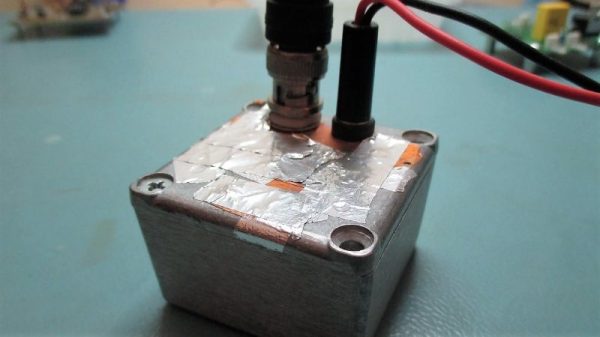
Luckily, there are other ways to see what’s going on in the radioactive world, like this semiconductor radiation detector. [Robert Gawron] built it as a proof-of-concept after having built a few G-M tube detectors before. His solid-state design relies on a reverse-biased photodiode conducting when ionizing radiation hits the P-N junction. The tiny signal is amplified by a pair of low-noise op-amps and output to a BNC connector. The sensor’s analog output is sent to an oscilloscope whose trigger out is connected to a Nucleo board for data acquisition. The Nucleo is in turn connected to a Raspberry Pi for totalizing and logging. It’s a complicated chain, but the sensor appears to work, even detecting alpha emissions from thoriated TIG electrodes, a feat we haven’t been able to replicate with our G-M tube counter.

[Robert]’s solid-state detector might not be optimal, but it has promise. And we have seen PIN diodes used as radiation detectors before, too.

[via Dangerous Prototypes]

A Network Attached Radiation Monitor

It started as a joke, as sometimes these things do. [Marek Więcek] thought building a personal radiation detector would not only give him something to work on, but it would be like having a gadget out of the Fallout games. He would check the data from time to time and have a bit of a laugh. But then things got real. When he started seeing rumors on social media that a nearby nuclear reactor had suffered some kind of radiation leak, his “joke” radiation detector suddenly became serious business.

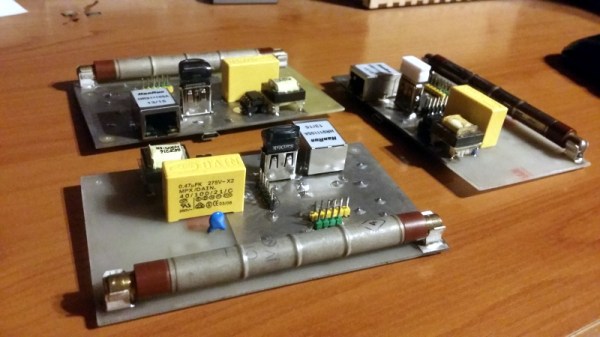
With the realization that having his own source of detailed environmental data might not be such a bad idea after all, [Marek] has developed a more refined version of his original detector (Google Translate). This small device includes a Geiger counter as well as sensors for more mundane data points such as temperature and barometric pressure. Since it’s intended to be a stationary monitoring device, he even designed it to be directly plugged into an Ethernet network so that it can be polled over TCP/IP.

[Marek] based the design around a Soviet-era STS-5 Geiger tube, and outfitted his board with the high voltage electronics to provide it with the required 400 volts. Temperature, barometric pressure, and humidity are read with the popular Bosch BME280 sensor. If there’s no Ethernet network available, data from the sensors can be stored on either the built-in SPI flash chip or a standard USB flash drive.

The monitor is powered by a PIC32MX270F256B microcontroller with an Ethernet interface provided by the ENC28J60 chip. In practice, [Marek] has a central Raspberry Pi that’s polling the monitors over the network and collecting their data and putting it into a web-based dashboard. He’s happy with this setup, but mentions he has plans to add an LCD display to the board so the values can be read directly off of the device. He also says that a future version might add WiFi for easier deployment in remote areas.

Over the years we’ve seen a fair number of radiation monitors, from solar-powered WiFi-connected units to the incredible work [Radu Motisan] has done building his global network of radiation detectors. It seems hackers would rather not take somebody else’s word for it when it comes to the dangers of radiation.

A Very Different ‘Hot Or Not’ Application For Your Phone

Radioactivity stirs up a lot of anxiety, partially because ionizing radiation is undetectable by any of the senses we were born with. Anytime radiation makes the news, there is a surge of people worried about their exposure levels and a lack of quick and accurate answers. Doctors are flooded with calls, detection devices become scarce, and fraudsters swoop in to make a quick buck. Recognizing the need for a better way, researchers are devising methods to measure cumulative exposure experienced by commodity surface mount resistors.

Cumulative exposure is typically tracked by wearing a dosimeter a.k.a. “radiation badge”. It is standard operating procedure for people working with nuclear material to wear them. But in the aftermath of what researchers euphemistically call “a nuclear event” there will be an urgent need to determine exposure for a large number of people who were not wearing dosimeters. Fortunately, many people today do wear personal electronics full of components made with high purity ingredients to tightly controlled tolerances. The resistor is the simplest and most common part, and we can hack a dosimeter with them.

Lab experiments established that SMD resistors will reveal their history of radiation exposure under high heat. Not to the accuracy of established dosimetry techniques, but more than good enough to differentiate people who need immediate medical attention from those who need to be monitored and, hopefully, reassure people in neither of those categories. Today’s technique is a destructive test as it requires removing resistors from the device and heating them well above their maximum temperature, but research is still ongoing in this field of knowledge we hope we’ll never need.

If you prefer to read about SMD resistor hacks with less doomsday, we recently covered their use as a 3D printer’s Z-axis touch sensor. Those who want to stay on the topic can review detection hacks like using a single diode as a Geiger counter and the IoT dosimeter submitted for the 2017 Hackaday Prize. Or we can choose to focus on the bright side of radioactivity with the good things made possible by controlled artificial radioactivity, pioneered by Irène Joliot-Curie.

[via Science News]