An Autonomous Drone For Working Rare Squares

Amateur radio is an extremely broad church when it comes to the numerous different activities that it covers. Most of the stories featuring radio amateurs that we cover here have involved home-made radios, but that represents a surprisingly small subset of licence holders.

One activity that captivates many operators is grid square collecting. The map is divided into grid squares, can you make contact with all of them? Land-based squares in Europe and North America are easy, those in some more sparsely populated regions a little less so, and some squares out in the ocean are nigh-on impossible. As an attempt to solve this problem, the Jupiter Research Foundation Amateur Radio Club have put an HF transceiver and associated electronics in a WaveGlider autonomous seagoing vehicle. The idea is that it will traverse the ocean, and you can work it, thus getting the contact you require to add those rarest of grid squares to your list.

The transceiver in question is a commercial portable one, an Elecraft KX3, and the brain of the payload is a Raspberry PI. It’s operating the FT8 mode, and will respond to a call on 14074 kHz in an automated fashion (Or it would, were its status page not telling us that it is offline due to power issues). It’s currently somewhere in the Pacific ocean, having been at sea now for a couple of months.

We spotted this through a spirited online discussion as to whether working an automated station is really a proper contact at all, with one amateur commenting that it might be a way for him to keep on going post mortem. But the ethics of the contact aside, it’s an extremely interesting project and one we hope eventually will come back online.

Thanks Sotabeams, via [AE5X].
At 71,572 KM, You Won’t Beat This LoRa Record

A distance record for LoRa transmission has been set that you probably won’t be able to beat. Pack up your gear and go home, nothing more to achieve here. At a superficial reading having a figure of 71,572 km (44,473 miles) seems an impossible figure for one of the little LoRa radio modules many of us have hooked up to our microcontrollers, but the story isn’t quite what you’d expect and contains within it some extremely interesting use of technology.

So the folks at Outernet have sent data over LoRa for that incredible distance, but they did so not through the little ISM band modules we’re used to but over a suitably powerful Ku-band uplink to a geostationary satellite. They are also not using the LoRaWAN protocols of the earthbound systems, but simply the LoRa modulation scheme. So it’s not directly comparable to terrestrial records such as the 702 km we reported on last year, and they are the first to admit that.

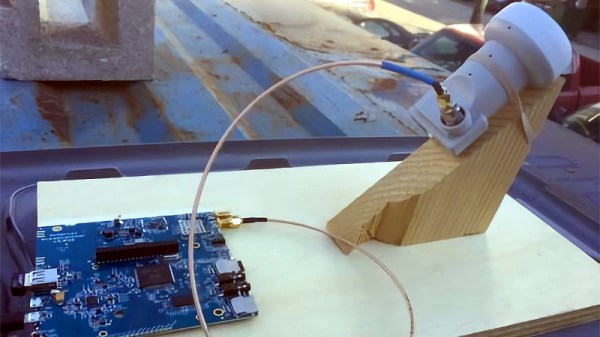
Where their achievement becomes especially interesting though is in their choice of receiver. We are all used to Ku-band receivers, you may even have one on your house somewhere for satellite TV. It will probably involve a parabolic dish with a narrow beam width and an LNB whose horn antenna is placed at its focus. It would have required some skill and effort to set up, because it has to be pointed very carefully at the satellite’s position in the sky. Outernet’s mission of delivering an information service with the lowest possible barrier to entry precludes the extra expense of shipping a dish and providing trained staff to align it, so they take a very different approach. Their receiver uses either an LNB horn or a small patch antenna pointing at the satellite, with none of the dishes or phased arrays you might be used to in a Ku-band installation.

You might wonder how such a receiver could possibly work with such a meagre antenna, but the secret lies in LoRa’s relatively tiny bandwidth as well as the resistance to co-channel interference that is a built-in feature of the LoRa modulation scheme. Even though the receiver will be illuminated by multiple satellites at once it is able to retrieve the signal and achieve a 30 kb/s data rate that they hope with technical refinements to increase to 100 kb/s. This rate will be enough over which to push an SD video stream to name just one of the several examples of the type of content they hope to deliver.

It’s likely that the average Hackaday reader will not be hiring satellite uplink time upon which to place their LoRa traffic. But this story does provide a demonstration of LoRa’s impressive capabilities, and will make us look upon our humble LNBs with new eyes.

Via ABOpen.

You All Know Reginald Fessenden. Who?

Quick, name someone influential in the history of radio. Who do did you think of? Marconi? Tesla? Armstrong? Hertz? Perhaps Sarnoff? We bet only a handful would have said Reginald Fessenden. That’s a shame because he was the first to do something that most of us do every day.

Few know this Canadian inventor’s name even though he developed quite a few innovations. Unlike Colpitts and Hartley we don’t have anything named after him. However, Fessenden was the first man to make a two-way transatlantic radio contact (Marconi’s was one way) and he was a pioneer in using voice over the radio.

He did even more than that. He patented transmitting with a continuous wave instead of a spark, which made modern radio practical. This was unpopular at the time because most thought the spark was necessary to generate enough energy. In 1906, John Fleming (who gave us tubes that are sometimes still called Fleming valves) wrote that “a simple sine-curve would not be likely to produce the required effect.” That was in 1906, five years after Fessenden’s patent.

Continue reading “You All Know Reginald Fessenden. Who?”

Making Software Defined Radio Portable

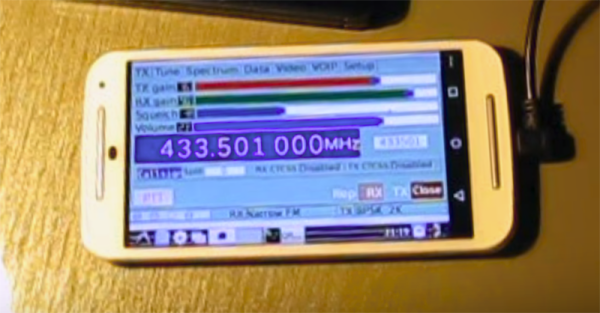
While most smartphones can receive at least some radio, transmitting radio signals is an entirely different matter. But, if you have an Android phone and a few antennas (and a ham radio license) it turns out that it is possible to get a respectable software-defined radio on your handset.

[Adrian] set this up to be fully portable as well, so he is running both the transceiver and the Android phone from a rechargeable battery bank. The transceiver is also an interesting miniaturized version of the LimeSDR, the Lime SDR Mini, a crowdfunded Open Source radio platform intended for applications where space is at a premium. It operates on the 10 MHz to 3.5 GHz bands, has two channels, and has a decent price tag too at under $100.

For someone looking for an SDR project or who needs something very portable and self-contained, this could be a great option. The code, firmware, and board layout files are all also open source, which is always a great feature. If you’re new to SDR though, there’s a classic project that will get you off the ground for even less effort.

Continue reading “Making Software Defined Radio Portable”

Repairs You Can Print: Fixing A Chewed Up Remote

What is it about remote controls? They’re like some vortex of household chaos, burrowing into couch cushions while accusations fly about who used it last. Or they land in just the right spot on the floor to be stepped on during a trip to the bathroom. And don’t get us started about the fragility of their battery case covers; it’s a rare remote in a house with kids whose batteries aren’t held in by strips of packing tape.

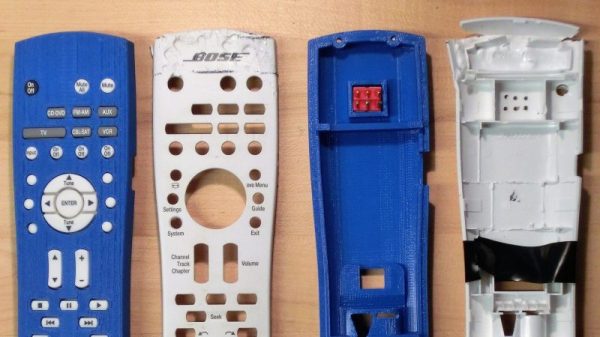
But [Alex Rich]’s Bose radio remote discovered another failure mode: imitating a dog chew toy. Rather than fork out $90 for a replacement, [Alex] undertook a 3D-printed case to repair the chewed remote. He put an impressive amount of reverse engineering into the replacement case, probably expending much more than $90 worth of effort. But it’s the principle of the thing, plus he wanted to support some special modifications to the stock remote. One was a hardware power switch to disconnect the batteries entirely, hidden in the bottom shell of the case. The second was the addition of a link to his thermostat to adjust the volume automatically when the AC comes on. That required a Trinket inside the remote and a few mods to make room for it.

Yes, this project dates from a few years back, but [Alex] only just brought it to our attention for the Repairs You Can Print contest. Got some special unobtanium part that you were able to print to get out of a jam? Enter and win prizes to add to the glory of fixing something yourself.

ESP32 Makes For World’s Worst Radio Station

We can say one thing for [bitluni]: the BOMs for his projects, like this ESP32 AM radio transmitter, are always on the low side. That’s because he leverages software to do jobs traditionally accomplished with hardware, always with instructive results.

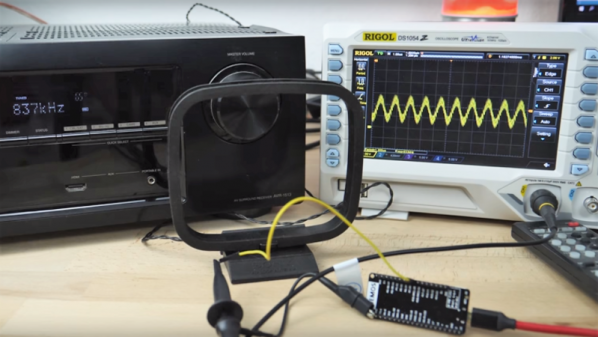
In this case, the job at hand is creating an RF oscillator in the broadcast AM band and modulating some audio onto it. From his previous experience using an ESP32 to watch video on an oscilloscope, [bitluni] knew that the microcontroller’s DACs were up to the task of producing an 800-kHz signal, and he managed to produce a more-or-less sine wave carrier with some clever code. His sketch takes data from a header file, modulates it onto the carrier, and sends it out over the ether using a short stub of wire for an antenna. The range is severely limited, but for what it is, it gets the job done and shows the basics. And as a bonus, [bitluni] included a bit of JavaScript that turns an audio file into a header file that’s ready to go out over the airwaves for all your trolling needs.

If you’re looking for a little more range for your low power transmitter and you’re a licensed amateur operator, you might want to explore the world of QRP radio.

Continue reading “ESP32 Makes For World’s Worst Radio Station”

Drink Lots Of Beer To Raise Your Monopole

When we published a piece about an ADS-B antenna using a Coke can as a groundplane, Hackaday reader [2ftg] got in contact with us about something with a bit more… stature.

A monopole groundplane antenna is a single vertical conductor mounted on an insulator and rising up above a conductive groundplane. In radio terms the groundplane is supposed to look as something of a mirror, to provide a reflection of what would come from the other half of a dipole were there to be two conductors. You can use anything conductive as your monopole, a piece of wire, (in radio amateur humour) a piece of wet string, or even beer cans. “Beer cans?” you ask incredulously, expecting this to be another joke. Yes, beer cans, and [2ftg] has been good enough to supply us with a few examples. The first is a 57-foot stack of them welded together in the 1950s for use on the 80 metre band ( we suspect steel cans may have been more common than aluminum back then), the second is a more modest erection for the 2 metre band, and the final one consists of photographs only of an HF version that looks a little wavy and whose cans are a little less beery.

The reporting in the 1950s piece is rather cheesy, but does give a reasonable description of it requiring welding rods as reinforcement. It also gives evidence of the antenna’s effectiveness, showing that it could work the world. Hardly surprising, given that a decent monopole is a decent monopole no matter how many pints of ale you have dispatched in its making.

The Coke can ADSB can be seen in all its glory here, and if all this amateur radio business sounds interesting, here’s an introduction.

Beer cans picture: Visitor7 [CC BY-SA 3.0].