Hull Pixel Bot, A Mobile Pixel

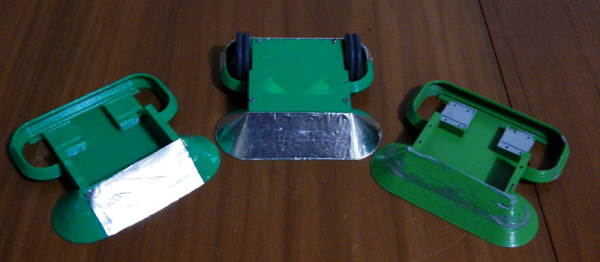
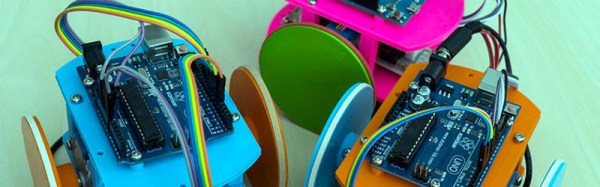
There are many designs for little two-wheeled robots available to download for constructors with an interest in simple robotics. You might even think there are so many that there could not possibly be room for another, but that has not deterred [Rob Miles]. He’s created HullPixelBot, a platform for a mobile pixel as well as for simple robotic experimentation.

So what makes HullPixelBot more than just Yet Another Arduino Powered Robot? For a start, it’s extremely well designed, and has a budget of less than £10 ($12.50). But the real reason to take notice lies in the comprehensive software, which packs in a language interpreter and MQTT endpoint for talking to an Azure IoT hub. This is much more than a simple Arduino bot on which you must craft your own sketches, instead, it is a platform for which the Arduino bot is merely the carrier.

The project has had quite a while to mature since its initial release, and now has the option of a single pixel or a ring of pixels. The eventual aim is to use swarms of networked HullPixelBots to create large autonomous moving pixel displays, containing more than a hundred individual pixels.

There is an early video of some PixelBots in action which we’ve placed below the break, but it serves more as eye candy than anything else. If you have a spare ten quid, download and print yourself a chassis, install Arduino and motors, and have a go yourself!
Continue reading “Hull Pixel Bot, A Mobile Pixel”

The Enchanting Power Of SDDSbot

Who doesn’t love a good robot? If you don’t — how dare you! — then this charming little scamp might just bring the hint of a smile to your face.

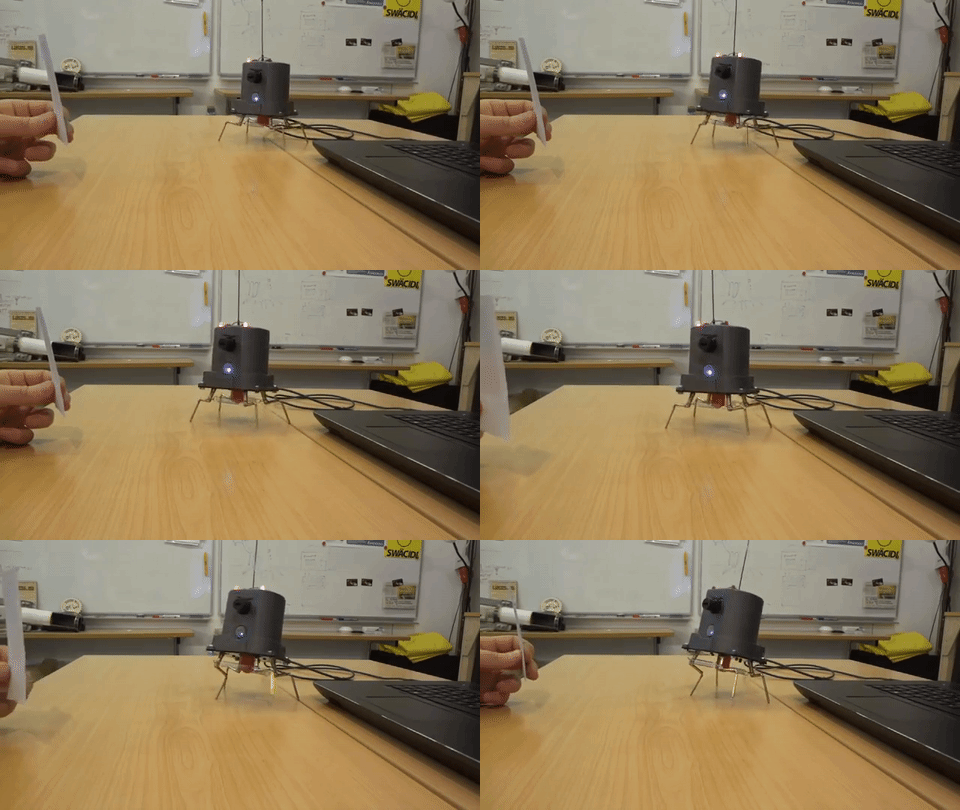
SDDSbot — built out of an old Sony Dynamic Digital Sound system’s reel cover — can’t do much other than turn left, right, or walk forwards on four D/C motor-controlled legs, but it does so using the power of a Pixy camera and an Arduino. The Pixy reads colour combinations that denote stop and go commands from sheets of paper, attempting to keep it in the center of its field of view as it toddles along. Once the robot gets close enough to the ‘go’ colour code, the paper’s  orientation directs the robot to steer itself left or right — the goal being the capacity to navigate a maze. While not quite there yet, it’s certainly a handful as it is.

Continue reading “The Enchanting Power Of SDDSbot”

Taking A Robot For A Drive

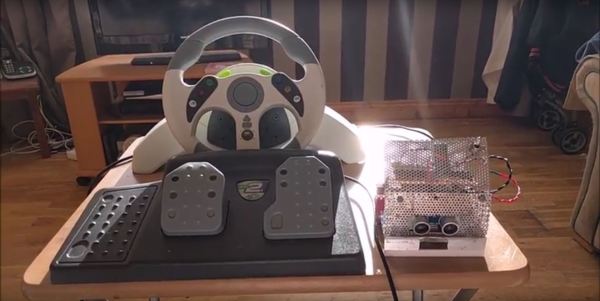
Instructables user [Roboro] had a Mad Catz Xbox steering wheel controller he hasn’t had much use for of late, so he decided to hack and use it as a controller for a robot instead.

Conceivably, you could use any RC car, but [Roboro] is reusing one he used for a robot sumo competition a few years back. Cracking open the controller revealed a warren of wires that were — surprise, surprise — grouped and labelled, making for a far less painful hacking process. Of course, [Roboro] is only using the Xbox button for power, the player-two LED to show the connection status, the wheel, and the pedals, but knowing which wires are which might come in handy later.

An Arduino Uno in the wheel and a Nano in the robot are connected via CC41-A Bluetooth modules which — despite having less functionality than the HM10 module they’re cloned from — perform admirably. A bit of code and integration of a SN754410 H-bridge motor driver — the Arduino doesn’t supply enough current to [Roboro]’s robot’s motors — and the little robot’s ready for its test drive.

Continue reading “Taking A Robot For A Drive”

Octosonar Is 8X Better Than Monosonar

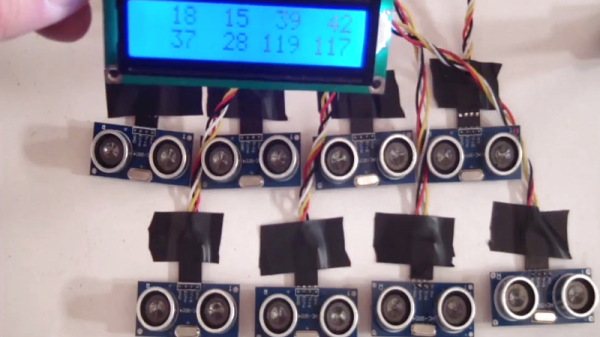
The HC-SR04 sonar modules are available for a mere pittance and, with some coaxing, can do a pretty decent job of helping your robot measure the distance to the nearest wall. But when sellers on eBay are shipping these things in ten-packs, why would you stop at mounting just one or two on your ‘bot? Octosonar is a hardware and Arduino software library that’ll get you up and running with up to eight sonar sensors in short order.

Octosonar uses an I2C multiplexer to send the “start” trigger pulses, and an eight-way OR gate to return the “echo” signal back to the host microcontroller. The software library then sends the I2C command to select and trigger a sonar module, and a couple of interrupt routines watch the “echo” line to figure out the time of flight, and thus the distance.

Having two sonars on each side of a rectangular robot allows it move parallel to a wall in a straightforward fashion: steer toward or away from the wall until they match. Watch the video below for a demo of this very simple setup. (But also note where the robot’s 45-degree blind spot is: bump-bump-bump!)

Continue reading “Octosonar Is 8X Better Than Monosonar”

Toast-Bot Butters For You (Sometimes)

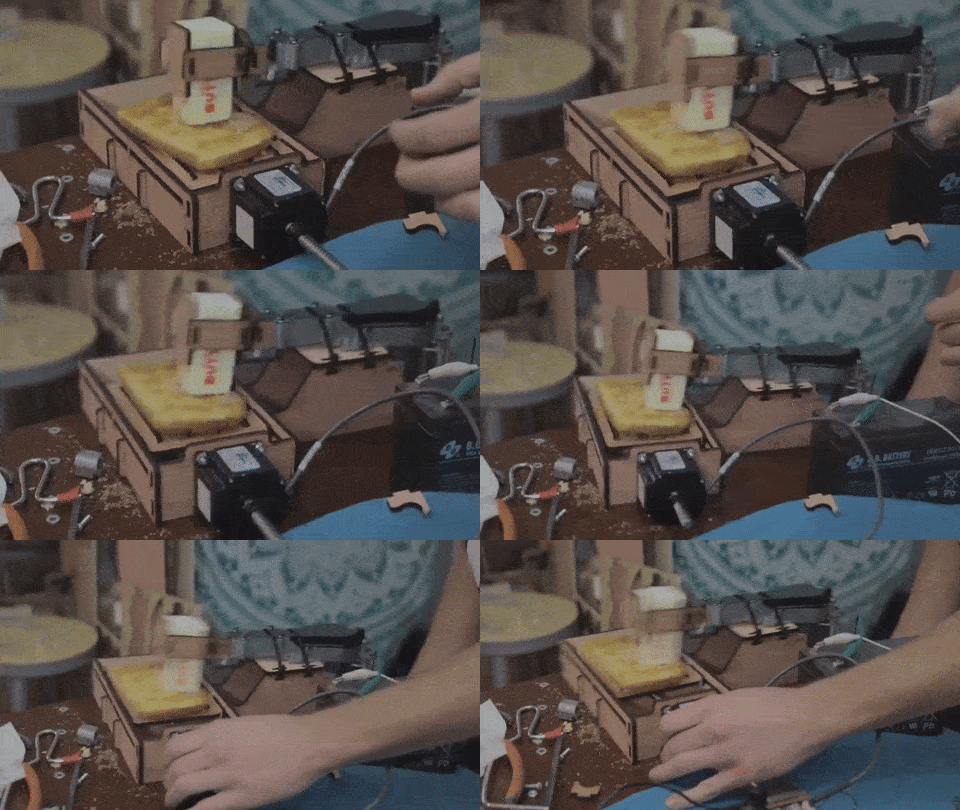
Sometimes — despite impracticality, safety, failure, and general good sense — one has an urge to see a project through for the sake of it. When you’re sick of buttering your toast every morning, you might take a leaf out of Rick Sandc– ahem, [William Osman]’s book and build a toast-bot to take care of the task for you.

[Osman] — opting for nail the overkill quotient — is using a reciprocating saw motor to hold the butter while the toast moves underneath the apparatus on a platform controlled by a linear stepper motor. The frame and mounts for Toast-Bot were cut out of wood on his home-built laser cutter — affectionately named Retina Smelter 9000′ — and assembled after some frustration and application of zip-ties. The final result DOES butter toast, but — well — see for yourself.

Continue reading “Toast-Bot Butters For You (Sometimes)”

What Is This, A Battle-Bot For Ants?

Instructables user [Team_Panic] — inspired by the resurgence of robot battle arena shows — wanted to dive in to his local ‘bot building club. Being that they fight at the UK ant weight scale with a cap of 150 grams, [Team_Panic] built a spunky little Arduino Mini-controlled bot on the cheap.

The Instructable is aimed at beginners, and so is peppered with sound advice. For instance, [Team_Panic] advises building from “the weapon out” as that dictates how the rest of the robot will come together around it. There are also some simple design considerations on wiring and circuit boards considering the robot in question will take a few hits, as well as instructions to bring the robot together. To assist any beginners in the audience, [Team_Panic] has provided his design for a simple, “slightly crude,” wedge-bot, as well as his code. Just don’t forget to change the radio pipe so you aren’t interfering with other bots!

Continue reading “What Is This, A Battle-Bot For Ants?”

Turbine-driven Robot To Navigate Inside Space Station

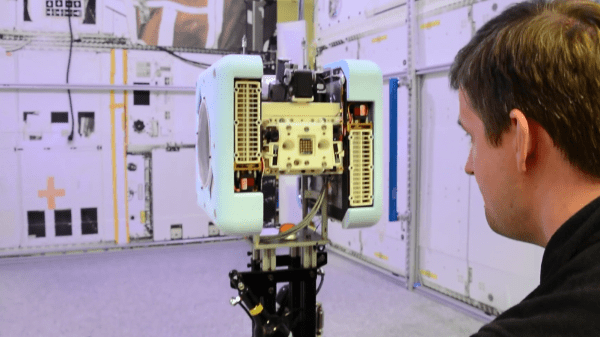
It may look more like a Companion Cube than R2-D2, but the ISS is getting an astromech droid of sorts.

According to [Trey Smith] of the NASA Ames Research Center, Astrobee is an autonomous robot that will be able to maneuver inside the ISS in three dimensions using vectored thrust from a pair of turbines. The floating droid will navigate visually, using a camera to pick out landmarks aboard the station, including docking ports that let it interface with power and data. A simple arm allows Astrobee to grab onto any of the hand rails inside the ISS to provide a stable point for viewing astronaut activities or helping out with the science.

As cool as Astrobee is, we’re intrigued by how the team at Ames is testing it. The droid is mounted on a stand that floats over an enormous and perfectly flat granite slab using low-friction CO₂ gas bearings, giving it freedom to move in two dimensions. We can’t help but wonder why they didn’t suspend the Astrobee from a gantry using a counterweight to add that third dimension in. Maybe that’s next.

From the sound of it, Astrobee is slated to be flight ready by the end of 2017, so we’ll be watching to see how it does. But if they find themselves with a little free time in the schedule, perhaps adding a few 3D-printed cosmetics would allow them to enter the Hackaday Sci-Fi Contest.