Submersible Robots Hunt Lice With Lasers

De-lousing is a trying agricultural process. It becomes a major problem in pens which contain the hundreds of thousands of salmon farmed by Norwegians — the world’s largest salmon exporter — an environment which allows the parasite to flourish. To tackle the problem, the Stingray, developed by [Stingray Marine Solutions],  is an autonomous drone capable of destroying the lice with a laser in the order of tens of thousands per day.

Introduced in Norway back in 2014 — and some areas in Scotland in 2016 — the Stingray floats in the salmon pen, alert and waiting. If the lice-recognition software (never thought you’d hear that term, huh?) detects a parasite for more than two frames in the video feed, it immediately annihilates it with a 530 nanometre-wide, 100 millisecond laser pulse from up to two metres away. Don’t worry — the salmon’s scales are reflective enough to leave it unharmed, while the pest is fried to a crisp.  In action, it’s reminiscent of a point-defense laser on a spaceship.
Continue reading “Submersible Robots Hunt Lice With Lasers”

Quadruped Robot Can Crawl Under Cars And Jump-Kick-Open Doors

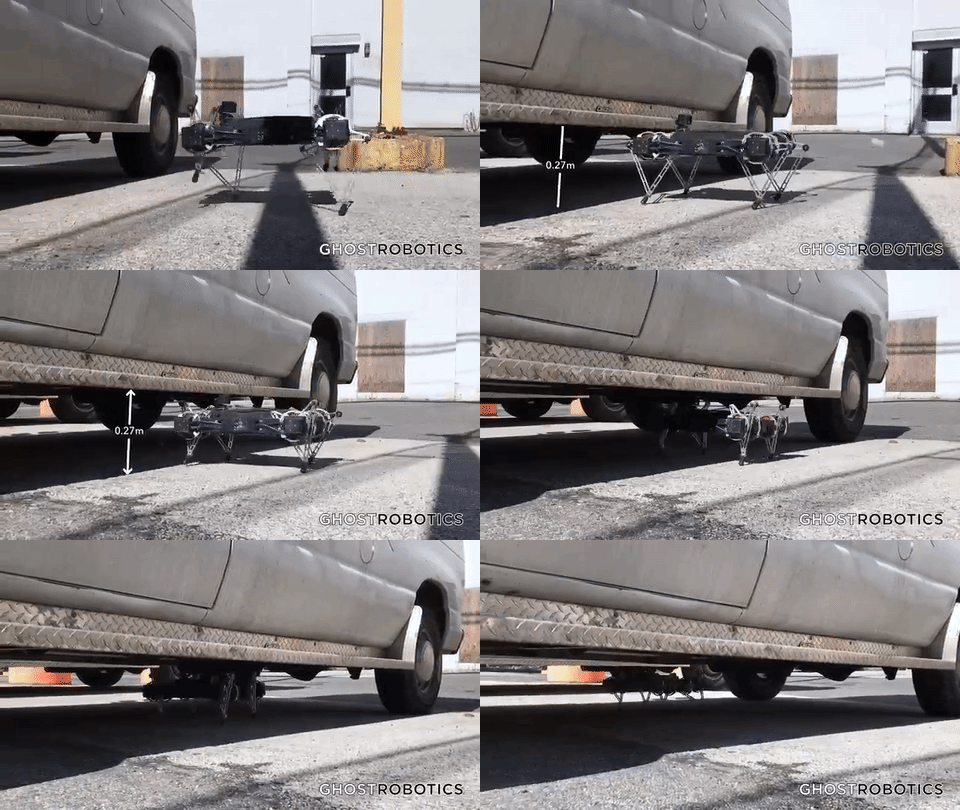
The wheel is a revolutionary invention — as they say — but going back to basics sometimes opens new pathways. Robots that traverse terrain on legs are on the rise, most notably the Boston Dynamics Big Dog series of robots — and [Ghost Robotics]’ Minitaur quadruped aims to keep pace.

One of [Ghost Robotics] founders, [Gavin Knneally] states that co-ordination is one of the main problems to overcome when developing quadruped robots; being designed to clamber across especially harsh terrain, Minitaur’s staccato steps carry it up steep hills, stairs, across ice, and more. Its legs also allow it to adjust its height — the video shows it trot up to a car, hunker down, then begin to waddle underneath with ease.

Continue reading “Quadruped Robot Can Crawl Under Cars And Jump-Kick-Open Doors”

Robot Arm From Recyclables

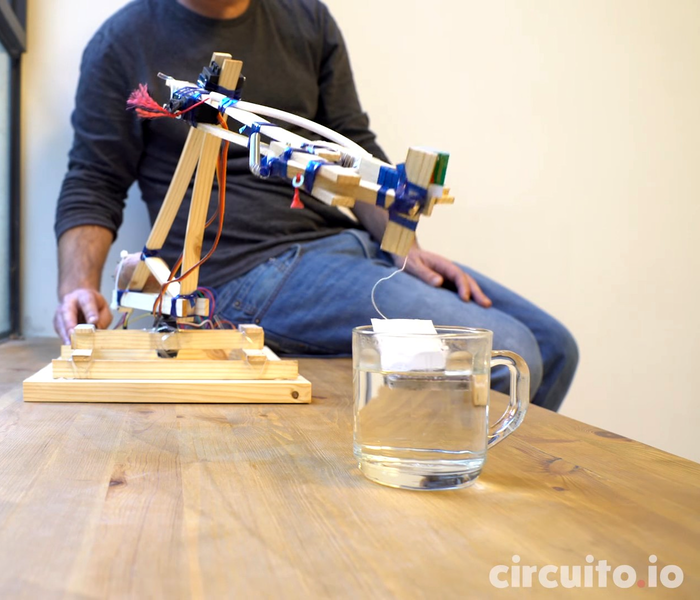
A robot assistant would make the lives of many much easier. Luckily, it’s possible to make one of your own with few fancy materials. The [circuito.io] team demonstrates this by building a robot arm out of recyclables!

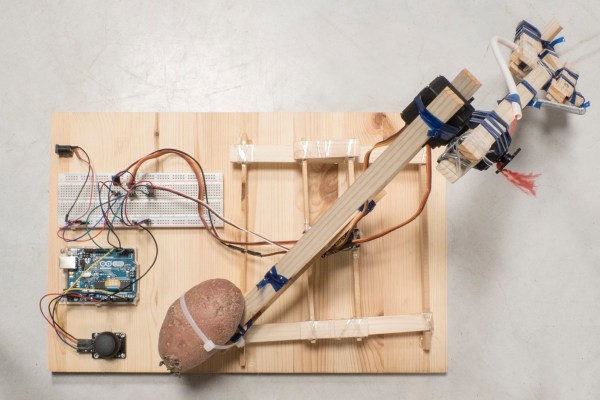
With the exception of the electronics — an Arduino, a trio of servo motors, and a joystick — the arm is made almost completely out of salvaged recyclables: scrap wood, a plastic bottle, bits of plastic string and a spring. Oh, and — demonstrating yet another use for those multi-talented tubers — a potato acts as a counterweight.

Instead of using screws or glue, these hackers used string made from a plastic bottle as a form of heat shrink wrap to bind the parts of the arm together. The gripper has only one pivoting claw for greater strength, and the spring snaps it open once released. Behold: your tea-bag dunking assistant.

Continue reading “Robot Arm From Recyclables”

Line Follower Has Lots Of Recycled Parts, But Zero Brains

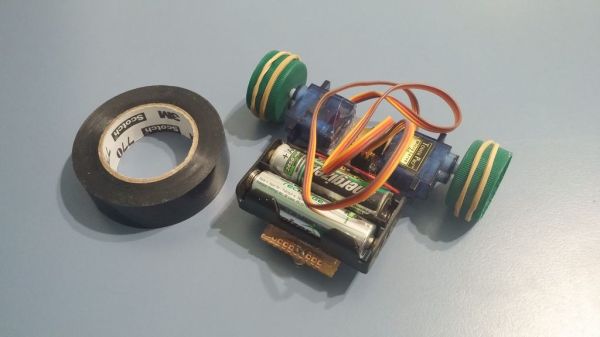
Line Followers are a tried-and-true type of robot; both hardware and software need to be doing their job in harmony in order to be successful at a clearly defined physical task. But robots don’t always have microcontrollers and software, as [Mati_DIY]’s zero programming analog line follower demonstrates.

For readers used to seeing a Raspberry Pi or Arduino in almost everything, an analog robot whose “programming” exists only as a harmony between its discrete parts can be an eye-opener as well as an accessible project. A video of the robot in action is embedded below.

[Mati_DIY]’s design uses two CNY70 reflective sensors (which are essentially infrared emitter/phototransistor pairs) and an LM358 dual op-amp. Together, the sensors act as two near-sighted eyes. By using the output of each sensor to drive a motor via a transistor, the presence or absence of the black line is directly and immediately reflected by the motion of the attached motor. The more black the sensor sees, the more the motor turns. Electrically, that’s all that happens; but by attaching the right sensor to the left motor and the left sensor to the right motor, you get a robot that always tries to keep the black line centered under the sensors. Playing with the spacing of the motors and sensors further tweaks the performance.

Continue reading “Line Follower Has Lots Of Recycled Parts, But Zero Brains”

Arpeggio – The Piano SuperDroid

I never had the musical talent in me. Every now and then I would try to pick up a guitar or try and learn the piano, romanticising a glamorous career out of it at some point. Arpeggio – the Piano SuperDroid (YouTube, embedded below) sure makes me glad I chose a different career path. This remarkable machine is the brain child of [Nick Morris], who spent two years building it.

Although there are no detailed technical descriptions yet, at its heart this handsome robot consists of a set of machined ‘fingers’ connected to a set of actuators — most likely solenoids . The solenoids are controlled by proprietary software that combines traditional musical data with additional parameters to accurately mimic performances by your favourite pianists, right in your living room. Professional pianists, who were otherwise assuming excellent job security under Skynet, clearly have to reconsider now.

Continue reading “Arpeggio – The Piano SuperDroid”

Paul: A Robot And Its Ball

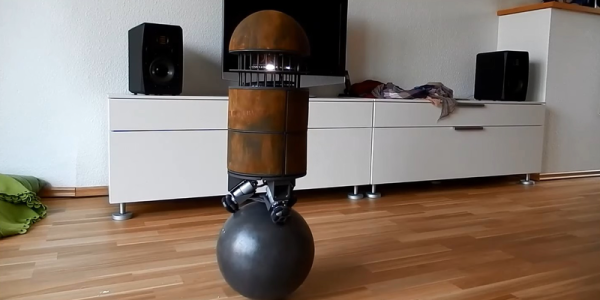
[Jochen Alt]’s Paul is one of the coolest robots of its type, and maybe one of the coolest robots period. Personality? Check. Omniwheels? Check. Gratuitous feats of derring-do? Check. Paul is a ball balancing robot.

Under the hood, Paul isn’t all that strange. He’s got two microcontrollers, one for taking care of the balancing and kinematics, and another that handles the LEDs, speech processor, loudspeaker, remote-control, and other frilly bits. But the mathematics! Paul is a cylinder standing up on top of a bowling ball, so the only way it can roll forwards is to lean forwards. But of course, it can’t lean too much, because it has also got to balance. It’s absolutely the least reasonable means of locomotion. We love it.

[Jochen] was nice enough to put everything up on GitHub, so you can see how it was done, even though it looks like magic. And we dare you to watch the video, embedded below, and not feel at least a pang of sympathy pain when (spoiler alert!) he falls flat on his face. Does he recover? We’d love to know!

Paul is just one of the stellar robots in the 2017 Hackaday Sci-Fi contest, so head on over there if you still don’t have your fill.

Continue reading “Paul: A Robot And Its Ball”

How To Telepathically Tell A Robot It Screwed Up

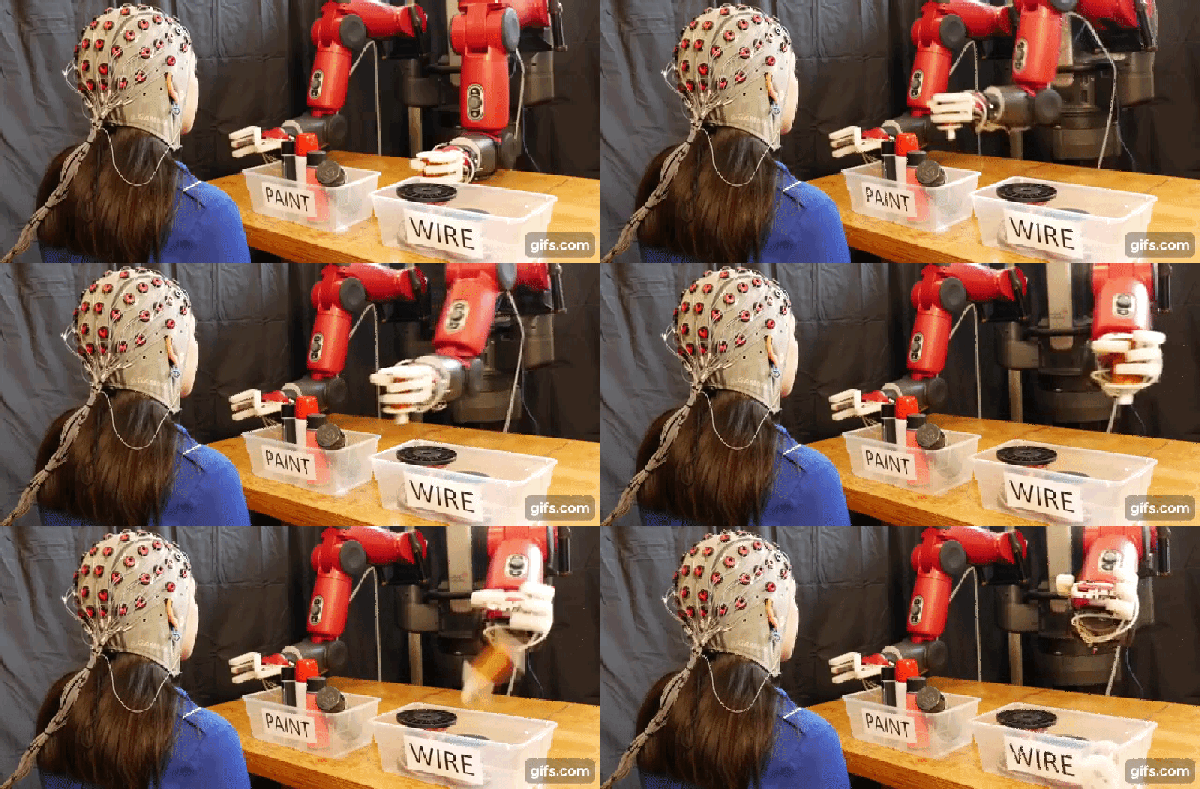
Training machines to effectively complete tasks is an ongoing area of research. This can be done in a variety of ways, from complex programming interfaces, to systems that understand commands in natural langauge. A team from MIT’s Computer Science and Artificial Intelligence Laboratory (CSAIL) wanted to see if it was possible for humans to communicate more directly when training a robot. Their system allows a user to correct a robot’s actions using only their brain.

The concept is simple – using an EEG cap to detect brainwaves, the system measures a special type of brain signals called “error-related potentials”. Simply noticing the robot making a mistake allows the robot to correct itself, and for a nice extra touch – blush in embarassment.

This interface allows for a very intuitive way of working with a robot – upon noticing a mistake, the robot is able to automatically stop or correct its behaviour. Currently the system is only capable of being used for very simple tasks – the video shows the robot sorting objects of two types into corresponding bins. The robot knows that if the human has detected an error, it must simply place the object in the other bin. Further research seeks to expand the possibilities of using this automatic brainwave feedback to train robots for more complex tasks. You can read the research paper here.

MIT’s CSAIL work on lots of exciting projects – their video microphone technology is truly astounding.

[Thanks to Adam Connor-Simmons for the tip!]