Spacing Out: Launch Successes And Failures, Next Stop Mars, Rocket Catching, & Space Stations

As large sections of the globe have seen themselves plunged into further resurgences of the pandemic over the past few weeks there has been no let-up in the world of space exploration even for the Christmas holidays, so here we are with another Spacing Out column in which we take a look at what’s going up, what’s flying overhead, and what’s coming down.

Not today, Paul. r2hox from Madrid, Spain, CC BY-SA 2.0.

December was eventful, with China returning lunar samples and Japan doing the same with asteroid dust. And it was reported that we  might just possibly have detected radio waves from ET. The truth may be out there and we sincerely want to believe, but this widely reported signal from Proxima Centauri probably isn’t the confirmation of alien life we’ve all been waiting for.

There has been no shortage of launches over the last month from the usual agencies and companies, with a first launch from China of their Long March 8 heavy lift rocket from the Wenchang launch site in Hainan Province. Its payload of five satellites made it safely to orbit, and we expect the rocket will be a workhorse of their future exploration programme. Meanwhile SpaceX conducted a high-altitude test of their Starship SN8 vehicle, which proceeded according to plan until the craft was approaching the landing pad, at which point the failure of one of its engines to fire caused a spectacular crash. This does not equate to an unsuccessful test flight as it performed faultlessly in the rest of its manoeuvres, but it certainly made for some impressive video.

On the subject of SpaceX and Starship, Elon Musk has said he will sell all his personal property to fund a Martian colony. This will require a fleet of up to 1000 Starships, with three launches a day to ferry both colonists and supplies to the Red Planet. He attracted controversy though by saying that interplanetary immigration would be open to people of all means with loans available for the estimated $50,000 one-way travel cost, and Martian jobs on offer to enable the debt to be paid. Many critics replied to his Tweets likening the idea to indentured servitude. It’s worth remembering that Musk is the master of the grand publicity stunt, and while it seems a good bet that SpaceX will indeed reach Mars, it’s also not inconceivable that his timeline and plans might be somewhat optimistic.

A more tangible story from SpaceX comes in their super heavy booster rocket, which is to be reusable in the same manner as their existing Falcon 9, but not landing on its own legs in the manner of the earlier rocket. It will instead dock with its launch tower, being caught by the same support structures used to stabilise it before launch. At first glance this might seem too difficult to succeed, but no doubt people expressed the same doubts before the Falcon 9s performed their synchronised landings.

Finally away from more troubling developments in the political field, The Hill takes a look at some of those likely to have a hand in providing a commercial replacement for the ISS when it eventually reaches the end of its life. They examine the likely funding for NASA’s tenancy on the station, and looked at the cluster of Texas-based companies gearing up for space station manufacture. That’s right — space station modules from the likes of Axiom Space will become a manufactured assembly rather than one-off commissions. The decades beyond the ISS’s current 2030 projected end of life are likely to have some exciting developments in orbit.

The coming year is likely to be an exciting one, with a brace of missions heading to Mars for February as well as a new space station to catch our attention. The Chinese aren’t content to stop at the Moon, with their Tianwen-1 Mars mission due to start exploring our planetary neighbour, and the first Tianhe module of what will become their much larger space station taking to the skies in the coming year. Meanwhile the Red planet will see NASA’s Perseverance rover also reaching its surface, taking with it the Ingenuity helicopter. Finally, the United Arab Emirates’ Hope probe will go into orbit, making the second month one that should have plenty of news.

Wherever you are, keep yourself safe from Earth-bound viruses, and keep looking at the skies in 2021.

Starlink Satellite Dish X-Rayed To Unlock RF Magic Inside

When [Kenneth Keiter] took apart his Starlink dish back in November, he did his best to explain the high-level functionality of the incredibly complex device in a video posted to his YouTube channel. It was a fascinating look at the equipment, but by his own admission, he wasn’t the right person to try and explain the nuances of how the phased array actually functioned. But he knew who could do the technology justice, which is why he shipped the dismembered dish over to [Shahriar Shahramian] of The Signal Path.

Don’t be surprised if you can’t quite wrap your head around his detailed analysis after your first viewing. You’ll probably have a few lingering questions after the second re-watch as well. But that’s OK, as [Shahriar] still has a few of his own. Even after cutting out a section of the dish and putting it under an X-ray, it’s still not completely clear how the SpaceX engineers managed to cram everything into such a tidy package. Though there seems to be no question that the $500 price for the early-access hardware is an absolute steal, all things considered.

The layered antenna works on multiple frequencies.

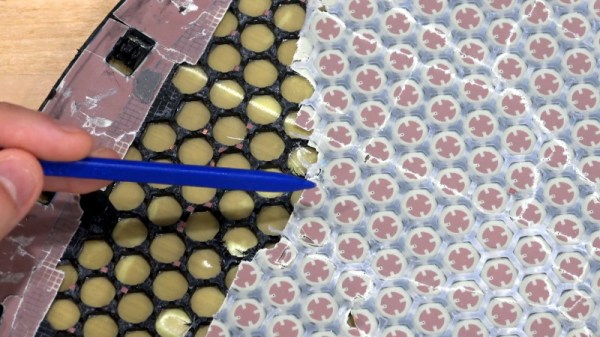
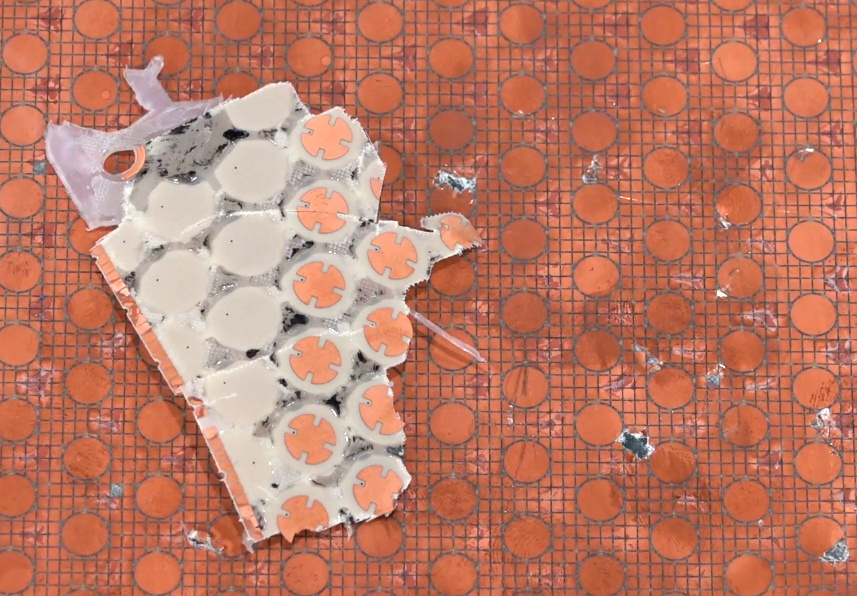
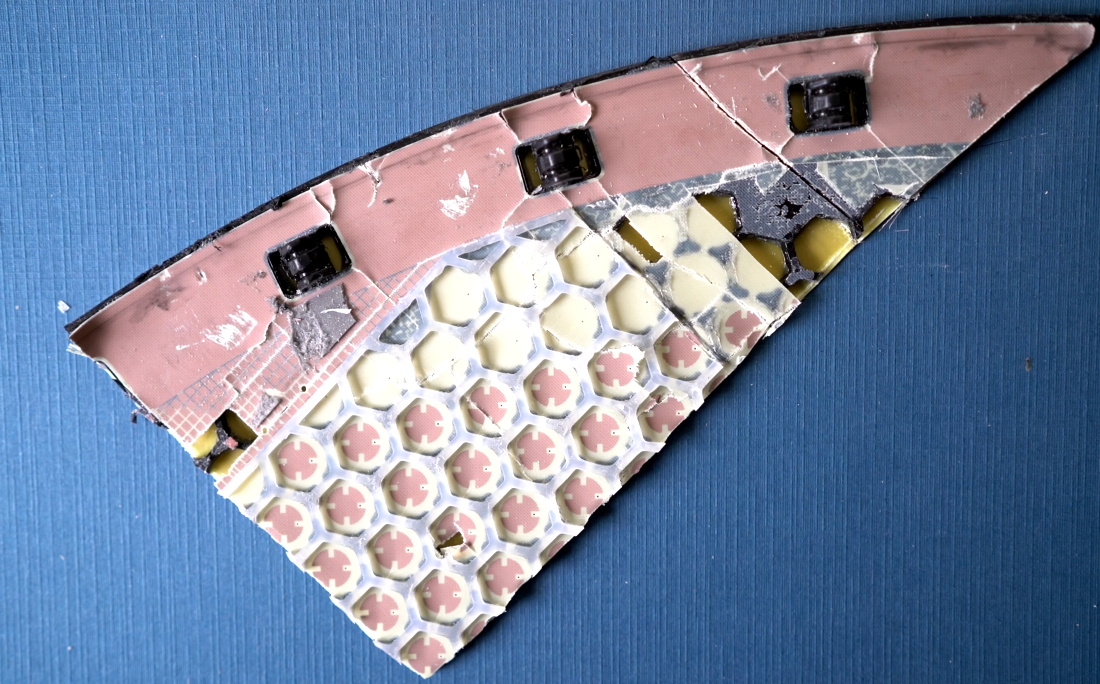
Most of the video is spent examining the stacked honeycomb construction of the phased antenna array, which as expected, holds a number of RF secrets if you know what to look for. Put simply, there’s no such thing as an insignificant detail to the trained eye. From the carefully sized injection molded spacer sheet that keeps the upper array a specific distance from the RF4-like radome, to the almost microscopic holes that have been bored through each floating patch to maintain equalized air pressure through the stack up, [Shahriar] picks up on fascinating details which might otherwise seem like arbitrary design decisions.

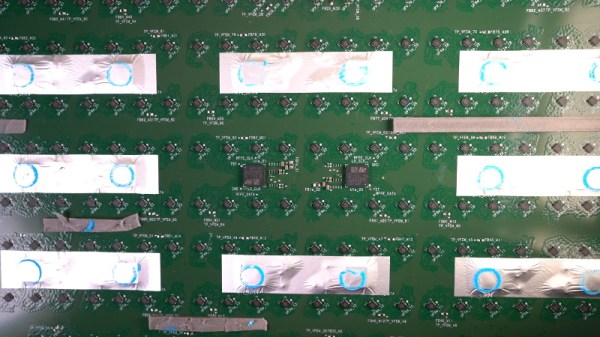
But a visual inspection will only get you so far. Eventually [Shahriar] has to cut out a slice of the PCB so he can fit it into the X-ray machine, but don’t feel too bad, the dish was long dead before he got his hands on it. While he hasn’t yet completed his full analysis, an initial examination indicates that each large IC and the eight chips surrounding it make up a 16 channel beam forming module. Each channel is further split into two RX and TX pairs, which provides the necessary right and left hand polarization. That said, he admits there’s some room for interpretation and that further work would be necessary before any hard conclusions could be made.

Between this RF analysis and the initial overview provided by [Kenneth], we’ve already learned a lot more about this device than many might have expected considering how rare and expensive the hardware is. While we admit it’s not immediately clear what kind of hijinks hardware hackers could get into once this device is fully understood, we’re certainly eager to find out.

Continue reading “Starlink Satellite Dish X-Rayed To Unlock RF Magic Inside”

2020: As The Hardware World Turns

By pretty much any metric you care to use, 2020 has been an unforgettable year. Usually that would be a positive thing, but this time around it’s a bit more complicated. The global pandemic, unprecedented in modern times, impacted the way we work, learn, and gather. Some will look back on their time in lockdown as productive, if a bit lonely. Other’s have had their entire way of life uprooted, with no indication as to when or if things will ever return to normal. Whatever “normal” is at this point.

But even in the face of such adversity, there have been bright spots for our community. With traditional gatherings out of the question, many long-running tech conferences moved over to a virtual format that allowed a larger and more diverse array of presenters and attendees than would have been possible in the past. We also saw hackers and makers all over the planet devote their skills and tools to the production of personal protective equipment (PPE). In a turn of events few could have predicted, the 2020 COVID-19 pandemic helped demonstrate the validity of hyperlocal manufacturing in a way that’s never happened before.

For better or for worse, most of us will associate 2020 with COVID-19 for the rest of our lives. Really, how could we not? But over these last twelve months we’ve borne witness to plenty of stories that are just as deserving of a spot in our collective memories. As we approach the twilight hours of this most ponderous year, let’s take a look back at some of the most interesting themes that touched our little corner of the tech world this year.

Continue reading “2020: As The Hardware World Turns”

RC Starship Perfects Its Skydiving Routine

There’s a good chance you already saw SpaceX’s towering Starship prototype make its impressive twelve kilometer test flight. While the attempt ended with a spectacular fireball, it was still a phenomenal success as it demonstrated a number of concepts that to this point had never been attempted in the real world. Most importantly, the “Belly Flop” maneuver which sees the 50 meter (160 foot) long rocket transition from vertical flight to a horizontal semi-glide using electrically actuated flight surfaces.

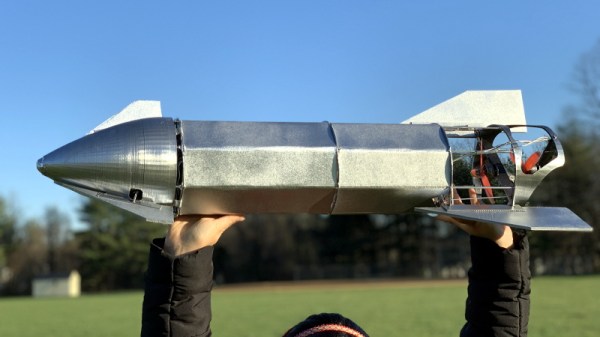
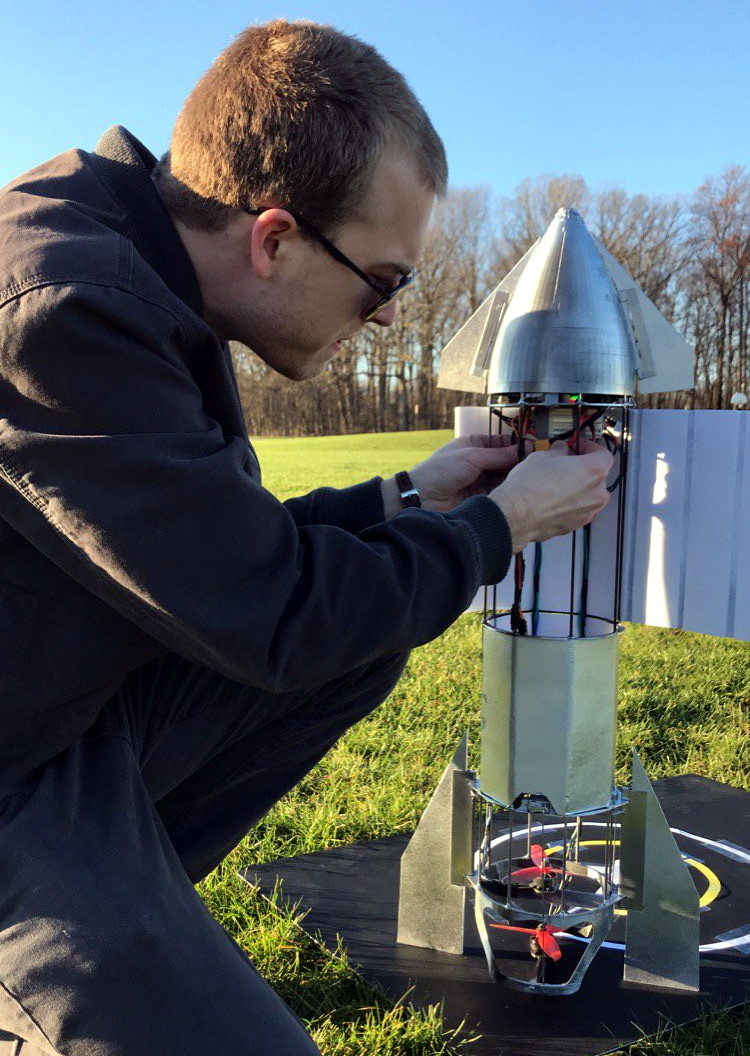
Finding himself inspired by this futuristic spacecraft, [Nicholas Rehm] has designed his own radio controlled Starship that’s capable of all the same aerobatic tricks as the real-thing. It swaps the rocket engines for a pair of electric brushless motors, but otherwise, it’s a fairly accurate recreation of SpaceX’s current test program vehicle. As you can see in the video after the break, it’s even able to stick the landing. Well, sometimes anyway.

Just like the real Starship, vectored thrust is used to both stabilize the vehicle during vertical ascent and help transition it into and out of horizontal flight. Of course, there are no rocket nozzles to slew around, so [Nicholas] is using servo-controlled vanes in the bottom of the rocket to divert the airflow from the motors. Servos are also used to control the external control surfaces, which provide stability and a bit of control authority as the vehicle is falling.

As an interesting aside, Internet sleuths looking through pictures of the Starship’s wreckage have noted that SpaceX appears to be actuating the flaps with gearboxes driven by Tesla motors. The vehicle is reportedly using Tesla battery packs as well. So while moving the control surfaces on model aircraft with battery-powered servos might historically have been a compromise to minimize internal complexity, here it’s actually quite close to the real thing.

Unfortunately, the RC Starship made a hard landing of its own on a recent test flight, so [Nicholas] currently has to rebuild the craft before he can continue with further development. We’re confident he’ll get it back in the air, though it will be interesting to see whether or not he’s flying before SpaceX fires off their next prototype.

Continue reading “RC Starship Perfects Its Skydiving Routine”

Literally Tearing Apart A SpaceX Starlink Antenna

While SpaceX’s constellation of Starlink satellites is nowhere near its projected final size, the company has enough of the birds zipping around in low Earth orbit to start a limited testing period they call the Better Than Nothing Beta. If you’re lucky enough to get selected, you have to cough up $500 for the hardware and another $100 a month for the service. Despite the fairly high bar for getting your hands on one, [Kenneth Keiter] decided to sacrifice his Starlink dish to the teardown Gods.

We say sacrifice because [Kenneth] had to literally destroy the dish to get a look inside. It doesn’t appear that you can realistically get into the exceptionally thin antenna array without pulling it all apart, thanks in part to preposterous amount of adhesive that holds the structural back plate onto the PCB. The sky-facing side of the phased array, the key element that allows the antenna to track the rapidly moving Starlink satellites as they pass overhead, is also laminated to a stack-up comprised of plastic hexagonal mesh layers, passive antenna elements, and the outer fiberglass skin. In short, there are definitely no user-serviceable parts inside.

The dish hides many secrets under its skin.

Beyond attempting to analyze the RF magic that’s happening inside the antenna, [Kenneth] also takes viewers through a tour of some of the more recognizable components of the PCB; picking out things like the Power over Ethernet magnetics, a GPS receiver, some flash storage, and the H-Bridge drivers used to control the pan and tilt motors in the base of the dish.

It also appears that the antenna is a self-contained computer of sorts, complete with ARM processor and RAM to run the software that aims the phased array. Speaking of which, it should come as no surprise to find that not only are the ICs that drive the dizzying array of antenna elements the most numerous components on the PCB, but that they appear to be some kind of custom silicon designed specifically for SpaceX.

In short, there’s still plenty we don’t know about how this high-tech receiver actually works. While [Kenneth] does a respectable job of trying to make sense of it all, and we admire the dedication required to rip apart such a rare and expensive piece of kit, it’s still going to be awhile before the hacker community truly masters the tech that SpaceX is putting into their ambitions global Internet service.

Continue reading “Literally Tearing Apart A SpaceX Starlink Antenna”

Spacing Out: A Big Anniversary, Starlink Failures Plummet, Lunar Cellphones, And A Crewed Launch

After a couple of months away we’re returning with our periodic roundup of happenings in orbit, as we tear you away from Star Trek: Discovery and The Mandalorian, and bring you up to date with some highlights from the real world of space. We’ve got a launch to look forward to this week, as well as a significant anniversary.

Continue reading “Spacing Out: A Big Anniversary, Starlink Failures Plummet, Lunar Cellphones, And A Crewed Launch”

Engine Trouble Delays SpaceX’s Return To The ISS

A crewed mission to the International Space Station that was set to depart from Kennedy Space Center on Halloween has been pushed back at least several weeks as NASA and SpaceX investigate an issue with the company’s Merlin rocket engine. But the problem in question wasn’t actually discovered on the booster that’s slated to carry the four new crew members up to the orbiting outpost. This story starts back on October 2nd, when the computer aboard a Falcon 9 set to carry a next-generation GPS III satellite into orbit for the US Space Force shut down the engines with just two seconds to go before liftoff.

The fact that SpaceX and NASA have decided to push back the launch of a different Falcon 9 is a clear indication that the issue isn’t limited to just one specific booster, and must be a problem with the design or construction of the Merlin engine itself. While both entities have been relatively tight lipped about the current situation, a Tweet from CEO Elon Musk made just hours after the GPS III abort hinted the problem was with the engine’s gas generator:

As we’ve discussed previously, the Merlin is what’s known as an “open cycle” rocket engine. In this classical design, which dates back to the German V-2 of WWII, the exhaust from what’s essentially a smaller and less efficient rocket engine is used to spin a turbine and generate the power required to pump the propellants into the main combustion chamber. Higher than expected pressure in the gas generator could lead to a catastrophic failure of the turbine it drives, so it’s no surprise that the Falcon 9’s onboard systems determined an abort was in order.

Grounding an entire fleet of rockets because a potentially serious fault has been discovered in one of them is a rational precaution, and has been done many times before. Engineers need time to investigate the issue and determine if changes must be made on the rest of the vehicles before they can safely return to flight. But that’s where things get interesting in this case.

SpaceX hasn’t grounded their entire fleet of Falcon 9 rockets. In fact, the company has flown several of them since the October 2nd launch abort. So why are only some of these boosters stuck in their hangers, while others are continuing to fly their scheduled missions?

Continue reading “Engine Trouble Delays SpaceX’s Return To The ISS”