Scratch Built Watch Case Is A Work Of Art

The wristwatch was once an absolute necessity, as much fashion statement as it was a practical piece of equipment. Phones in our pockets (and more often than not, in our faces) replaced the necessity of the wristwatch for the majority of people, and the fashion half of the equation really only interests a relatively small  subset of the population. The end result is that, aside from the recent emergence of smartwatches and fitness trackers, walking down the street it’s fairly unlikely you’ll see many people wearing a traditional watch.

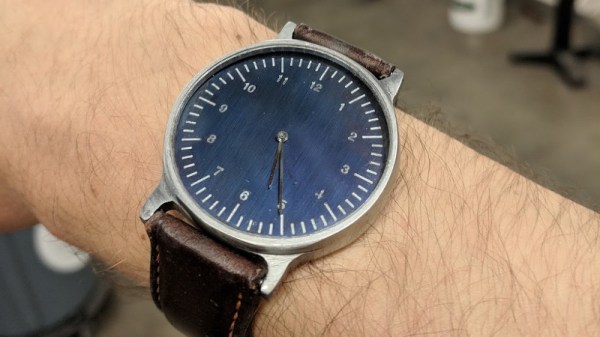
But we think the scratch built wristwatch case recently shown off by [Colin Merkel] adds a new justification for wearing a watch: pride. From a chunk of steel rod stock, [Colin] walks through every step of the process to creating a professional looking watch case. This is actually his second attempt at the project; while his first one certainly didn’t look bad, he felt that he learned enough from his earlier mistakes that it was worth starting over from scratch. A man after our own heart, to be sure. Continue reading “Scratch Built Watch Case Is A Work Of Art”

The Tourbillon: Anti-Gravity For Watch Movements

Do you know what time it is? Chances are good that you used a computer or a cell phone to answer that question. The time on your phone is about as accurate as chronometry gets these days. That’s because cell networks are timed from satellites, which are in turn timed from atomic clocks. And these days, it may be that atomic clocks are the only clocks that matter.

Before this modern era of quartz and atomic accuracy, though, timepieces were mechanical. Clocks were driven by heavy weights that made them impractical for travel. It wasn’t until the mainspring-driven movement came along that timekeeping could even begin to become portable.

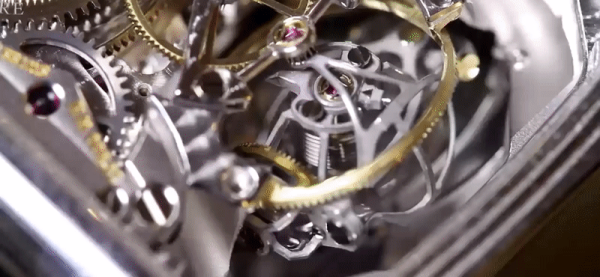
But while the invention of the mainspring made portable timepieces possible, it hurt their accuracy. That’s because the driving force of a tightly wound spring isn’t constant like that of an inert, solid weight.  So pocket watches weren’t exactly an overnight success. Early pieces were largely ornamental, and only told the hour. Worst of all, they would slow down throughout the day as the mainspring unwound, becoming useless unless wound several times a day. The mainspring wasn’t the only problem plaguing pocket watches, but it was the among the most obvious.

Continue reading “The Tourbillon: Anti-Gravity For Watch Movements”

Wooden Word Wristwatch Wows Woomies

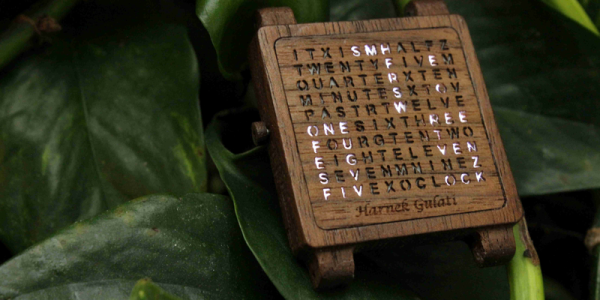
[HakuG] wanted to make a watch for his roommates, and had a design project due. He killed two birds with one stone, and then some. The result is a classic word clock, but with a refined all-wood look that’s also small enough to wear on your wrist.

Nothing good ever comes out right the first time, and the log of [HakuG]’s different versions is full of different attempts, all of them just fine in their own right, but none of them “perfect”. Kudos to [HakuG] for sticking with it and refining the project far past the initial prototype stage to something that really looks like a finished product.

Of course we’ve covered word clocks before. Heck, we’ve even seen a beautiful wooden one. But we’re pretty sure that this is the first wooden word-clock watch we’ve ever written up, and it’s surely one of the nicest.

Thanks [Paul Hein] for the link!

Tell Time With A Reverse-Sundial Watch

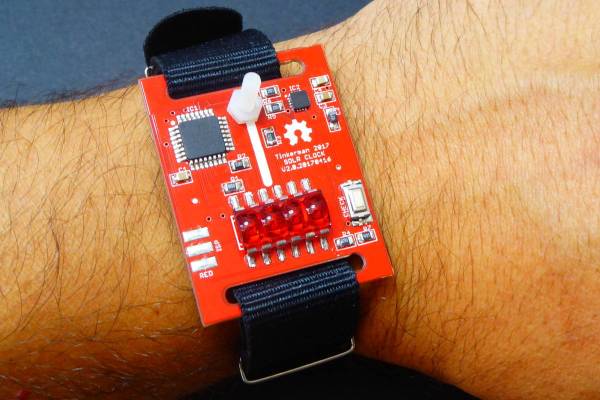
[Xose Pérez] set out to make a sundial wristwatch by combining a magnetometer a small nylon bolt for the gnomon, but it doesn’t work like you’d think. Instead of using the magnetometer to point the sundial north, you angle the watch until the bolt’s shadow matches the white line on the PCB, and the ATmega328P computes the azimuth of the sun and determines the time thereby. To display the time he used one of those QDSP-6064 bubble displays, because sundials are retro.

His description of the project build includes a lot of fun anecdotes, like him attempting to solder the LCC connections of the HMC5883 magnetometer before giving up and making use of Seeedstudio’s PCBA service. He got 10 boards back with the ATmega and magnetometer populated while leaving the rest for [Xose] to fill in.

One fun detail of the project? You can’t tell what time it is without the sun, but you can’t read the bubble display in bright sunlight.

If you’re looking for more watch projects we’ve published, check out this wrist-controlled watch, the Chronio DIY watch, and this cool nixie-tube watch.

Hackaday Prize Entry: Health-Monitoring Flexible Smartwatch

[Nick Ames]’s Flexible Smartwatch project aims to create an Open Source smartwatch made out of a flexible, capacitive e-ink touchscreen that uses the whole surface of the band. This wraparound smartwatch displays information from the on-board pulse and blood oximetry sensor as well as the accelerometer and magnetometer, giving you a clear idea of how stressed you are about your upcoming meeting.

The display [Nick] went with is called an electrophoretic display (EPD). It’s 400×200-pixels at 115ppi with a 4″ diagonal, and can bend around a wrist. It can draw shapes in 16 shades of gray with a refresh time of under a second or B&W with a faster refresh.

The smartwatch described in [Nick]’s project would be 2.5mm thick — certainly thin enough to fit under a sleeve. We suspect that success of the form factor may hinge on [Nick]’s success in making it not look like a hospital wristband. Although this gives us the thought that a biofeedback-sensing smart wristband is probably the future of hospital stays.

The Smartest Smart Watch Is The One You Make Yourself

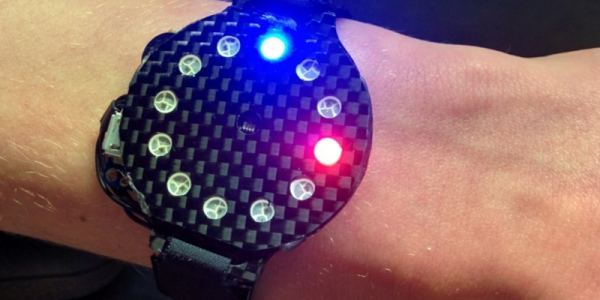
If you’re building a smart watch these days (yawn!), you’ve got to have some special sauce to impress the jaded Hackaday community. [Dominic]’s NeoPixel SmartWatch delivers, with his own take on what’s important to have on your wrist, and just as importantly, what isn’t.

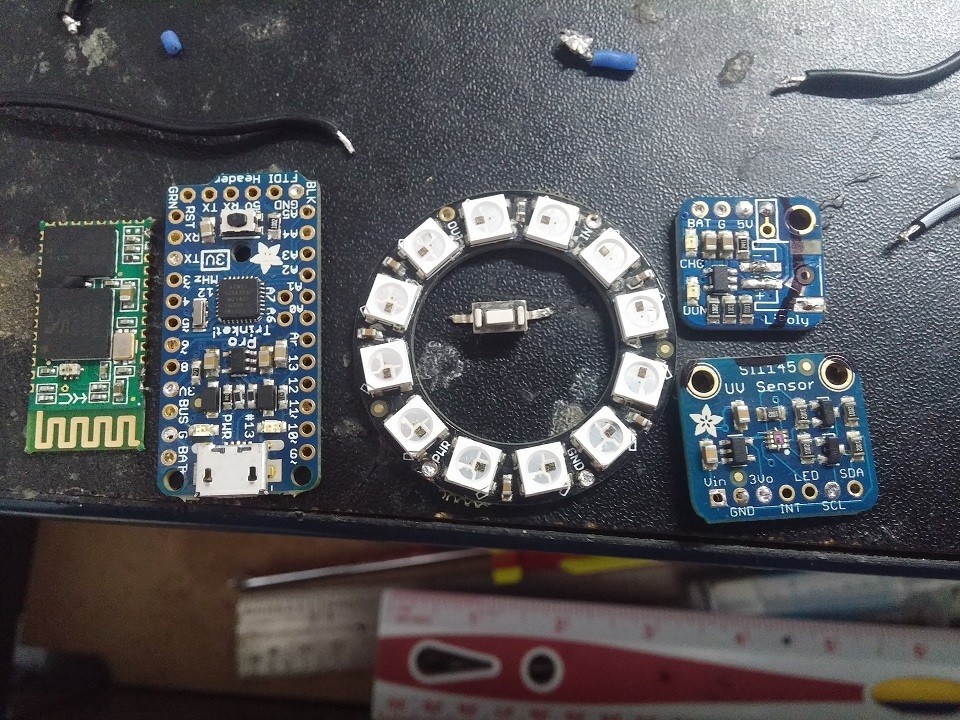
There’s no fancy screen. Instead, the watch gets by with a ring of NeoPixels for all its notification needs. But notification is what it does right. It tells [Dominic] when he’s got an incoming call of course, but also has different flashing color modes for SMS, Snapchat, and e-mail. Oh yeah, and it tells time and even has a flashlight mode. Great functionality for a minimalistic display.

But that’s not all! It’s also got a light sensor that works from the UV all the way down to IR. At the moment, it’s being used to automatically adjust the LED brightness and to display current UV levels. (We imagine turning this into a sunburn alarm mode.) Also planned is a TV-B-Gone style IR transmitter.

The hardware is the tough part of this build, and [Dominic] ended up using a custom PCB to help in cramming so many off-the-shelf modules into a tiny space. Making it look good is icing on the cake.

Thanks [Marcello] for the tip!

Continue reading “The Smartest Smart Watch Is The One You Make Yourself”

Building A Replica Of An Ultraluxury Watch

In the world of late-stage capitalism, unchecked redistribution of wealth to the upper classes has led to the development of so-called ultraluxury watches. Free from any reasonable constraints on material or R&D cost, manufacturers are free to explore the outer limits of the horological art. [Karel] is an aspiring engineer and watch enthusiast, and has a taste for the creations of Urwerk. They decided to see if they could create a replica of the UR202 watch with nothing more than the marketing materials as a guide.

[Karel]’s first job was to create a model of the watch in CAD. For a regular watch this might be simple enough, but the UR202 is no run-of-the-mill timepiece. It features a highly irregular mechanism, full of things like a turbine regulated winding mechanism, telescoping rods instead of minute hands, and tumbling rotors to indicate the hours. The official product sheet bears some of these features out. Through careful analysis of photos and watching videos frame-by-frame, they managed to recreate what they believe to be a functioning mechanical model within their CAD software.

It was then time to try and build the timepiece for real. It was then that [Karel] started hitting some serious stumbling blocks. As a humble engineering student, it’s not often possible to purchase an entire machine shop capable of turning out the tiny, precision parts necessary to make even a basic watch mechanism. Your basic 3D printer squirting hot plastic isn’t going to cut it here. Farming out machining wasn’t an option as the cost would be astronomical. [Karel] instead decided on combining a Miyota movement with a machined aluminum base plate and parts 3D printed using a process known as “Multijet Modelling” which essentially is an inkjet printhead spitting out UV curable polymer.

In the end, [Karel] was able to get just the tumbling hour indicator working. The telescoping minute hand, compressed air turbine winding system, and other features didn’t make it into the build. However, the process of simulating these features within a CAD package, as well as manufacturing a semi-functional replica of the watch, was clearly a powerful learning experience. [Karel] used their passion to pursue a project that ended up giving them a strong grasp of some valuable skills, and that is something that is incredibly rewarding.

We’ve seen others trying to fabricate parts of a wristwatch at home. Keep your horological tips coming in!

[Thanks to Str Alorman for the tip!]