This clever Instructable demonstrates how to etch beautiful aluminum control panels for electronics projects. We like how similar this process is to DIY circuit board etching. Both abide by the same technique and use blue transfer paper. The primary difference is in the use of muriatic acid and hydrogen peroxide for etching aluminum.
Flex sensors, like the ones used in the Nintendo Power Glove, are generally expensive and hard to find. However, [jiovine] demonstrates that they are easy enough to make from spare parts. He sandwiched a strip of plastic from ESD bags between pieces of copper foil, and wrapped the whole thing in heat shrink tubing. The sensor is able to detect bends in either direction, unlike the original power glove sensors. His version had a nominal resistance of about 20k ohms, but by choosing a different resistive layer you could create sensors that are more or less resistive.
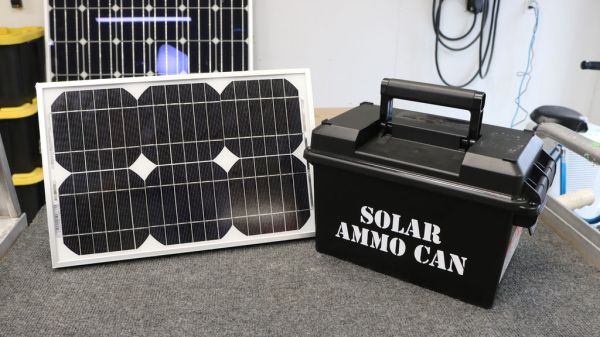
Our love for solar projects continues on with this method to make your own solar panels. [Mike] built a 60 watt solar panel from individual solar cells he purchased off eBay. Procuring parts off of eBay normally causes others hardship when they try to duplicate the project, however in this case there are so many types of cells people can use to produce their own unique solar panel. Even cells that are extremely damaged my still be used, as in this example. To charge a 12 volt battery the number of cells in series just needs to be 16-18 volts, and the rest in parallel will supply more current. Charging a battery without a charge controller is not recommended, but commercial ones are easily had. Those not interested in jumping all the way in with solar may want to test the waters by building their own panel and putting it to use as a charging station for your portable gadgets.
Taking a cue from the jog wheel we posted last week, [42ndOddity] has built an improved version. The design is based around a solid state rotary encoder instead of an optical encoder. The rotary encoder is far easier to attach and position properly. The knob is milled from scrap aluminum-it was a copier foot. To make the motion smooth, it’s sitting in a bearing from the same copier.
[blakebevin]’s sister shattered the screen on his Amazon Kindle, so he decided to try replacing it with the screen from a Sony Reader. He disassembled the Sony Reader and used a Dremel to mill down most of the aluminum tabs on the E Ink screen. The screen plugs into the same harness as the original Kindle screen the only problem is fit. The new screen interferes with some of the button movement and without trimming the case will bulge a little. Performance wise the screen ghosts on page turn and [blakebevin] assumes this is due to older technology. We’d hope to never have to do this, but it’s good to know the transplant option is there and not very difficult.
[whatsisface] sent in his scratch built clone of a Griffin PowerMate. The PowerMate… is just a big knob, so it’s easy to see why more than one person has attempted this. [whatsisface] was inspired by a bit-tech post that did nearly the same thing, only they used the head out of a VCR for the knob. All the other components, like the optical encoder, are salvaged from a mouse, which we talked about in our scavenging How-To. He used a RC car tire for the actual knob. While we’re sure it works great in dirt, we’d probably go with the weight and inertia of the VCR head instead. Have a look at the video below to see the knob being used with the Volumouse software.
If you’ve been puzzled over a discreet, durable way to sew wiring into your clothing, then puzzle no more: [Plusea] has put together a writeup detailing how to make a USB cable partly out of stretchy cotton fabric. Although the design as detailed doesn’t give much practical use for the invention, we can think of several very effective ways of exploiting this toy. Imagine, for example, placing a USB battery pack into one pocket of a jacket, a portable digital audio recorder in the other, and a lavalier microphone in the lining, thus enabling dozens of hours of covert audio surveillance.
[jonboytang] documented his construction of a clone of the famous Tube Screamer overdrive pedal from a set of plans found at tonepad. The tonepad site says you can use the plans to build either a TS-9 or a TS-808, both of which have been classic staples in every guitar player’s setup since the 70s. Although the old parts are no longer available, these new variants still have a really nice sound.
This project is really just a look into [jonboytang]’s etching and enclosure building process, but it may be useful for someone. The build and the circuit look really simple so this would be a great project for guitar players looking to learn how to etch their own PCBs. If you need more information on etching, we would suggest starting out by reading our How-To on etching single sided PCBs. If you are lazy and would rather spend a little money, check out tonepad’s online store. They have a board for this project and many others.
It might not be as elegant or technologically-advanced as a Segway or a motorized unicycle, but this easily constructed 2-wheeled robot might be a fun project for a free afternoon. The heart of the balancing mechanism is an SPDT switch with a button cell attached that reverses the motor when the robot begins to tip in one direction. It’s not controllable and it tends to fall over quite a bit, but it’s a good starting point and could be refined by lowering the center of gravity or figuring out a simple way to change the motor speed based on how far the robot has tipped over. There are no accelerometers or tilt switches so the components could be sourced from a parts bin, and its simple design definitely leaves a lot of room for improvement.
Here’s something for those of you who always wanted your projects to attract more shotgun blasts. [courtney] built two RC duck decoys. The decoys were only $10 to begin with and the RC submarines were an additional $20 at RadioShack. The construction is fairly clever, using a heat gun to conform the duck body to the submarine. We think the most surprising bit is that this has been done many times over: RC duck with rocket launcher, RC duck cam, and someone is producing commercial ones. Whatever you end up putting in your remotely operated duck, we’ll be sure to include it in our next movie plot threat entry.