3D Printed Stick Shift Handle

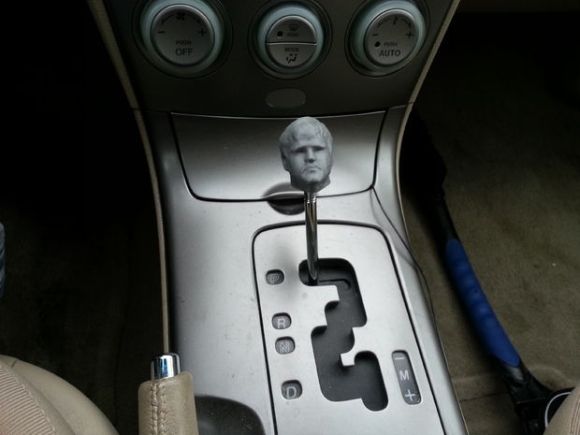
3D printed gear shifter

Here’s a silly hack for you guys. Turn your head (or anything else really) into a stick shift handle!

All jokes about vanity aside, [Haqnmaq] has outlined an excellent Instructable on how to take 3D scans, manipulate them, and make them 3D printer ready. He’s chosen to use a Microsoft Kinect (one of the cheapest 3D scanners around) combined with some low-cost 3D software. He’s used both Skanect and Reconstructme with great success, which both have free (albeit slightly limited) versions. The model he used for his stick shift was actually taken at the 3D Printing Experience in Chicago.

Continue reading “3D Printed Stick Shift Handle”

Game Boy Vs. Electronic Shelf Labels

SANYO DIGITAL CAMERAWhile they’re probably rare as hen’s teeth in the US, there have been a few major stores around the world that have started rolling out electronic shelf labels for every item in the store. These labels ensure every item on a shelf has the same price as what’s in the store’s computer, and they’re all controlled by an infrared transceiver hanging on the store’s ceiling. After studying one of these base stations, [furrtek] realized they’re wide open if you have the right equipment. The right equipment, it turns out, is a Game Boy Color.

The shelf labels in question are controlled by a base station with a decidedly non-standard carrier frequency and a proprietary protocol. IR driver chips found in phones are too slow to communicate with these labels, and old PDAs like Palm Pilots, Zauruses, and Pocket PCs only have an IrDA chip. There is one device that has an active development scene and an IR LED connected directly to a CPU pin, though, so [furrtek] started tinkering around with the hardware.

The Game Boy needed to be overclocked to get the right carrier frequency of 1.25 MHz. With a proof of concept already developed on a FPGA board, [furrtek] started coding for the Game Boy, developing an interface that allows him to change the ‘pages’ of these electronic labels, or display customized data on a particular label.

There’s also a much, much more facepalming implication of this build: these electronic labels’ firmware is able to be updated through IR. All [furrtek] needs is the development tools for the uC inside one of these labels.

There’s a great video [furrtek] put together going over this one. Check that out below.

Continue reading “Game Boy Vs. Electronic Shelf Labels”

Go On A Power Trip With Powerduino

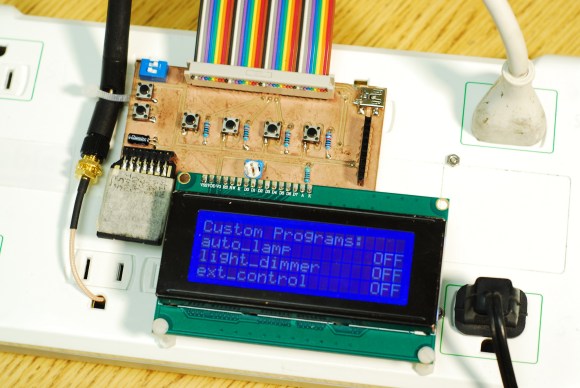
powerduinoThings don’t always run the way we want them to or operate at the ideal temperature out of the box. Instead of spending extra for power controls that may or may not meet your needs, wouldn’t it make more sense to dial in the ideal level from the source? That’s what [dekuNukem] had in mind when he decided to make Powerduino, an arduino-compatible programmable power strip.

With Powerduino, [dekuNukem] can control the electrical consumption of all kinds of things without ever worrying about the irreversible deadliness of mains voltage. It actually uses a Teensy 3.1 which can be programmed with the Arduino IDE through the micro USB connector. He’s really tricked it out to the point of putting Kill A Watt meters to shame. A wi-fi module lets him control any of the outlets from anywhere, and the RTC module lets him make customized schedules for them. Powerduino has an SD card slot for logging energy consumption, and a 20 x 4 LCD screen makes it easy to directly interface with the power strip.

The Powerduino code is up on GitHub, and [dekuNukem]’s walkthrough video is after the jump.

Continue reading “Go On A Power Trip With Powerduino”

Off-Road Quad Uses… A Pneumatic Drive?

AirQuad_Outside

Now here’s a really cool engineering degree project — a team of students from a university in Vienna have made a pneumatically driven motor — and fitted it into a quad! (Translated)

The team consists of [Simon Friesacher], [Simon Schedl], [Christoph Sieber] and [Manuel Streith] who all happen to be in the same class as [Maximilian] and [Sebastian] the duo who brought us the VoLumen display, and [Max’s] Ripper CNC!

For their main project, the goal was to create an alternative and innovative motor — one that runs off of compressed air, using firefighter’s air tanks. Once they had that figured out, they decided to have some fun with it and put together the Air Quad. It only has a range of a few kilometers, and doesn’t perform quite as well its original gasoline counterpart, but we have to admit, it’s a very slick proof of concept!

Stick around after the break to see a promotional demo of the Air Quad in action!

Continue reading “Off-Road Quad Uses… A Pneumatic Drive?”

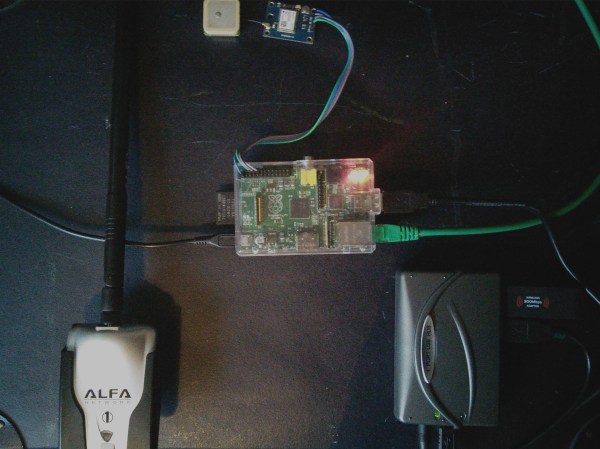
Raspi, GPS, USB hub and battery hooked together

NSA Technology Goes Open Hardware

When [Edward Snowden] smeared the internet with classified NSA documents, it brought to light the many spying capabilities our government has at its disposal. One the most interesting of these documents is known as the ANT catalog. This 50 page catalog, now available to the public, reads like a mail order form where agents can simply select the technology they want and order it. One of these technologies is called the Sparrow II, and a group of hackers at Hyperion Bristol has attempted to create their own version.

The Sparrow II is an aerial surveillance platform designed to map and catalog WiFi access points. Think wardriving from a UAV. Now, if you were an NSA agent, you could just order yourself one of these nifty devices from the ANT catalog for a measly 6 grand.  However, if you’re like most of us, you can use the guidance from Hyperion Bristol to make your own.

They start off with a Raspi, a run-of-the-mill USB WiFi adapter, a Ublox GY-NEO6MV2 GPS Module, and a 1200 mAh battery to power it all. Be sure to check out the link for full details.

Thanks to [Joe] for the tip!

Japanese Edition: 3Dプリンターで24時間以内に住宅建設。しかもリサイクル材料を用いたエコ建築。

3d printed house in china

by: [Hideyuki Yamamoto] based on this feature.

3Dプリンターメーカーが小さくて精度が高いプリンターを開発するのに躍起になっている中でShanghai WinSun Decoration Design Engineering Companyという中国にある会社がオリンピックプールの半分程度の大きさの巨大な3Dプリンターで実験を重ねているとBBCなどは報じている。

http://3dprinterplans.info/3d-printer-plans-news-round-up-for-wednesday-16042014/

縦32m、横10m、高さ6.6mものマンモスプリンターで400m2の平屋一戸建て住宅がプリント出来る。FDM技術によりセメントと建築廃材混合の壁が作られ、その会社によると一軒あたり5000ドル以下で建てられ、1日あたりなんと10戸の製作が可能とのこと。

そのプリンターは数年前に設計され、WinSunが海外から部品を調達し、蘇州工場で組み立てられた。
この会社は街全体の家をプリントする計画を立てており、リサイクル施設を建設するための部材を集めているという。この家は、まずは青島にて販売される予定だ。

FDM技術を使えば軽量で耐久性のある家がプリント可能になる。この手法は間違いなくオランダのKamerMaker社による建築よりも早いであろう。耐久性や安全性に関してはまだまだ改善の余地があると思われるが、安くて短期間に家が建つ可能性が拡がる話題である。

Continue reading “Japanese Edition: 3Dプリンターで24時間以内に住宅建設。しかもリサイクル材料を用いたエコ建築。”

Star Wars Training Droid Uses The Force

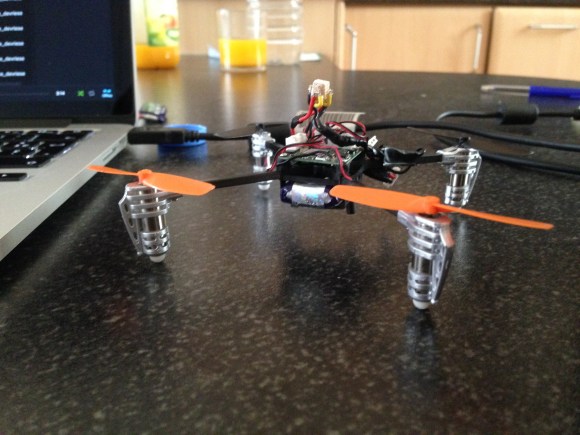
Star Wars Training Droid

We all know the scene, Obi-Wan Kenobi gives Luke a helmet with the blast shield down. He tells Luke “Your eyes can deceive you. Don’t trust them. Stretch out with your feelings!” Easy for Obi-Wan to say – he doesn’t have a remote training droid flying around and shooting at him. [Roeland] and his team are working to create a real-life version of the training droid for Hackday’s Sci-Fi contest.

The training droid in Star Wars may not have had the Force on its side, but it was pretty darn agile in the air. To replicate this, the team started with a standard Walkera Ladybird micro quadcopter. It would have been simple to have a human controlling the drone-turned-droid, but [Roeland and co] wanted a fully computer controlled system. The Ladybird can carry a small payload, but it just doesn’t have the power to lift a computer and sensor suite. The team took a note from the GRASP Lab and used an external computer with a camera to control their droid.

Rather than the expensive motion capture system used by the big labs, the team used a pair of Wii Remote controllers for stereo vision. A small IR LED mounted atop the droid made it visible to the Wii Remotes’ cameras. A laptop was employed to calculate the current position of the droid. With the current and desired positions known, the laptop calculated and sent commands to an Arduino, which then translated them for the droid’s controller.

Nice work guys! Now you just have to add the blaster emitters to it!

Continue reading “Star Wars Training Droid Uses The Force”