Earliest Recorded Computer Music Restored

You want old skool electronic music? How about 1951?

Researchers at the University of Canterbury in New Zealand have just restored what is probably the oldest piece of recorded, computer-generated music. Recorded in 1951, the rendition of “God Save The King”, “Baa-Baa Black Sheep” and “In The Mood” was produced by a computer built by none other Alan Turing and other researchers at the Computing Machine Research Laboratory in Manchester.

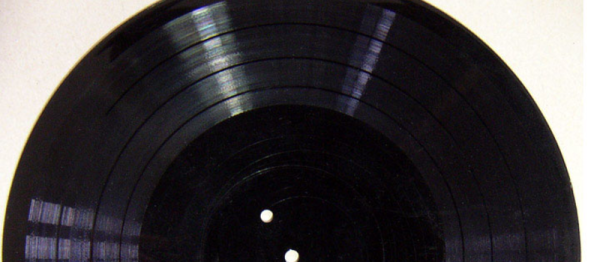
These phat beats were captured by the BBC for broadcast on an acetate disk that the researchers found in an archive. They sampled and restored the recording, fixing the rather poor quality recording to reproduce the squawky tones that the computer played. You can hear the restored recording after the break.

It halts apparently unexpectedly in the middle of a stanza, sounds essentially horrible, and goes out of tune on the higher notes. But you gotta learn to crawl before you can walk, and these are the equivalent of the grainy 8mm films of baby’s first steps. And as such, the record is remarkable.

Via ABC News

Continue reading “Earliest Recorded Computer Music Restored”
Boombox Doorjam Plays Your Theme Song When You Step In The Ring

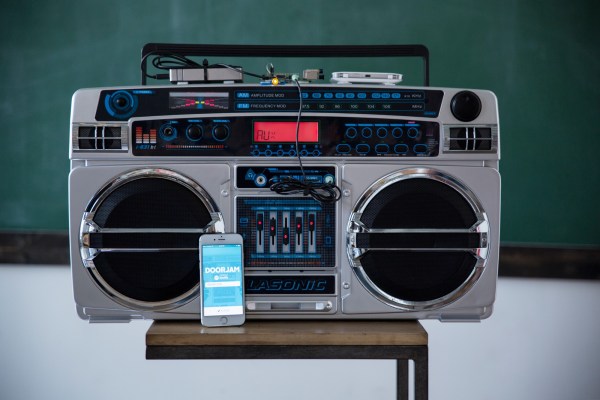
Although many of us may have had childhood aspirations to be a famous wrestler in the WWE, not very many of us will ever realize those dreams. You can get close, though, if you have your own epic intro music theme that plays anytime you walk into a room. Although it’s not quite the same as entering a wrestling ring, [Matt]’s latest project will have you feeling just as good whenever you enter a room to your own theme song.

The core of the build consists of a boom box with an auxiliary input. The boom box is fed sound via a Raspberry Pi which also serves as the control center for the rest of the project. It runs Node.js and receives commands via websockets from a publicly accessible control server. The Pi is also running Spotify which allows a user to select a theme song, and whenever that user’s iBeacon is within range, the Pi will play that theme song over the stereo.

The project looks like it would be easy to adapt to any other stereo if you’re looking to build your own. Most of the instructions and code you’ll need are available on the project’s website, too. And, if you’re a fan of music playing whenever you open a door of some sort, this unique project is clearly the gold standard. It might even make Stone Cold Steve Austin jealous.

Hallucinating Machines Generate Tiny Video Clips

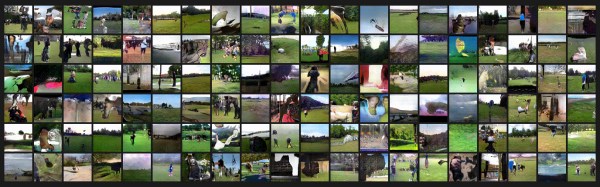
Hallucination is the erroneous perception of something that’s actually absent – or in other words: A possible interpretation of training data. Researchers from the MIT and the UMBC have developed and trained a generative-machine learning model that learns to generate tiny videos at random. The hallucination-like, 64×64 pixels small clips are somewhat plausible, but also a bit spooky.

The machine-learning model behind these artificial clips is capable of learning from unlabeled “in-the-wild” training videos and relies mostly on the temporal coherence of subsequent frames as well as the presence of a static background. It learns to disentangle foreground objects from the background and extracts the overall dynamics from the scenes. The trained model can then be used to generate new clips at random (as shown above), or from a static input image (as shown in pairs below).

Currently, the team limits the clips to a resolution of 64×64 pixels and 32 frames in duration in order to decrease the amount of required training data, which is still at 7 TB. Despite obvious deficiencies in terms of photorealism, the little clips have been judged “more realistic” than real clips by about 20 percent of the participants in a psychophysical study the team conducted. The code for the project (Torch7/LuaJIT) can already be found on GitHub, together with a pre-trained model. The project will also be shown in December at the 2016 NIPS conference.

Testing The Speed-of-Light Conspiracy

There are a number of ways to measure the speed of light. If you’ve got an oscilloscope and a few spare parts, you can build your own apparatus for just a few bucks. Don’t believe the “lies” that “they” tell you: measure it yourself!

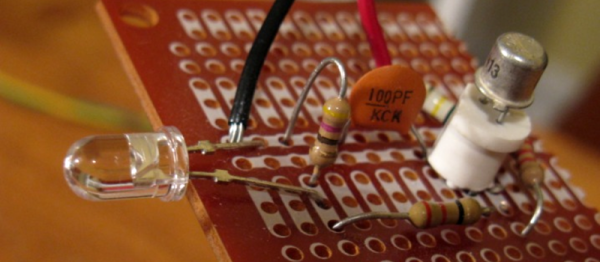
OK, we’re pretty sure that conspiracy theories weren’t the motivation that got [Michael Gallant] to build his own speed-of-light measurement rig, but the result is a great writeup, and a project that includes one of our favorite circuits, the avalanche transistor pulse generator.

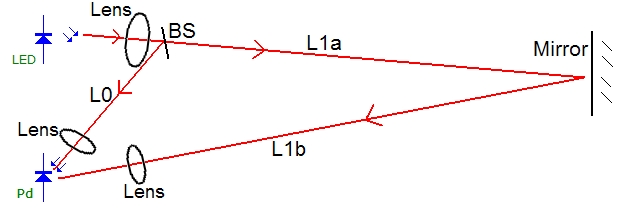
setupThe apparatus starts off with a very quickly pulsed IR LED, a lens, and a beam-splitter. One half of the beam takes a shortcut, and the other bounces off a mirror that is farther away. A simple op-amp circuit amplifies the resulting pulses after they are detected by a photodiode. The delay is measured on an oscilloscope, and the path difference measured with a tape measure.

If you happen to have a photomultiplier tube in your junk box, you can do away with the amplifier stage. Or if you have some really fast logic circuits, here’s another project that might interest you. But if you just want the most direct measurement we can think of that’s astoundingly accurate for something lashed up on breadboards, you can’t beat [Michael]’s lash-up.

Oh and PS: He got 299,000 (+/- 5,000) km/sec.

Creating A PCB In Everything: Eagle DRC And Gerber Files

For the next post in the Creating A PCB series, we’re going to continue our explorations of Eagle. In Part 1,  I went over how to create a part from scratch in Eagle. In Part 2, we used this part to create the small example board from the Introduction.

This time around I’ll be going over Design Rule Check (DRC) — or making sure your board house can actually fabricate what you’ve designed. I’ll also be covering the creation of Gerber files (so you can get the PCB fabbed anywhere you want), and putting real art into the silkscreen and soldermask layers of your boards.

The idea behind this series is to explore different EDA suites and PCB design tools by designing the same circuit in each. You can check out the rest of the posts in this series right here.

Continue reading “Creating A PCB In Everything: Eagle DRC And Gerber Files”

Taking A U2F Hardware Key From Design To Production

Building a circuit from prototyping to printed circuit board assembly is within the reach of pretty much anyone with the will to get the job done. If that turns out to be something that everyone else wants, though, the job gets suddenly much more complex. This is what happened to [Conor], who started with an idea to create two-factor authentication tokens and ended up manufacturing an selling them on Amazon. He documented his trials and tribulations along the way, it’s both an interesting and perhaps cautionary tale.

[Conor]’s tokens themselves are interesting in their simplicity: they use an Atmel ATECC508A specifically designed for P-256 signatures and keys, a the cheapest USB-enabled microcontroller he could find: a Silicon Labs EFM8UB1. His original idea was to solder all of the tokens over the course of one night, which is of course overly optimistic. Instead, he had the tokens fabricated and assembled before being shipped to him for programming.

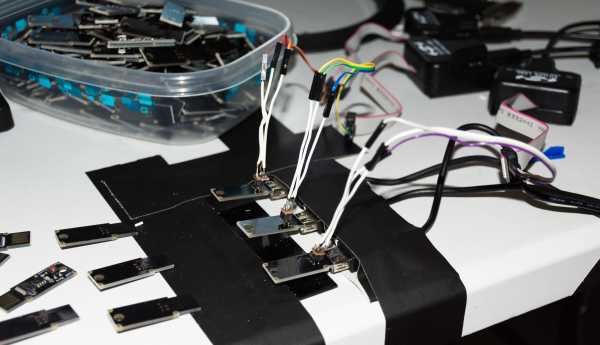
Normally the programming step would be straightforward, but using identical pieces of software for every token would compromise their security. He wrote a script based on the Atmel chip and creates a unique attestation certificate for each one. He was able to cut a significant amount of time off of the programming step by using the computed values with a programming jig he built to flash three units concurrently. This follows the same testing and programming path that [Bob Baddeley] advocated for in his Tools of the Trade series.

From there [Conor] just needed to get set up with Amazon. This was a process worthy of its own novel, with Amazon requiring an interesting amount of paperwork from [Conor] before he was able to proceed. Then there was an issue of an import tariff, but all-in-all everything seems to have gone pretty smoothly.

Creating a product from scratch like this can be an involved process. In this case it sounds like [Conor] extracted value from having gone through the entire process himself. But he also talks about a best-case-scenario margin of about 43%. That’s a tough bottom line but a good lesson anyone looking at building low-cost electronics.