Pokemon Go Physical Pokeball Catches ‘Em All

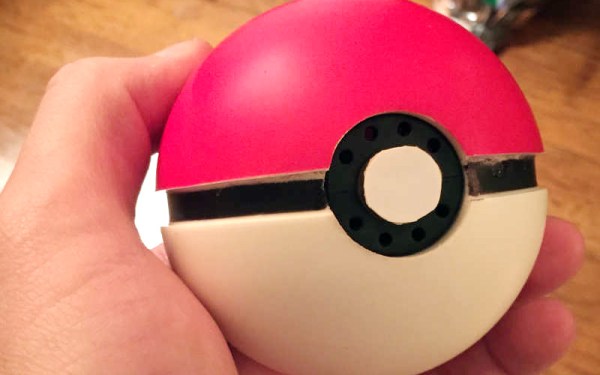
There’s something irresistible about throwing Pokeballs at unexpectedly appearing creatures. But wait. When did you actually, physically throw a Pokeball? Swiping over colored pixels wasn’t enough for [Trey Keown], so he built a real, throwable, Pokemon-catching Pokeball for Pokemon Go.

Continue reading “Pokemon Go Physical Pokeball Catches ‘Em All”

Hands-on The AND!XOR Unofficial DEF CON Badge

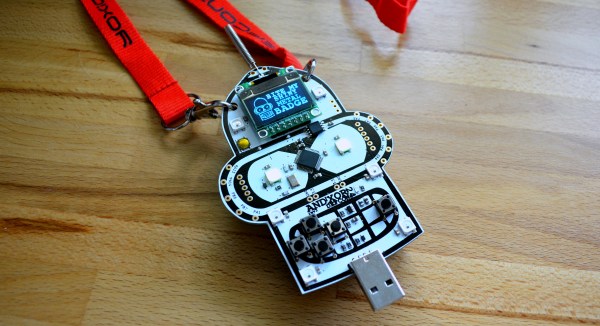
DEF CON 24 is still about two weeks away but we managed to get our hands on a hardware badge early. This is not the official hardware — there’s no way they’d let us leak that early. Although it may be unofficial in the sense that it won’t get you into the con, I’m declaring the AND!XOR badge to be officially awesome. I’ll walk you through it. There’s also a video below.

Over the past several years, building your own electronic badge has become an impromptu event. People who met at DEF CON and have been returning year after year spend the time in between coming up with great ideas and building as many badges as they can leading up to the event. This is how I met the trio who built this badge — AND!XORAndrew Riley, and Jorge Lacoste — last year they invited me up to their room where they were assembling the last of the Crypto Badges. Go check out my guide to 2015 Unofficial DEF CON badges for more on that story (and a video of the AM transmissions that badge was capable of).

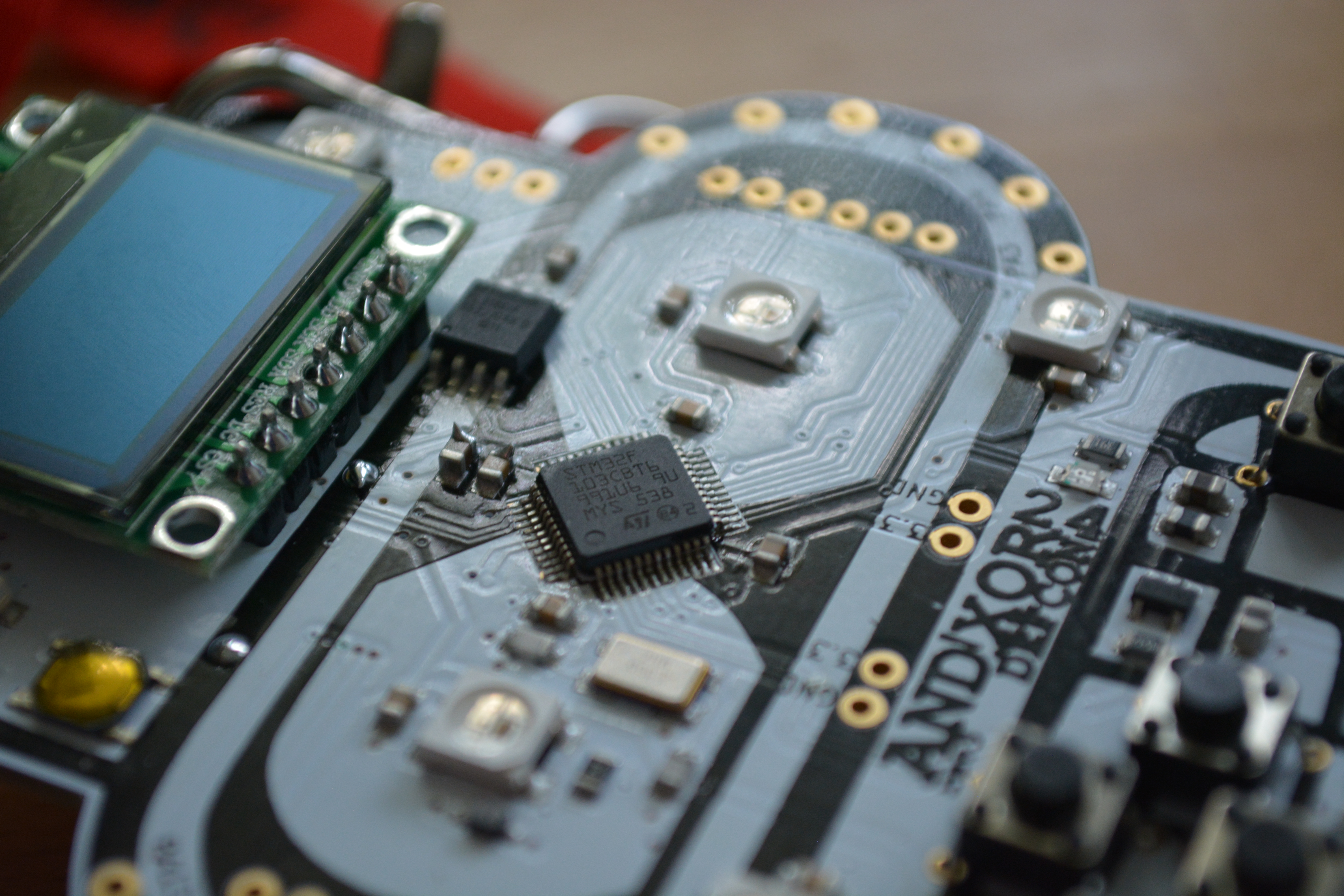
The outline is this year’s badge is of course Bender from Futurama. Both eyes are RGB LEDs, with another half dozen located at different points around his head. The microcontroller, an STM32F103 ARM Cortex-M0 Cortex-M3, sits in a diamond pattern between his eyes. Above the eyes you’ll find 16 Mbit of flash, a 128×64 OLED screen, and a reset button. The user inputs are five switches and the badge is powered by three AA batteries found on the flip side.

bender's-nose-closeup

That alone makes an interesting piece of hardware, but the RFM69W module makes all of the badges interactive. The spring coming off the top of Bender’s dome is a coil antenna for the 433 MHz communications. I only have the one badge on hand so I couldn’t delve too deeply what interactive tricks a large pool of badges will perform, but the menu hints at a structure in place for some very fun and interesting applications.

Continue reading “Hands-on The AND!XOR Unofficial DEF CON Badge”

DIY Command Station For Kerbal Space Program Is Overkill

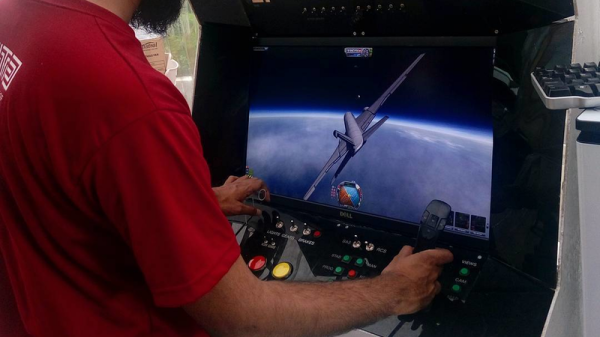
We’ve seen custom controller mods for Kerbal Space Program before, but a group calling themselves the Makerforce went a step further with their design and build of the KSP “Overkill” Command Station, which has much more in common with a fancy standup arcade unit than a custom controller. Kerbal Space Program is a hit indie game that, among other things, simulates the challenges of spaceflight. Like most games, you use the mouse and keyboard for control but many fans find this too limiting. With the help of a software mod that exposes control and status information over hardware serial communications, the door to full telemetry and remote control was opened to just about anyone to craft their own custom hardware such as flight sticks and status displays. Not content with the idea of having just a joystick and a few buttons critical for the flight process, this project took a different approach.

Continue reading “DIY Command Station For Kerbal Space Program Is Overkill”

What It’s Like To Quit Your Job And Start A Company – Then Fail

Some of our more dedicated readers may remember me as that promising and talented new writer who disappeared after only a couple of months last fall. Or, alternatively, that moronic new writer who had no idea what he was talking about. But, I’m just going to go ahead and assume it was the former in order to protect my ego. In either case, if you remember me at all, you may have wondered why I left. Was it cholera? Was I drafted into a top-secret CIA program? Did I join a circus as a fledgling trapeze artist?

No, it was none of that. That would be absurd. What would make you think I had any trapeze skills at all, much less circus-worthy ones? The truth is a lot more straightforward, but was also a lot scarier (and more exciting) for me — I started a business. The astute readers among you have probably already put the dots together and figured out that I failed. The title was a pretty strong hint, right? This isn’t a story of bootstraps-pulling success, or a heartwarming underdog tale. This is an opportunity for me to talk about the lessons I learned as I failed, and to give the entrepreneurs out there something to consider when they start their businesses. We’ll laugh together, we’ll cry together, and maybe we’ll even learn something together. Ready? Alright, let’s dive right into the heart of it, starting when I was seven years old…

Continue reading “What It’s Like To Quit Your Job And Start A Company – Then Fail”

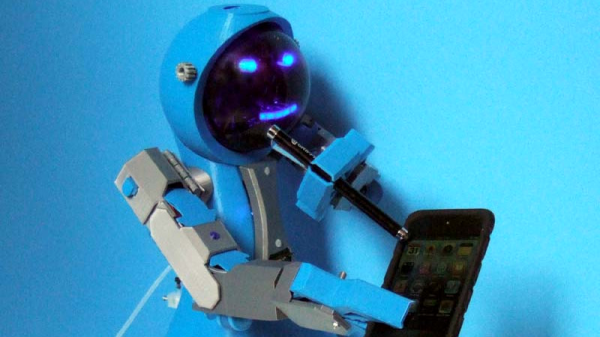
Zizzy The Personal Robot Uses 3D Printed Artificial Muscles Instead Of Hobby Servos

Zizzy is a personal robot designed to help those with limited mobility. Rather than being assisted by a nightmare creature, Zizzy would offer a more appealing and friendly option.

The coolest part about Zizzy is the 3D printable pneumatic artificial muscles. Project creator, [Michael Roybal] said it took over a year of development to arrive at the design.

The muscles are hollow bellows printed out of Ninjaflex with carefully calibrated settings. A lot of work must have gone into the design to make sure that they were printable. After printing the muscles are painted with a mixture of fabric glue and MEK solvent. If all is done correctly the bellows should be able to hold 20 PSI without any problem.

This results in a robot with very smooth and precise movement. It has none of the gear noise and can also give when it collides with a user, a feature typically found only in very expensive motor systems. If [Michael] can find a quiet compressor system the robot will be nearly silent.

Drinkro The Synchro Bartender

There is a significant constituency among hackers and makers for whom it is not the surroundings in which the drink is served or the character of the person serving it that is important, but the quality of its preparation. Not for them the distilled wit and wisdom of a bartender who has seen it all, instead the computer-controlled accuracy of a precisely prepared drink. They are the creators of bartending robots, and maybe some day all dank taverns will be replaced with their creations.

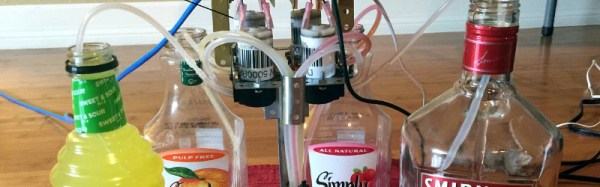
Drinkro is a bartending robot built by the team at [Synchro Labs]. It uses a Raspberry Pi 3 and a custom motor controller board driving a brace of DC peristaltic liquid pumps. that lift a variety of constituent beverages into the user’s glass. There is a multi-platform app through which multiple thirsty drinkers can place their orders, and all the source code and hardware files can be found in GitHub repositories. The robot possesses a fairly meagre repertoire of vodka and only three mixers, but perhaps it will be expanded with more motor driver and pump combinations.

There is a video of the machine in action, shown below the break. We can’t help noticing it’s not the fastest of bartenders, but maybe speed isn’t everything.

Continue reading “Drinkro The Synchro Bartender”

Hackaday Prize Entry: Augmented Reality For Firefighters

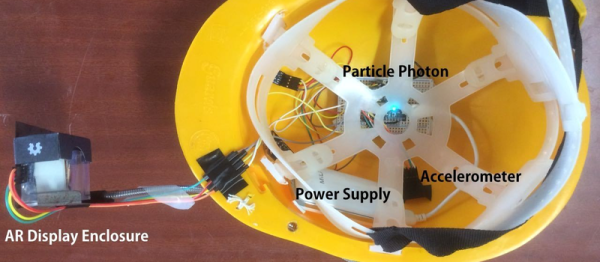
Augmented reality is all the rage right now, and it’s all because of Pokemon. Of course, this means the entire idea of augmented reality is now wrapped up in taking pictures of Pidgeys in their unnatural setting. There are more useful applications of augmented reality, as [vijayvictory]’s Hackaday Prize entry shows us. He’s built an augmented reality helmet for firefighters that will detect temperature, gasses, smoke and the user’s own vital signs, displaying the readings on a heads up display.

The core of the build is a Particle Photon, a WiFi-enabled microcontroller that also gives this helmet the ability to relay data back to a base station, ostensibly one that’s not on fire. To this, [vijayvictory] has added an accelerometer, gas sensor, and a beautiful OLED display mounted just behind a prism. This display overlays the relevant data to the firefighter without obstructing their field of vision.

Right now, this system is fairly basic, but [vijayvictory] has a few more tricks up his sleeve. By expanding this system to include a FLIR thermal imaging sensor, this augmented reality helmet will have the ability to see through smoke. By integrating this system into an existing network and adding a few cool WiFi tricks, this system will be able to located a downed firefighter using signal trilateralization. It’s a very cool device, and one that should be very useful, making it a great entry for The Hackaday Prize.