Avoiding Exercise With An ESP8266 And Blynk

[Mike Diamond] was tired of climbing down (and back up) 40 stairs to check his mailbox. He decided to create a mailbox alert using the ESP8266 to connect to his WiFi. The idea was simple: have the ESP8266 monitor when the mailbox flap opened using a magnet and a reed switch. As always, though, the devil is in the details. [Mike] got things working with a little help and shares not only the finished design but how he got there.

To handle the sending of e-mail, [Mike] used the Blynk app. You often think of Blynk as a way to build user interfaces on an Android or iOS device that can control an Arduino. In this case, though, [Mike] used the library with the ESP8266 and had it send e-mail on his behalf.

Continue reading “Avoiding Exercise With An ESP8266 And Blynk”

Cracking The Sega Saturn After 20 Years

When it was released 20 years ago, the Sega Saturn was by far the most powerful video game console available. It was a revolutionary device, had incredible (for the time) graphics, and a huge library of IP Sega could draw from. The Saturn was quickly overshadowed by the Sony Playstation, and soon these devices found themselves unused, unloved, and fetching high prices on the collectors market.

After finding a Sega Saturn on a trip to Japan, [jhl] decided he would like to write some code for this machine. Unlike earlier consoles, where Flash cartridges are readily available, or later consoles, where writing directly to the on-board storage is easy, bringing up a development environment for the Saturn isn’t easy. The best method is installing a mod chip and working off of burned CDs. Instead of writing a game or two for the Saturn, [jhl] got distracted for a few years and developed an optical drive emulator.
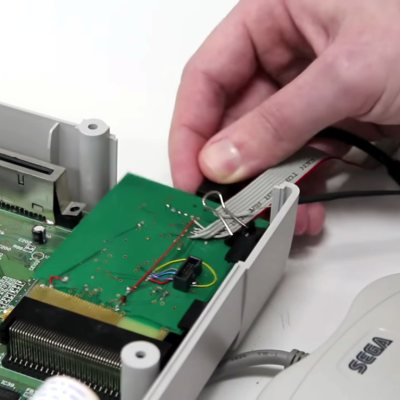
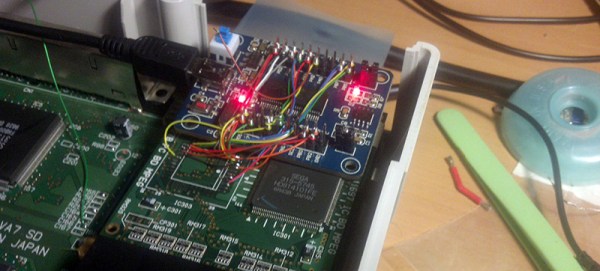
cracking-the-sega-saturn-thumbAccording to [jhl], the design of the Sega Saturn is tremendously complicated. There’s an entire chip dedicated to controlling the CD drive, and after some serious reverse engineering work, [jhl] had it pretty much figured out. The question then was how to load data onto the Saturn. For that. [jhl] turned to the internal expansion port on the Saturn. This internal expansion port was designed to accept an MPEG decoder card for playing video CDs on the Saturn, but the connector presents the entire bus. By attaching a Game Boy Flash cartridge, [jhl] was able to dump the ROM on the CD controller.

With a little bit of work, a fast ARM microcontroller, and a CPLD for all the logic glue, [jhl] was built an adapter to push CD data to the Saturn through this internal expansion port. Not only is this a boon for homebrew Saturn development, but this build also completely replaces the CD drive in the Saturn – a common failure point in this 20-year-old machine.

The formal release for this ultimate Saturn crack isn’t out yet, but it’s coming shortly, allowing anyone who still has a Saturn to enjoy all those very blocky games and develop their own games. You can check out a short, amateur documentary made on [jhl]’s efforts below.

Continue reading “Cracking The Sega Saturn After 20 Years”

Micropython Binaries For The ESP8266 To Be Released

MicroPython is a Kickstarted project that brings Python to small, embeddable devices. As part of the terms of the Kickstarter, supporters were to get exclusive access to binary builds, with a few exceptions. Now it looks like the ESP8266-version is going to be added to the binary list. This is awesome news for anyone who enjoys playing around with the popular WiFi chip.

But even more heartwarming is the overwhelming response of the Kickstarter’s backers for making the binary builds public. Basically everyone was in favor of opening the binaries up to the general public, and many wrote that they wanted public binaries all along. People can be so giving.

But there’s also something in it for them! The more people get behind MicroPython, the more (free and paid) development support it will warrant, and the more bug reports it will garner. Wins all around. So keep clicking refresh on the binary list until you see it live. Or better yet, if you’re interested, head over to the forum. (Or just wait for us to cover it here. You know we will.)

Not Quite 101 Uses For An Analog UHF TV Tuner

Young electronics hackers today are very fortunate to grow up in an era with both a plethora of capable devices to stimulate their imagination, and cheap and ready access to them. Less than the price of a hamburger meal can secure you a Linux computing platform such as the Raspberry Pi Zero, and a huge choice of sensors and peripherals are only an overnight postage envelope away.

Casing back a few decades to the 1980s, things were a little different for electronically inclined youth. We had the first generation of 8-bit microcomputers but they were expensive, and unless you had well-heeled parents prepared to buy you a top-end model they could be challenging to interface to. Other electronic parts were far more expensive, and mail order could take weeks to deliver the goods.

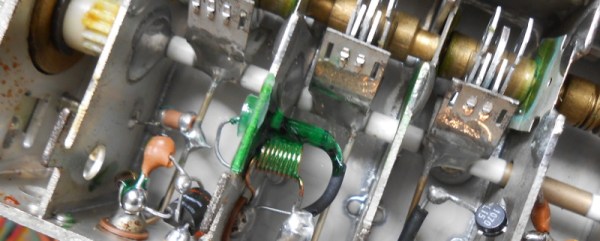
For some of us, this was not a problem. We simply cast around for other sources of parts, and one of the most convenient was the scrap CRT TV you’d find in nearly every dumpster in those days before electronic recycling. If you could make it from 1970s-era consumer-grade discrete components, we probably did so having carefully pored over a heap of large PCBs to seek out the right component values. Good training, you certainly end up knowing resistor colour codes by sight that way.

Continue reading “Not Quite 101 Uses For An Analog UHF TV Tuner”

Challenge Accepted: Automation

Today marks the beginning of the Automation Challenge round for the 2016 Hackaday Prize. We want to see what you can create that automates life. It’s a terrifically fun jumping off point for a project, and done just right, it can score you some amazing prizes.

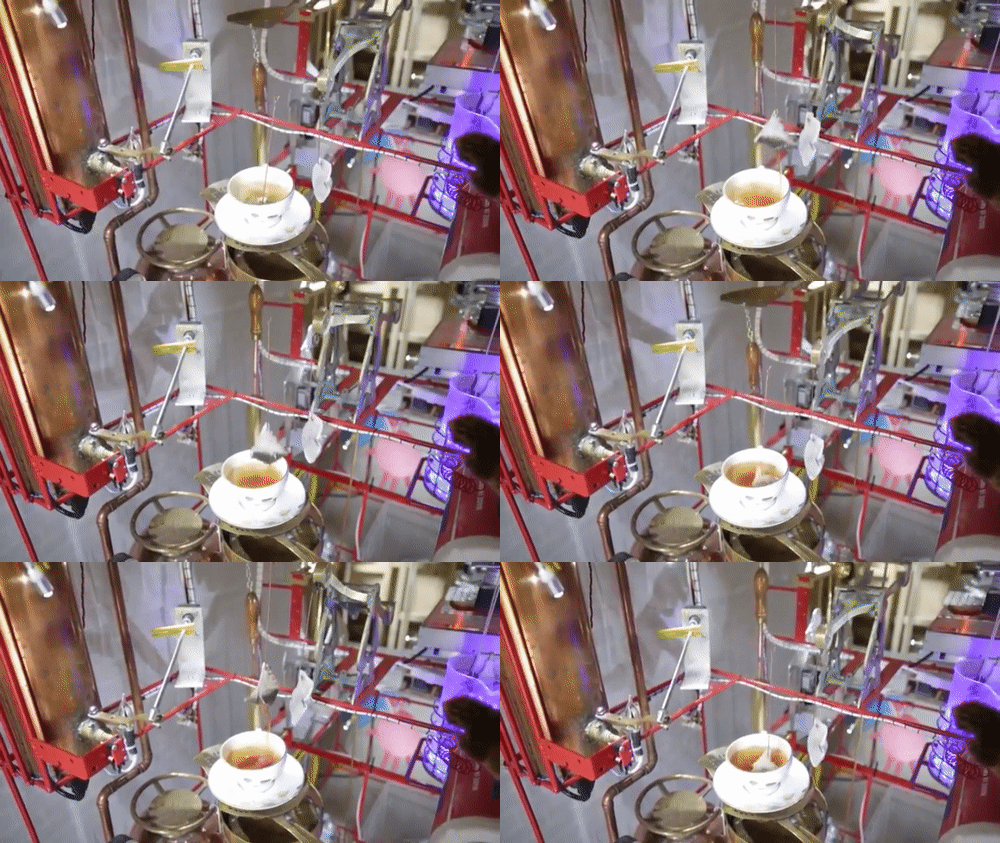
Technology can make life better and automation is one place that is about to see huge expansion. This is a chance to put your mark on the future by envisioning, prototyping, and explaining your ideas. The animated image at the top of this post is a perfect example of how fun automation builds can be. It’s the part of the Sunday Morning Breakfast Machine which steeps the tea. We covered this Rube-Goldberg like device a few weeks ago. About 1,000 hours went into building a completely automated breakfast machine.

Building something whimsical is fine for entering this round — a lot of discovery happens when having fun with interesting ideas. But there is plenty of room for serious builds as well. Technological development has always included iterating on automation; asking and answering the question of how can we do more with less effort.

AutomationFor instance, you can boil coffee in a pot but then you have to use some filtering technique to sequester the grounds. You can use a French press but that this hasn’t saved you much effort. So someone invented the percolator but you still must watch that you don’t burn your brew. From there we have espresso machines and drip brewers that both regulate how much water is used and at what temperature (in addition to keeping the grounds separate). And now we’re seeing single-unit machines like Nespresso and Keurig which make everything a one-step process, if you’re happy with the pods they sell you. I like to refill my own pods, which lets me choose my own grind. I’d love to see someone automate this entire process of cleaning, grinding, filling and presenting a reusable pod. That would make a great entry and help move more people away from disposable plastic/metal.

All I see when I look around me are ways that life should be more automated, and I bet you have the same proclivity. Now you have a reason to take on the challenge. Automate something and enter it in the Hackaday Prize. Twenty of those entries will be awarded $1,000 and move on to vie for the grand prize of $150,000 and a residency at the Supplyframe Design Lab in Pasadena, plus four other huge top prizes.

The HackadayPrize2016 is Sponsored by:

STM32 And FPGAs In A Tiny Package

Slowly, very slowly, the time when we don’t subject embedded beginners to AVRs and PICs is coming. At a glacial pace, FPGA development platforms are becoming ever more capable and less expensive. [Eric Brombaugh] has been playing around with both ARMs and FPGAs for a while now and decided to combine these two loves into a single board that’s capable of a lot.

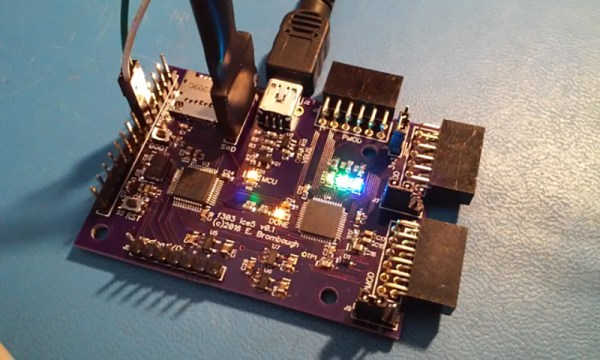
This board is fittingly called an STM32F303 + ice5 development board, and does exactly what it says on the tin. There’s an STM32F303 on board providing a 32-bit CPU running at 72 MHz, 48 kB of SRAM, a quarter meg of Flash, and enough peripherals to keep anyone happy. The FPGA side of this board is a Lattice iCE5 with about 3k Look Up Tables (LUTs), and one time programmable non-volatile config memory.

The connections between the ARM and FPGA include a dedicated SPI port, and enough GPIOs to implement full-duplex I2S and a USART. Like all good projects, [Eric] has shared all the files, schematics, and BOMs required to make this board your very own reality, and has provided a few links to the development toolchains. While the FPGA is from Lattice’s ice40 family, it’s not supported by the Open Source Project Icestorm toolchain. Still, it’s a very capable board for ARM and FPGA development.

The Dubious Claim Of A World Helium Shortage

If you’ve been reading the news lately, you doubtless read about the find of a really big new helium gas field in Tanzania. It’s being touted as “life-saving” and “game-changing” in the popular media, but this is all spin. Helium is important for balloon animals, scientists, and MRI machines alike, but while it’s certainly true that helium prices have been rising steadily since 2000, this new field is unlikely to matter all that much in the grand scheme of things.

helium_uses
Source: USGS

The foundation of every news story on helium is that we’re running out of the stuff. As with most doomsday scenarios, the end of the world’s supply of helium is overstated, and we don’t just mean in light of the new Tanzanian field. Helium is the second-most abundant element, making up 24% of the total mass of the universe. And while the earth has a disproportionate amount of heavier elements, helium is in rocks everywhere. It’s just a question of getting it out, and at what price that’s viable.

So while we’re stoked that the era of (relatively) cheap helium can continue onwards for a few more years, we’re still pretty certain that the price is going to continue to rise, and our children’s children won’t be using the stuff for something so frivolous as blowing up party balloons — it’ll be used primarily, as it is now, where it’s more valuable: in science, medicine, and industry.

Let’s take this moment to reflect on the economics of second-lightest element. Here’s to you, Helium!

Continue reading “The Dubious Claim Of A World Helium Shortage”