Arduino Wire Bender Probably Won’t Kill All Humans

Do you want to make your own springs? Yeah, that’s what we thought. Well, blow the dust off of that spare Arduino and keep reading. A few months ago, we let you know that renowned circuit sculptor [Jiří Praus] was working on a precision wire-bending machine to help him hone his craft. Now it’s real, it’s spectacular, and it’s completely open source.

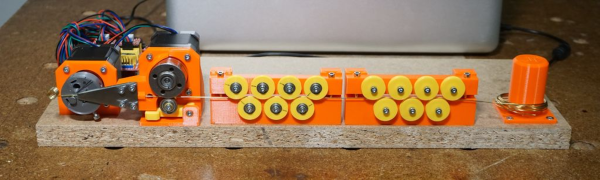
Along with that ‘duino you’ll need a CNC shield and a couple of NEMA 17 steppers — one to feed the wire and one to help bend it. Before being bent or coiled into springs, the wire must be super straight, so the wire coming off the spool holder runs through two sets of rollers before being fed into the bender.

[Jiří]’s main goal for this build was precision, which we can totally get behind. If you’re going to build a machine to do something for you, ideally, it should also do a better job than you alone. It’s his secondary goal that makes this build so extraordinary. [Jiří] wanted it to be easy to build with commonly-available hardware and a 3D printer. Every part is designed to be printed without supports. Bounce past the break to watch the build video.

You can also make your own springs on a lathe, or print them with hacked g-code.

Continue reading “Arduino Wire Bender Probably Won’t Kill All Humans”
Lighting The Way For The Visually Impaired

The latest creation from Bengali roboticist [nabilphysics] might sound familiar. His laser-augmented glove gives users the ability to detect objects horizontally in front of them, much like a cane or pole is used by the visually impaired to navigate through a physical space.

As a stand in for the physical cane, he uses the VL53L0X time-of-flight (TOF) sensor which detects the time taken for a laser source to bounce back to the sensor. Theses are much more accurate than IR distance sensors and have a much finer focus than ultrasonic sensors for excellent directionality.

While the sensors can succumb to interferences from background light or other time-of-flight sensors, the main advantages are speed of calculation (it relies on a single shot to compute the distances within a scene) and an efficient distance algorithm that simplifies the measurement of distance data. In contrast to stereo vision, which requires complex correlation algorithms, the process for extracting information for a time-of-flight sensor is entirely direct, requiring a small amount of processing power.

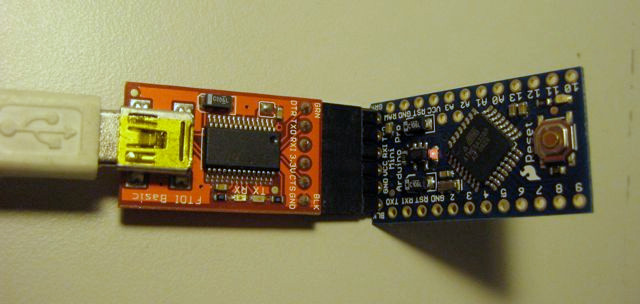
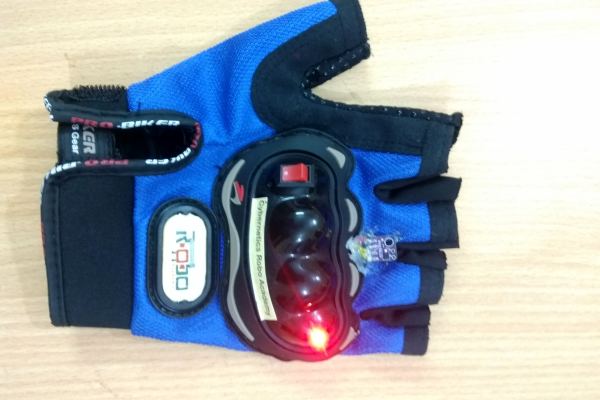
The glove delivers haptic feedback to the user to determine if an object is in their way. The feedback is controlled through an Arduino Pro Mini, powered remotely by a LiPo battery. The code is uploaded to the Arduino from an FTDI adapter, and works by taking continuous readings from the time-of-flight sensor and determining if the object in front is within 450 millimeters of the glove, at which point it triggers the vibration motor to alert the user of the object’s presence.

Since the glove used for the project is a bicycle glove, the form factor is straightforward — the Arduino, motor, battery, and switch are all located inside a plastic box on the top of the glove, while the time-of-flight sensor sticks out to make continuous measurements when the glove is switched on.

In general, the setup is fairly simple, but the idea of using a time-of-flight sensor rather than an IR or sonar sensor is interesting. In the broader usage of sensors, LIDARs are already the de facto sensor used for autonomous vehicles and robotic components that rely on distance sensing. This three-dimensional data wouldn’t be much use here and this sensor works without mechanical moving parts since it doesn’t rely on the point-by-point scan from a laser beam that LIDAR systems use.

Tiny ESP32 Fits Inside USB-A Connector

The ESP32 was introduced a few years ago as an inexpensive way to outfit various microcontrollers with WiFi or Bluetooth. Since then it has been experimented with and developed on, thanks to its similarities to the ESP8266 and the ability to easily program it. Watching the development of this small chip has truly been fascinating as it continues to grow. Or, in this case, shrink.

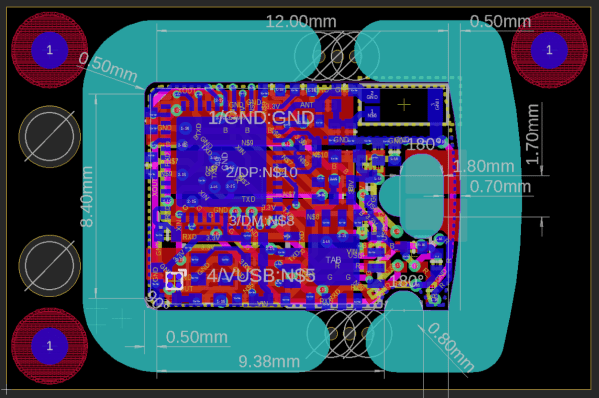
The latest development in the ESP32 world comes from [femtoduino] who, as the name suggests, makes very small things. This one is a complete ESP32 which fits inside a USB-A connector. The brains of the projects is the ESP32-D2WD which is a dual core chip with 2 Mb of memory, making it more than capable. In fact, a big part of this project was [femtoduino]’s modifications to MicroPython in order to allow it to run on this chipset. For that alone, it’s cool.

This project is impressive for both reasons, both the size and the addition to the MicroPython libraries. If you need something really really tiny, for whatever reason, you might want to look into picking up one of these. Be careful though, and be sure to get the latest version of the SDK.

3D Printing Is Transformative Experience For Airgun Shooter

It’s interesting to peek into other scenes and niches and see how they intersect with things that one may find commonplace, like 3D printing. In this case, [NewToOldGuns] wrote a guest blog post for PyramydAir (a retailer, so be prepared for a lot of product links) about how 3D printing has completely transformed the experience of how he uses one of his favorite airguns, and allowed him to make changes and improvements that would not otherwise have been practical.

Not only are the 3D printed improvements thoughtful and useful, but it’s interesting to see familiar insights into the whole design process. After explaining some 3D printing basics, he points out that rapid iteration is key to effective prototyping, and a 3D printer can allow that to happen in a way not previously possible.

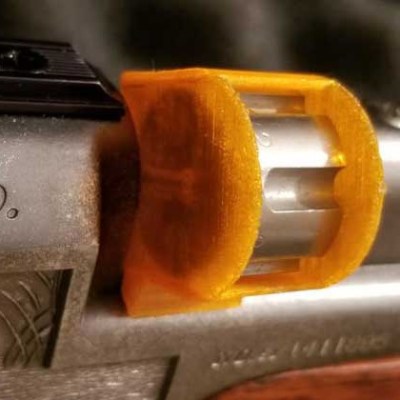
The pellets held inside the silver cylinder can no longer fall out, and the orange holder allows it to be simply pushed straight through into the gun’s receiver.

It all started with the small magazine which holds the rifle’s projectiles. It would be really handy to pre-load these for easier reloading, but there were practical problems preventing this. For one thing, there’s nothing to really hold the pellets in place and keep them from just falling out when it’s not loaded into the gun. Also, loading them into the gun without letting anything fall out was awkward at best. The solution was to design a simple holder that would cradle the magazine and cover the front and back to keep everything in place. [NewToOldGuns] also designed it so that it could mate directly to the gun, so the magazine could simply be pushed straight into the receiver while the action was held open.

Once this simple part was working, the floodgates of creativity were opened. Next was a belt attachment to hold multiple reloads, followed by a decision to mount the reloads directly onto the gun instead. An improved lever and sights quickly followed.

I also demonstrated the iterative approach to prototyping when I designed a simple alarm to detect when my 3D printer’s filament had run out. [NewToOldGuns] observes that the real power of 3D printing isn’t being able to make bottle openers or coat hooks on demand. It’s the ability to imagine a solution, then have that solution in hand in record time.

Dual Screen Laptop Is A Slick DIY Build

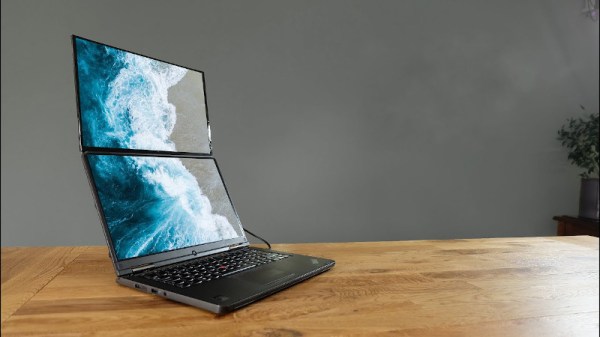
Laptops are great for portable productivity, but ergonomically they can leave something to be desired. They tend to force the user to look down, creating neck strain over extended periods. Rather than invest in expensive massages, [DIY Perks] decided what he really wanted was a dual screen laptop. So he built one! (Video embedded below.)

The build stats with a replacement laptop screen sourced from eBay, a nice full-HD IPS unit with a matching Embedded DisplayPort driver to enable the screen to be driven with the laptop’s existing HDMI port. To power the display, a USB-C Power Delivery board is used, in combination with a high-quality USB-PD compliant battery pack. This provides the 12 V required to run the screen.

To integrate the screen into the laptop, a set of 3D-printed hinges are used to create a folding mechanism, along with a brushed aluminium backing plate. Finished with a set of 3D-printed bezels, the final result is quite attractive from the front, looking almost stock at a glance.

It’s a build that may prove enticing to serious laptop professionals, particularly those that are willing to trade-off productivity against a little added bulk. We’ve seen other great work from [DIY Perks] before too, like these versatile LED panel lights. Video after the break.

Continue reading “Dual Screen Laptop Is A Slick DIY Build”

A CIA In 74HCT

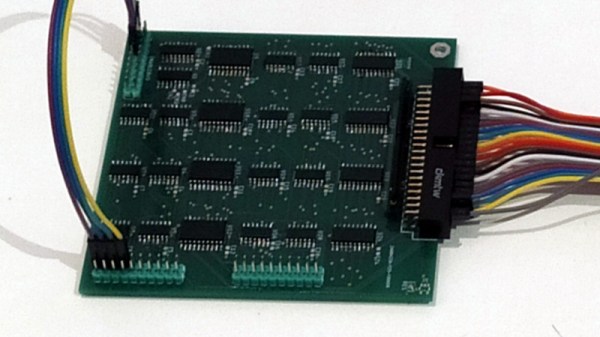
If you owned a classic Commodore home computer you might not have known it at the time, but it would have contained a versatile integrated circuit called the MOS6526. This so-called CIA chip, for Complex Interface Adaptor, contained parallel and serial ports, timers, and a time-of-day counter. Like so many similar pieces of classic silicon it’s long out of production, so [Daniel Molina] decided to replicate a modern version of it on a PCB using 74HGT CMOS logic.

The result will be a stack of boards board that appear to be about the size of a 3.5″ floppy disk covered in surface-mount 74 chips, and connected to the CIA socket of the Commodore by a ribbon cable. The base board is the only one completed so far and contains the data direction registers and parallel ports, but the succeding boards will each carry one of the chip’s other functions.

It seems rather odd to use so much silicon to recreate a single chip, but the point is not of course to provide a practical CIA replacement. Instead it’s instructive, it shows us how these interfaces work as well as just how much circuitry is crammed into the chip. It’s no surprise that it’s inspired by the C74 Project, a TTL 6502 processor that we featured last year.

A Raspberry Pi 4 Video Streaming Backpack

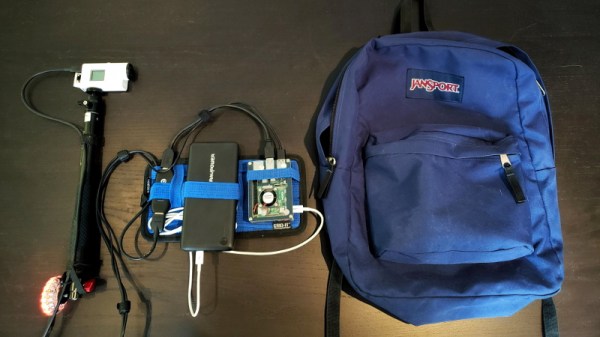
Were you aware that there’s a market for backpack-housed live streaming video systems, and that they can cost as much as $1600? Apparently these things are popular with social media moguls who want to stream themselves living their fabulous lives to people sitting at home watching on YouTube or Twitch. But believing that even slack jawed yokels like us should have access to the same technology, [Speedify Labs] has been working on less expensive DIY alternative based on the Raspberry Pi 4.

Now you’ll note we didn’t use the term “cheap” to describe this build. As detailed here, it’s still going to cost you around $600. You could always swap out the Sony AS-300 camera and Elgato Cam Link capture device with cheaper versions, but the goal of this project was to deliver high quality HD video that’s comparable to what the professional rigs are capable of, so those kinds of concessions were avoided.

Whatever video source your audience and budget are comfortable with, it eventually gets fed into the Raspberry Pi 4 which uses an ffmpeg one-liner to encode the video and ultimately push it out as 720p at 24 FPS, which [Speedify Labs] says seems to be about as good as the Pi can do. The operator is able to start and stop the stream at will using a Circuit Playground Express and a Python script.

Of course, the trick to all of this is getting the video stream uploaded over potentially flaky mobile networks. But as you might have guessed, that’s where [Speedify Labs] gets to flex their eponymous product: a VPN with software channel bonding that allows you to combine multiple Internet connections for higher bandwidth and reliability. With their software, the Pi is able to stream the video through two mobile phones connected to it over USB. As demonstrated in the video below, the setup was able to maintain the stream even as they walked in and out of buildings.

Our very own [Lewin Day] wrote about his experiments with streaming video over 4G on the Raspberry Pi which might be of interest to anyone looking to take their show on the road. Though if you want to get serious it would be worth taking a look at the impressive mobile streaming rig that [Jenny List] saw at the BornHack 2019 hacker camp in Denmark.

Continue reading “A Raspberry Pi 4 Video Streaming Backpack”