BASIC: Cross-Platform Software Hacking Then And Now

Surely BASIC is properly obsolete by now, right? Perhaps not. In addition to inspiring a large part of home computing today, BASIC is still very much alive today, even outside of retro computing.

There was a time, not even that long ago, when the lingua franca of the home computer world was BASIC. This wasn’t necessarily always the exact same BASIC; the commands and syntax differed between whatever BASIC dialect came with any given model of home computer (Commodore, Atari, Texas Instruments, Sinclair or any of the countless others). Fortunately most of these licensed or were derived from the most popular microcomputer implementation of BASIC: Microsoft BASIC.

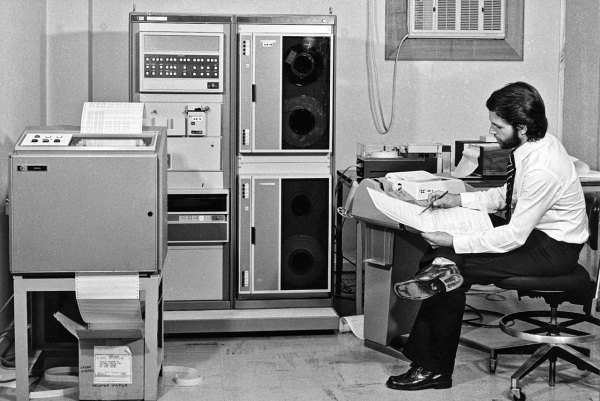
BASIC has its roots in academics, where it was intended to be an easy to use programming language for every student, even those outside the traditional STEM fields. Taking its cues from popular 1960s languages like FORTRAN and ALGOL, it saw widespread use on time-sharing systems at schools, with even IBM joining the party in 1973 with VS-BASIC. When the 1970s saw the arrival of microcomputers, small and cheap enough to be bought by anyone and used at home, it seemed only natural that they too would run BASIC.

The advantage of having BASIC  integrated into these systems was obvious: not only were most people who bought such a home computer already familiar with BASIC, it allows programs to be run without first being compiled. This was good, because compiling a program takes a lot of RAM and storage, neither of which were plentiful in microcomputers. Instead of compiling BASIC source code, BASIC interpreters would interpret and run the code one line at a time, trading execution speed for flexibility and low resource use.

After turning on one’s microcomputer, the BASIC interpreter would usually be loaded straight from an onboard ROM in lieu of a full-blown operating system. In this interpreter shell, one could use the hardware, write and load BASIC programs and save them to tape or disk. Running existing BASIC code as well as compiled programs on one’s computer, or even typing them in from a listing in a magazine all belonged to the options. As BASIC implementations between different home computers were relatively consistent, this provided for a lot of portability.

That was then, and this is now. Are people actually still using the Basic language?

Continue reading “BASIC: Cross-Platform Software Hacking Then And Now”

Continuous Excitation Piano Machine Looks Nervous, Sounds Grand

It’s not every day we see a grand piano with a Raspberry Pi inside, let alone one with 96 motors, but sometimes we get lucky. The contraption in question is one developed by [Konstantin Leonenko], as part of a collaboration with composer [Patricia Alessandrini] for a piece she created inspired by Ada Lovelace. Specifically, [Patricia] was inspired by Ada’s idea that an “analytical machine” would, someday, be able to create music on its own. [Konstantin] and [Patricia] worked together to make a machine that would learn from it’s human co-performers and create music with them.

Their creation, rather than just one tricked-out keyboard, is actually a portable attachment that can be easily fitted to any grand piano. Each of the device’s 96 motors drives a plastic “finger” that excites the piano’s strings. The result is a sound unlike any other — and you really need to experience it so click through that link at the top for the demo video.

Rather cleverly, the fingers are designed such that their dynamics help to mask the sound of the motor (a must for performances) while simultaneously enhancing the string’s timbre. Like any project, this one went through a number of iterations over the two-year design process, and even spun off into an entirely new, glove-based version.

We’ve seen some awesome music tech hacks, and this one fits right in with the rest. It’s always exciting to see an instrument as ubiquitous as the piano be used in new and refreshing ways. Be sure to check out the link at the top for a video of this incredible instrument in action!

Manned Electric Helicopter With 7 Tail Rotors

One of the best things to come from the growing drone industry is the development of compact and powerful brushless motors. We’ve seen several multi-rotors capable of carrying a human, but electric helicopters are rare. [OskarRDA] decided to experiment with this, converting his single-seat ultralight helicopter to electric power and giving it seven tail rotors in the process. Flight footage after the break.

The helicopter in question started life as a Mosquito Air, a bare-bones kit helicopter originally powered by a two-stroke engine. The engine and gearbox were replaced with an EMRAX 228 109 kW brushless motor. Initially, he used the conventional drive-shaft powered tail rotor but wanted to experiment with multiple smaller rotors powered by separate motors, which has several advantages. He only really needed four of the 5008 or 5010 size motors with 18″ props to get comparable thrust, but he added more for redundancy. The new setup was also lighter, even with its independent batteries, at 7.5 kg compared to the 8.1 kg of the old tail rotor assembly.

One of the major advantages of a conventional helicopter over a multirotor is the ability to autorotate safely to the ground if the engine fails. A coupled tail rotor bleeds some energy from the main rotor while autorotating, but since the tail rotor has independent power in this case, it allows all the energy to be used by the main rotor, theoretically decreasing decent speed by 120 feet per second. [OskarRDA] did some engine failure and autorotation test flights, and the results were positive. He likes his new tail rotors enough that he doesn’t plan on going back to a single large rotor.

Power for the main motor is provided by a 7.8 kWh, 40 kg LiPo battery pack mounted beneath the seat. Theoretically, this would allow flight times of up to 27 minutes, but [OskarRDA] has kept most of his flights to 10 minutes or less. He didn’t add any electronic gyro for stabilization, but he did add some electronic coupling between the main motor and tail motors, to reduce the torque correction required by the pilot. Even so, it is clear from the flight footage that [OskarRDA] is a skilled helicopter pilot. Continue reading “Manned Electric Helicopter With 7 Tail Rotors”

Listening In On Muscles With The BioAmp EMG Pill

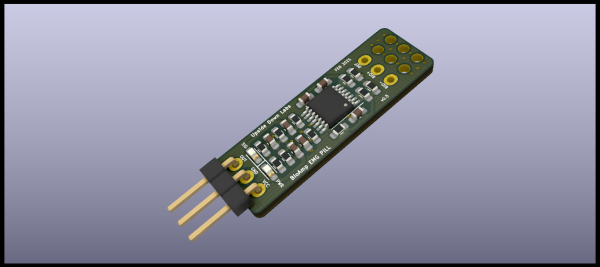
Ever felt like what your MCU of choice misses is a way to read the electrical signals from your muscles? In that case [Deepak Khatri] over at Upside Down Labs has got your back with the BioAmp EMG Pill. Described as an affordable, open source electromyography (EMG) module, based around a TL074 quad low-noise JFET-input opamp. At just over 32×10 millimeters, it’s pretty compact as well.

The onboard opamp ensures that the weak electrical signals captured from the muscles when they move are amplified sufficiently that the ADC of any microcontroller or similar can capture the signal for further processing. Some knowledge of how to set up an EMG is required to use the module, of course, and the TL074 opamp prefers an input voltage between 7-30 V. Even so, it has all the basics onboard, and the KiCad project is freely available via the above linked GitHub project.

In addition, [Deepak] also tweeted about working on an affordable, open source active prosthetics controller (and human augmentation device), which has us very much interested in what other projects may come out of Upside Down Labs before long. After, all we’re no strangers to hacking with biosignals.

The Tube Map, In Glorious 8-Bit!

There was a time when visitors to London would carry an A to Z map to navigate the city’s Undergound railway system, referring to the iconic London Transport map printed on its back as they did so. Now it’s likely they’ll do the same with their smartphones, with apps ranging from simple analogues of the printed version through to fully annotated route planners with up to the minute train information. Is this a new technology, something only possible in the last decade? Serial British rail YouTuber [Geoff Marshall] thinks otherwise, and has programmed a Tube map on a vintage BBC Micro.

We don’t expect anyone to heft a pile of vintage hardware onto the Central Line at rush hour even though in reality he’s running it on an emulator due to his real BBC Micro being kaput. Perhaps someone should drop him a line about capacitor replacement in that power supply. But it does provide an entertaining jaunt back into afternoons in a 1980s school computer lab, with MOVE, DRAW, and PLOT commands as he wrestles with the limited colour palette of MODE 2.  The result only covers Tube Zone 1, or the very centre of London, so to visit London Hackspace you’ll have to remember to take the Bakerloo line northbound out to Zone 4 and disembark at Wembley Central.

Happily as you can see in the video below the break he enlists the help of a friend to run it on real hardware. He posted the code as a comment to the video but it’s really hard to find. Try this direct link and scroll down, it should be the first comment but you need to click “Read more” to unfold the code. We think the Tube Map would make a great test for any retrocomputer, so we look forward to this feat being repeated.

Continue reading “The Tube Map, In Glorious 8-Bit!”

DRehmFlight: Customizable Flight Stabilisation For Your Weird Flying Contraptions

The availability of cheap and powerful RC motors and electronics has made it possible for almost anyone to build an RC flying machine. Software is usually the bigger challenge, which has led to the development of open-source packages like BetaFlight and Ardupilot. These packages are very powerful, but not easy to modify if you have unconventional requirements. [Nicholas Rehm] faced this challenge while doing his master’s degree, so he created dRehmFlight, a customizable flight controller for VTOL aircraft. Overview video after the break.

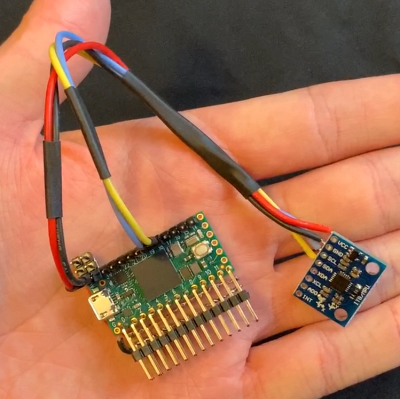
dRehmFlight runs on Teensy 4.0 with a MPU6050 or MPU9250 IMU

[Nicholas] has been building unique VTOL aircraft for close to a decade, and he specifically wanted flight stabilization software that is easy to modify and experiment with. Looking at the dRehmFlight code, we think he was successful. The main flight controller package is a single file of fewer than 1600 lines. It’s well commented and easy to figure out, even for an inexperienced programmer. A detailed PDF manual is also available, with full descriptions for all the functions and important variables, and a couple of tutorials to get you started. Libraries for interfacing with accelerometers and RC gear is also included. It runs on a 600 Mhz Teensy 4.0, and all the programming can be done from the Arduino IDE.

[Nicholas] has repeatedly demonstrated the capabilities of dRehmFlight with several unique aircraft, like the belly flopping RC Starship we covered a while ago, a VTOL quad rotor biplane, VTOL F35, and the cyclocopter seen in the header image. dRehmFlight might not have the racing drone performance of BetaFlight, or advanced autopilot features of Ardupilot, but it’s perfect for getting unconventional aircraft off the ground. Continue reading “DRehmFlight: Customizable Flight Stabilisation For Your Weird Flying Contraptions”

A Volume Control From A VCR Drum

The VHS VCR has now passed from widespread use, and can thus be found as a ready supply of interesting parts for the curious hardware hacker. [Clewsy] has a novel use for a VCR head scanning drum, the part that is supposed to be tasked with reading information off of magnetic tape. Instead, it’s reading information from fingers as the knob for a USB volume control. Underneath the drum is an optical encoder disk which is read by an ATmega32U4 for USB interfacing with a host computer.

The helical-scan video recorder was a mechanically complex solution to the problem of recording a high-bandwidth video signal onto a tape that could be made slow-moving enough to be practical. By recording the video in diagonal stripes across the tape from a fast-moving spinning head they avoided the need for huge reels of tape, enabling hours of video to be fitted into a roughly book-size cassette.

While over time the mechanics of a VCR mechanism were simplified and cheapened to a great extent, the heads and drum were the one area that could not be compromised. Thus the VCR head was for a time the most high-precision mechanical device owned by most consumers, and the drums usually have exceptionally nice bearings. All of this makes one a particularly good choice for a volume knob or indeed any other large rotational control, so much so that we’re surprised it hasn’t become a more frequent occurrence. So scour the electronic junk, and you might just find the ultimate in free high quality control hardware.

Of course, this isn’t the only thing a VCR head drum can do.  How about a centrifuge?