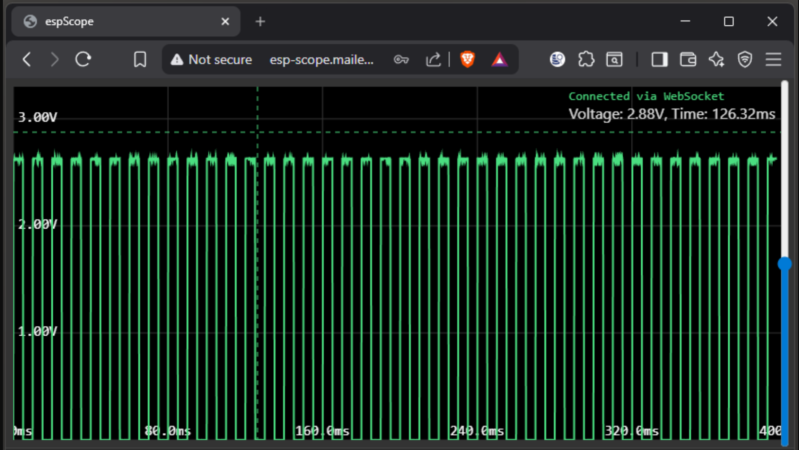
A browser window is shown, in which a web page is displaying a green trace of a square wave.

A Compact, Browser-Based ESP32 Oscilloscope

An oscilloscope is usually the most sensitive, and arguably most versatile, tool on a hacker’s workbench, often taking billions of samples per second to produce an accurate and informative representation of a signal. This vast processing power, however, often goes well beyond the needs of the signals in question, at which point it makes sense to use a less powerful and expensive device, such as [MatAtBread]’s ESP32 oscilloscope.

Continue reading “A Compact, Browser-Based ESP32 Oscilloscope”

Shoot Instax Film In A Polaroid Camera With The Aid Of Tape

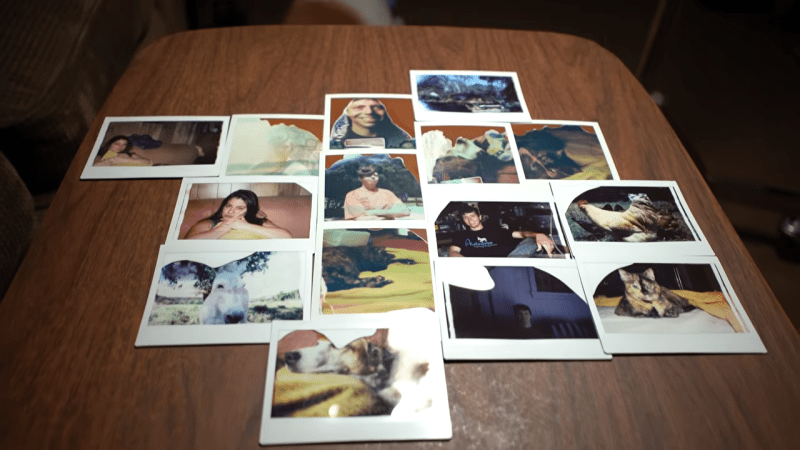
Polaroid cameras have been very popular for a very long time and are especially hot gifts this year. Fresh film is easy to find but relatively expensive. In contrast, Fuji’s Instax line of instant film and cameras aren’t as well established, but the film is easy to find and cheap. You might like to shoot cheap Instax film in your Polaroid camera. Thankfully, [Nick LoPresti] figured out how to do just that.

You can’t just slam an Instax cassette in an old Polaroid camera and expect it to work. The films are completely different sizes, and there’s no way they will feed properly through the camera’s mechanisms at all. Instead, you have to get manual about things. [Nick] starts by explaining the process of removing Instax film sheets from a cassette, which must be done without exposure to light if you want the film to remain useful. Then, if you know what you’re doing, you can tape it in place behind the lens of an old-school Polaroid camera, and expose it as you would any other shot. The chemistry is close enough that you’ll have a fair chance of getting something with passable exposure.

Once exposed, you have to develop the film. Normally, a Polaroid camera achieves this by squeezing the film sheet out through rollers to release the developer and start the process. Without being able to rely on the camera’s autofeed system, you need to find an alternative way to squeeze out the chemicals and get the image to develop. [Nick] recommends a simple kitchen rolling pin, while noting that you might struggle with some uneven chemical spread across the sheet. Ultimately, it’s a fussy hack, but it does work. It might only be worthwhile if you’ve got lots of Instax film kicking around and no other way to shoot it.

Instant cameras can seem a little arcane, but they’re actually quite simple to understand once you know how they’re built. You can even 3D print one from scratch if you’re so inclined. Video after the break.

Continue reading “Shoot Instax Film In A Polaroid Camera With The Aid Of Tape”

A Heavily Modified Rivian Attempts The Cannonball Run

There are few things more American than driving a car really fast in a straight line. Occasionally, the cars will make a few left turns, but otherwise, this is the pinnacle of American motorsport. And there’s no longer, straighter line than that from New York to Los Angeles, a time trial of sorts called the Cannonball Run, where drivers compete (in an extra-legal fashion) to see who can drive the fastest between these two cities. Generally, the cars are heavily modified with huge fuel tanks and a large amount of electronics to alert the drivers to the presence of law enforcement, but until now, no one has tried this race with an EV specifically modified for this task.

The vehicle used for this trial was a Rivian electric truck, chosen for a number of reasons. Primarily, [Ryan], the project’s mastermind, needed something that could hold a significant amount of extra batteries. The truck also runs software that makes it much more accepting of and capable of using an extra battery pack than other models. The extra batteries are also from Rivians that were scrapped after crash tests. The team disassembled two of these packs to cobble together a custom pack that fits in the bed of the truck (with the tonneau closed), which more than doubles the energy-carrying capacity of the truck.

Of course, for a time trial like this, an EV’s main weakness is going to come from charging times. [Ryan] and his team figured out a way to charge the truck’s main battery at one charging stall while charging the battery in the bed at a second stall, which combines for about a half megawatt of power consumption when it’s all working properly and minimizes charging time while maximizing energy intake. The other major factor for fast charging the battery in the bed was cooling, and rather than try to tie this system in with the truck’s, the team realized that using an ice water bath during the charge cycle would work well enough as long as there was a lead support vehicle ready to go at each charging stop with bags of ice on hand.

Although the weather and a few issues with the double-charging system stopped the team from completing this run, they hope to make a second attempt and finish it very soon. They should be able to smash the EV record, currently held by an unmodified Porsche, thanks to these modifications. In the meantime, though, there are plenty of other uses for EV batteries from wrecked vehicles that go beyond simple transportation.

Continue reading “A Heavily Modified Rivian Attempts The Cannonball Run”