The Atari 800

Atari Brings The Computer Age Home

[The 8-Bit Guy] tells us how 8-bit Atari computers work.

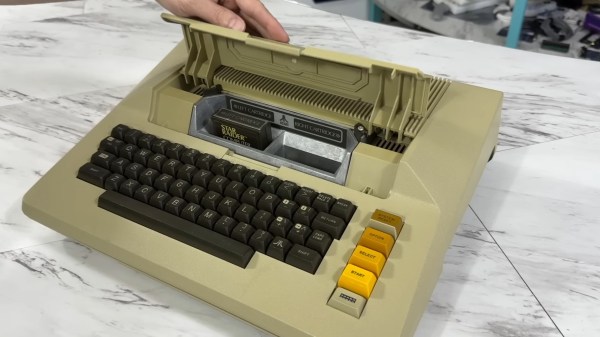
Personal Computer Market Share in 1984The first Atari came out in 1977, it was originally called the Atari Video Computer System. It was followed two years later, in 1979, by the Atari 400 and Atari 800. The Atari 800 had a music synthesizer, bit-mapped graphics, and sprites which compared favorably to the capabilities of the other systems of the day, known as the Trinity of 1977, being the Apple II, Commodore PET, and TRS-80. [The 8-Bit Guy] says the only real competition in terms of features came from the TI-99/4 which was released around the same time.

The main way to load software into the early Atari 400 and 800 computers was to plug in cartridges. The Atari 400 supported one cartridge and the Atari 800 supported two. The built-in keyboards were pretty terrible by today’s standards, but as [The 8-Bit Guy] points out there wasn’t really any expectations around keyboards back in the late 1970s because everything was new and not many precedents had been set.


Continue reading “Atari Brings The Computer Age Home”

When Electricity Doesn’t Take The Shortest Path

Everyone knows that the path of least resistance is the path that will always be taken, be it by water, electricity or the feet of humans. This is where the PCB presented by [ElectrArc240] on YouTube is rather confusing, as it demonstrates two similarly sized traces, one of which is much shorter than the other, yet the current opts to travel via the much longer trace. If you were to measure this PCB between each path, the shorter path has the lowest resistance at 0.44 Ω while the longer path is 1.44 Ω. Did the laws of physics break down here?

Of course, this is just a trick question, as the effective resistance for an electrical circuit isn’t just about ohmic resistance. Instead the relevant phrasing here is ‘path of least impedance‘, which is excellently demonstrated here using this PCB. Note that its return path sneaks on the back side along the same path as the long path on the front. To this is added a 1 MHz high current source that demonstrates the impact of alternating current, with reactance combining with the resistance.

Although for direct current it’s fair to say that impedance is the equivalent of resistance, once the inductance of a trace has to be taken into account – as in the case of AC and high-frequency signaling – the much higher inductance of the short path means that now the long path is actually the shortest.

When you are doing some impedance matching in your favorite EDA software while implementing an Ethernet RMII link or similar, this is basically part of the process, with higher frequencies requiring ever more stringent mechanisms to keep both sides happy. At some point any stray signals from nearby traces and components become a factor, never mind the properties of the PCB material.

Continue reading “When Electricity Doesn’t Take The Shortest Path”

Old Windsurfers Become New Electric Surfboards

Windsurfing has experienced a major decline in popularity in the last few decades as the sport’s culture failed to cater to beginners at the same time that experienced riders largely shifted to kiteboarding. While it’s sad to see a once-popular and enjoyable sport lose its mass market appeal, it does present a unique opportunity for others as there’s cheap windsurfing gear all over the online classifieds now. [Dane] recently found that some of these old boards are uniquely suited to be modified into electric surfboards.

The key design element of certain windsurfers that makes this possible is the centerboard, a fin mounted on the windsurfer extending down into the water that resists the lateral force of the sail, keeping the board moving forward instead of sideways. [Dane] used this strengthened area of the board to mount a submerged electric motor, with all of the control electronics and a battery on the top of the board. The motor controller did need a way to expel excess heat while being in a sealed waterproof enclosure, but with a hole cut in the case and a heat sink installed on top of it, this was a problem quickly solved.

The operator control consists of a few buttons which correspond to pre-selected speeds on the motor. There’s no separate control input for steering, though; in order to turn this contraption the operator has to lean the board. With some practice it’s possible to stand up on this like any other electric surfboard and scoot around [Dane]’s local lake. For the extreme budget version of this project be sure to check out [Ben Gravy]’s model which involves duct taping two cheap surfboards together instead.

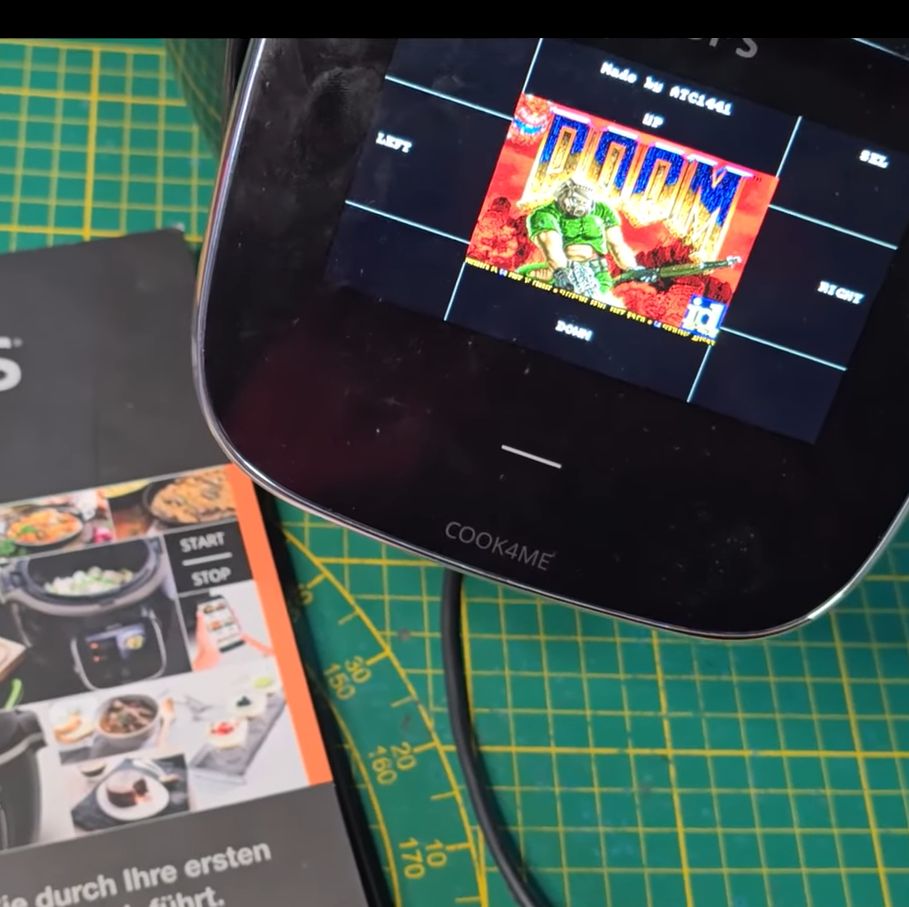
Hacking The Krups Cook4Me Smart Cooking Pot For Doom

With more and more kitchen utilities gaining touch screens and capable microcontrollers it’d be inconceivable that they do not get put to other uses as well. To this end [Aaron Christophel] is back with another briefly Doom-less device in the form of the Krups Cook4Me pressure cooking pot with its rather sizeable touch screen and proclaimed smarts in addition to WiFi and an associated smartphone app.

Inside is an ESP32 module for the WiFi side, with the brains of the whole operation being a Renesas R7S721031VC SoC with a single 400 MHz Cortex-A9. This is backed by 128 MB of Flash and 128 MB of RAM. The lower touch interface is handled by a separate Microchip PIC MCU to apparently enable for low standby power usage until woken up by touch.

The developers were nice enough to make it easy to dump the firmware on the SoC via SWD, allowing for convenient reverse-engineering and porting of Doom. With the touch screen used as the human input device it was actually quite playable, and considering the fairly beefy SoC, Doom runs like a dream. Sadly, due to the rarity of this device, [Aaron] is not releasing project files for it.

As for why a simple cooking pot needs all of this hardware, the answer is probably along the lines of ‘because we can’.

Continue reading “Hacking The Krups Cook4Me Smart Cooking Pot For Doom

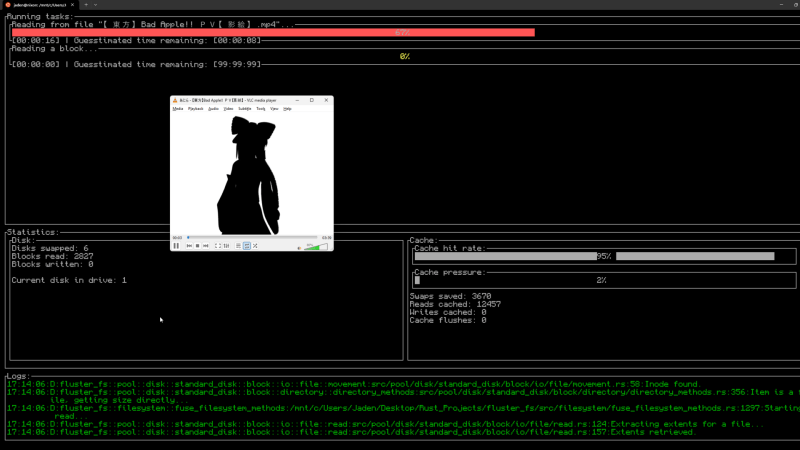
Playing Factorio On A Floppy Disk Cluster

While a revolutionary storage system for their time, floppy disks are not terribly useful these days. Though high failure rates and slow speeds are an issue, for this project, the key issue is capacity. That’s because [DocJade’s] goal is playing the video game Factorio off floppy disks. 

Storing several gigabytes of data on floppy disks is a rather daunting challenge. But instead of using a RAID array, only a single reader and a custom file system is deployed in this setup. A single disk is dedicated to storing pool information allowing for caching of file locations, reducing disk swaps. The file system can also store single files across multiple disks for storage of larger files. Everything mounts in fuse and is loosely POSIX compliment, but lacks some features like permissions and links.

With the data stored across thousands of disks, the user is prompted to insert a new disk when needed. This ends up being the limiting factor in read and write speeds, rather than the famously slow speeds of floppies. In fact, it takes about a week to load all of Factorio in this manner, even after optimizations to reduce disk swaps. Factorio is also one of the few games that could be installed in this manner, as it loads most of the game into memory at launch. Many other games that dynamically load textures and world maps would simply crash when a chunk is not immediately available.

Not a Factorio fan? No worries, you could always install modern Linux on a floppy!

Continue reading “Playing Factorio On A Floppy Disk Cluster”

Finding A Way To Produce Powerful Motors Without Rare Earths

The electric vehicle revolution has created market forces to drive all sorts of innovations. Battery technology has progressed at a rapid pace, and engineers have developed ways to charge vehicles at ever more breakneck rates. Similarly, electric motors have become more powerful and more compact, delivering greater performance than ever before.

In the latter case, while modern EV motors are very capable things, they’re also reliant on materials that are increasingly hard to come by. Most specifically, it’s the rare earth materials that make their magnets so good. The vast majority of these minerals come from China, with trade woes and geopolitics making it difficult to get them at any sort of reasonable price. Thus has sprung up a new market force, pushing engineers to search for new ways to make their motors compact, efficient, and powerful.

Continue reading “Finding A Way To Produce Powerful Motors Without Rare Earths”

Great Trains, Not So Great AI Chatbot Security

A joy of covering the world of the European hackerspace community is that it offers the chance for train travel across the continent using the ever-good-value Interrail pass. For a British traveler such a journey inevitably starts with a Eurostar train that whisks you in comfort through the Channel Tunnel, so a report of an AI vulnerability on the Eurostar website from [Ross Donald] particularly caught our eye. What it reveals goes beyond the train company, and tells us some interesting tidbits about how safeguards in AI chatbots can be circumvented.

The bot sits on the Eurostar website, and is a simple HTML and JavaScript client that talks to the LLM back-end itself through an API. The API queries contain the whole conversation, because as AI toy manufacturers whose products have been persuaded to spout adult context will tell you, large language models (LLM)s as commonly implemented do not have a context memory for the conversation in hand.

The Eurostar developers had not made a bot without guardrails, but the vulnerability lay in those guardrails only being applied to the most recent message. Thus an innocuous or empty message could be sent, with a payload concealed in a previous message in the conversation. He demonstrates the bot returning system information about itself, and embedding injected HTML and JavaScript in its responses.

He notes that the target of the resulting output could only be himself and that he was unable to access any data from other customers, so perhaps in this case the train operator was fortunately spared the risk of a breach. From his description though, we agree they could have responded to the disclosure in a better manner.


Header image: Eriksw, CC BY-SA 4.0.