Classic PDA Finds Second Life As A Network Touch Screen Display

pocketviewer

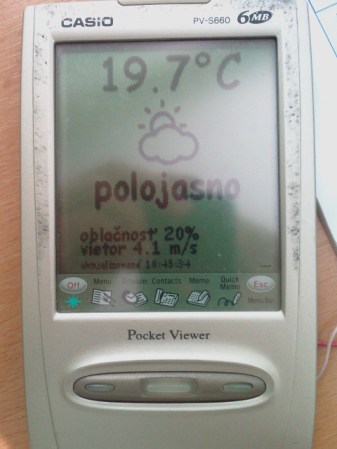
[Tomas Janco] had an old Casio Pocket Viewer PDA collecting dust. Rather than throw it away, He decided to re-purpose it as a display for time, weather, and the current status of his garage door.

The Casio Pocket Viewer was a competitor to the Palm Pilot. The two systems even shared the same LCD resolution – 160×160 monochrome. [Tomas’] particular model is an S660, sporting 6 megabytes of ram and an NEC V30MZ (Intel 8086 compatible) processor. Similar to Palm, Casio made an SDK freely available.

The SDK is still available from Casio, and [Tomas] was able to get it running on his PC. Development wasn’t without pitfalls though. The Pocket Viewer SDK was last updated in April of 2001. Software is written in C, but the then new C99 standard is not supported. The SDK does include a simulator and debugger, but it too is not as polished as todays systems – every simulator startup begins with setting the clock and calibrating the touch screen. Keep reading after the jump to learn about the rest of the hurdles he overcame to pull this one off.

Continue reading “Classic PDA Finds Second Life As A Network Touch Screen Display”
RepRap Simpson Puts A New Spin On Delta RepRaps

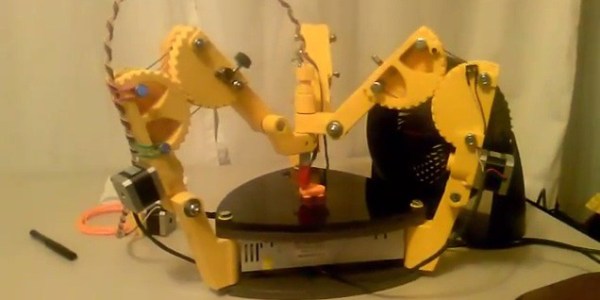
Just when you think you’ve seen it all in the 3D printer world, something new pops up! [Nicholas Seward] posted a video of RepRap Simpson, his latest project.  Simpson is a delta robot – but unlike any delta we’ve seen before. Previous offerings vertical rails on which the arms travel. As you can see, this design mounts three articulated arms directly to the base of the printer, using steel cables as part of the joint mechanism.

Judging by [Nicholas’] posts on the RepRap forums, Simpson’s grounded delta design has already gone through a few revisions. The basic geometry though, has remained the same. [Nicholas] calls this edition a “Proportional Gear Drive Joint Simpson”. The name may not roll off the tongue, but the movements are incredibly smooth, organic, and fast.

As with any delta design inverse kinematics play a huge role in the software. [Nicholas] is trying to simplify this with an optical calibration system. For the adventurous, the equations are posted on the forums, and a python Gcode preprocessor is posted on Thingiverse.

Even Simpson’s base received special attention.  It’s built from a water jet cut piece of basalt.  We like the use of opposed helical gears on the large joints, as well as the guitar machine heads used to tension the cable drive. One thing we are not sure of is the longevity of system – will cable stretch play an issue? Will the printed parts suffer wear from the cables? Only time will tell.

Continue reading “RepRap Simpson Puts A New Spin On Delta RepRaps”

Stewart Platform Reinvents The Wheel So You Don’t Have To

StewartPlatform

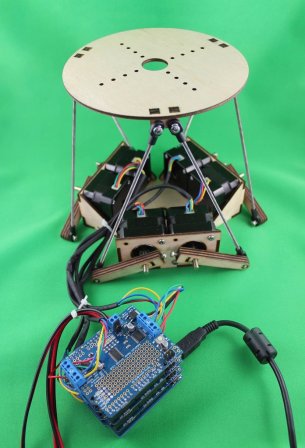
[Dan Royer] has noticed that most university projects involving a Stewart platform spend more time building a platform than on the project itself. He hopes to build a standard platform universities can use as the basis for other projects.

Stewart platforms are six degree of freedom platforms often seen hefting flight simulators or telescopes. The layout of the actuators allows movements in X,Y,and Z as well as pitch, roll and yaw. While large platforms often use hydraulic systems to accelerate heavy loads quickly. [Dan] is looking at a smaller scale system. His platform is built of laser cut wood and uses six steppers to control motion.

One of the harder parts in designing a platform such as this is creating a mechanical system that is strong, precise, and smooth. With so many linkages, it’s easy to see how binding joints could bring the entire thing to a grinding halt. [Dan] is currently using RC helicopter ball joints, but he’s on the lookout for something even smoother.

Continue reading “Stewart Platform Reinvents The Wheel So You Don’t Have To”

Team Van Gogh Uses OpenXC To Create Art From Your Drive

vangogh

In this video, [Joe Grand] takes us through [Team Van Gogh’s] entry in the OpenXC hackathon event. In what could possibly be the greatest road trip in history, [Joe Grand, Ben Krasnow, TechNinja, and Super Awesome Sylvia] all pile into a car. With them they bring a host of dev boards, wires, a CB Radio, and of course Sylvia’s WaterColorBot.

As their name implies, [Team Van Gogh] took a more artistic approach to the challenge than other teams.  OpenXC steering, gear shift, accelerator and brake data is sent through a ChipKit to an RS-232 link into [TechNinja’s] laptop. The laptop translates the data into commands for the WaterColorBot. With this system, a simple Sunday drive can become abstract art.

The team also showed the concept of what could be done if OpenXC was extended to send data back to the vehicle – something Ford doesn’t support. Their example works when a phone call comes in by using the system to lower the volume on a CB radio standing in for car’s Bluetooth system.

Most of this challenge was completed with simulated data from the OpenXC vehicle interface. The team only had a few minutes to work the bugs out in a real vehicle. However, they proved their concepts well enough to win the grand prize.

Continue reading “Team Van Gogh Uses OpenXC To Create Art From Your Drive”

Octoscroller Takes The Hexascroller To The Next Level

octosc2

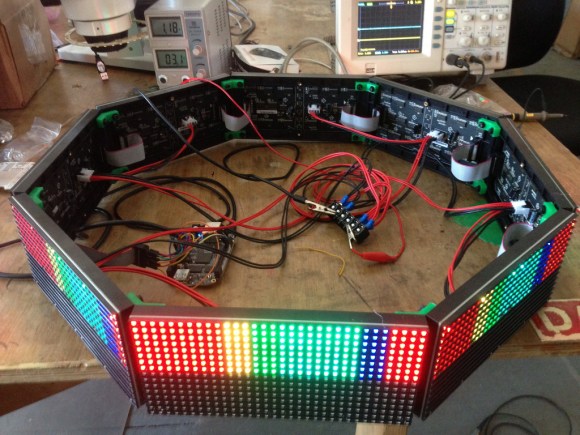
The folks at NYCResistor have a new toy in the Octoscroller. For a couple of years now the NYCResistor crew has used the HexaScroller as a clock and general alert system. Now that RGB LED panels are cheaply available, the group decided to upgrade both the number of sides and the number of colors.

Octoscroller uses eight 16×32 RGB LED panels. These panels are relatively easy to interface to, but require constant refresh even to display a static image. This makes them both memory and CPU intensive for smaller microcontrollers. Brightness control via PWM only increases the difficulty.

On the plus side, the panels are structurally strong. This allows the Octoscroller to avoid the plywood ring which made up the frame of the Hexascroller. 3D printed brackets and hardware were all that was needed to complete the Octoscroller frame.

The brain of the this beast is a BeagleBone Black running LEDscape along with some custom software. Imagery comes from the Disorient Pyramid.

If you’re in the New York area, NYCResistor plans to offer classes on building your own Octoscroller.  You can also see the Octoscroller in person at MakerFaire NYC this weekend.

Modified E-ZPass Detects Reads Far From Toll Booths

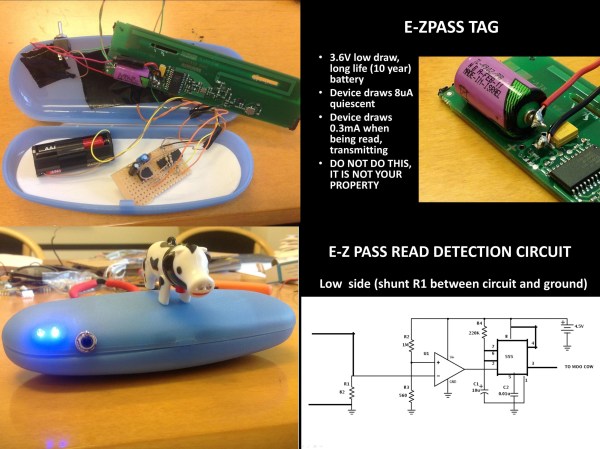
Def Con speaker [pukingmonkey] has spent quite a bit of time studying methods government and law enforcement use to track private citizens’ vehicles on the roads. One of the major tracking methods is E-ZPass, an electronic toll collection system used in several states around the country. [pukingmonkey] cracked open his E-ZPass tag to find a relatively basic circuit. In his DEF CON presentation (PDF), he notes you shouldn’t do this to your own tag, as tags are legally not the property of the user.

The tag uses a 3.6 volt long life battery to operate. When idle, the tag only draws 8 microamps. During reads, current draw jumps to 0.3 mA. Armed with this information, it was relatively simple to add a current detecting circuit that outputs a pulse on tag reads. Pulses are then fed into a toy cow, which lights up and “Moos” on each read.

Continue reading “Modified E-ZPass Detects Reads Far From Toll Booths”

USB Ableton Foot Controller Reuses Old Keyboard

footLooper2

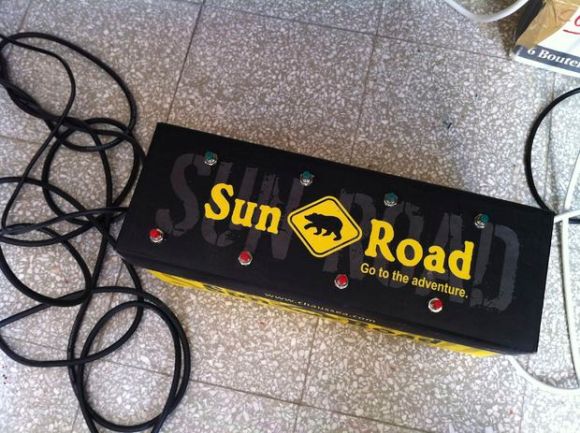
No, Hackaday hasn’t started advertising shoes, this is [Matlek’s] foot controller for Ableton Live.

Matlek plays guitar and needed an easy way to control Ableton Live, which he uses as a looper. Ableton normally expects keyboard input, so that’s exactly what he gave it.

An old dell keyboard was gutted down to its controller board. This exposes  the leads the keyboard uses to scan the key matrix.  From there it is simply trial and error connecting different pins together and seeing which keys are printed on the PC screen (A text editor works well for this). Only 8 characters are needed to control the looper, so [Matlek] chose digits 1-8.

Since some of the wires are going to be sharing pins, a small piece of stripboard comes in handy between the buttons and the keyboard controller. [Maltek] used basic momentary push buttons for his mini key matrix, though we think that box looks sturdy enough to support some larger stomp box style buttons.

Everything comes together inside a sturdy shoebox, which also serves to insulate the exposed keyboard PCB from shorting out.

The only major downside to the project is that the box is light enough that it slides easily on the floor when recording or triggering loops. Adding some heavy items (or dare we say, some shoes) would solve this problem. Self adhesive rubber feet on the bottom of the box would help too.

Continue reading “USB Ableton Foot Controller Reuses Old Keyboard”