Chess Computer Retires To Play Jazz

Years ago, [Leo Neumann]’s girlfriend gave him a 1970s chess computer game that was missing almost everything but the super cool clicky keyboard. Noting the similarity of chess move labeling to chord notation, [Leo] decided to turn it into something even nerdier — a jazz chord game where you jam with the computer.

To play the game, you and the computer take turns entering jazz chords that progress musically from the last one played. The hardware is simple — a Raspberry Pi Zero and a WM8960 audio hat with amplifier in speakers. [Leo] also put in a slightly larger display than the original and printed a new bottom half for the case. We love the look of this build, especially the groovy custom line font [Leo] designed.

On the software side, [Leo] made a Python prototyping environment using PYO Module and Kivy UI. Not content with other approaches to tonal consonance, [Leo] played a couple thousand chords and rated them according to their progressive harmony. Shake out those jazz hands and check it out after the break.

Want to play chess with computers? Make Alexa your go-between.

Continue reading “Chess Computer Retires To Play Jazz”

Cornhole Boards Play Victory Songs

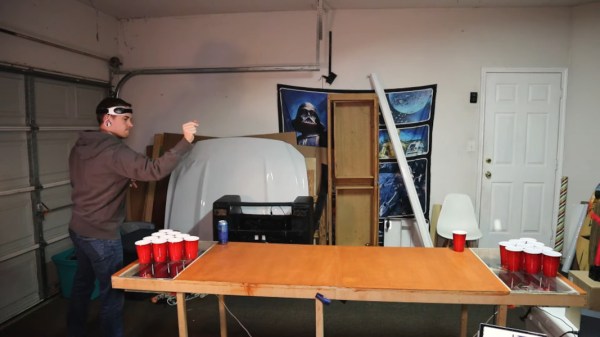
How do you instantly make any game better? By lighting it up and playing at night. We would normally say ‘drinking’, but we’re pretty sure that drinking is already a prerequisite for cornhole — that’s the game where you toss bean bags at holes in angled boards.

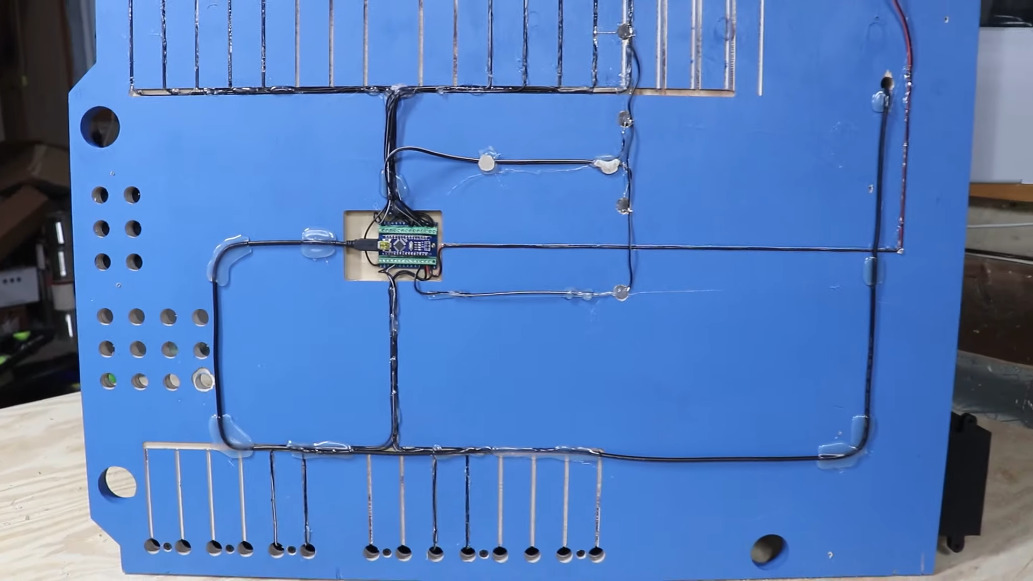
[Hardware Unknown] loves cornhole, and was gifted a set of portable, folding boards that light up around the ring for nighttime action. These turned out to be the perfect basis for reactive boards that light up and play sound whenever points are scored. Both boards have a vibration sensor to detect bags hitting the top, and an IR break-beam sensor pair across the hole. An Arduino Nano reads from the sensors and controls an amplifier and a DF Player for sound.

Players get a point and a song for landing a bag on top of the board, and three points and a different song for making it in the hole. We love the Easter egg — anyone who manages to trip both the vibration sensor and the break-beam detector at the same time will be treated to the sound of a flock of honking geese. Check out the build journey after the break.

No good at cornhole? This one doesn’t let you miss.

Continue reading “Cornhole Boards Play Victory Songs”

Garrett Augustus Morgan Made The World Safer

Some people invent with the intent of seeking fame and prestige. Few inventors seem to truly care about other people the way that Garrett Augustus Morgan did. His inventions saved many lives, including those of a few people who were rescued by Garrett himself after an explosion tore through a tunnel beneath Lake Erie.

Though he had little formal education, Garrett’s curiosity took him into many fields from sewing machine repair to gas masks to transportation problems. He achieved great success and improved many lives along the way.

Of Seams and Straighteners

Image via Wikipedia

Garrett Augustus Morgan was born March 4th, 1877 in Claysville, Kentucky. He was the seventh of eleven children born to Sydney and Elizabeth Morgan, who had both been slaves. His mother was part Native American.

Armed with a sixth grade education and ten cents in his pocket, Garrett left home at fourteen look for work, which was common for kids his age at the time. He first landed in Cincinnati and spent a few years working as a handyman.

In 1895 he moved to Cleveland and started repairing sewing machines. This is where he developed his taste for the way things work. After a decade or so, he opened his own sewing machine shop. He had gotten married in the meantime, and a few years later, he and his wife Mary Anne, a seamstress, opened a discount ladies clothing store and hired thirty-two employees to make all the suits, coats, and dresses in-house.

One day Garrett was sewing a woolen fabric that kept getting scorched by the extremely high speed of the sewing machine needle. He experimented with a few chemicals to coat the needle and keep it cool. As the story goes, he wiped his hands off on a piece of cloth and went to lunch. When he came back, the wavy fibers in the fabric had been completely straightened by the chemical.

Curious, he tried the solution on his neighbor’s dog’s fur, and it straightened that, too. Then he worked up the nerve to try it on his own hair, and discovered the hair relaxer. He turned the solution into a cream and established the G.A. Morgan Hair Refining Company to sell his hair relaxer to African Americans. The company was terrifically successful and Garrett earned enough money from sales to keep inventing.

Continue reading “Garrett Augustus Morgan Made The World Safer”

Bet You Didn’t Know Arduinos Are Psychic

Are you running out of ways to entertain yourself and your family? If you’ve read all the books and watched all the movies, it might be time to explore the psychic abilities of silicon. [Hari Wiguna] has just the trick to keep them guessing for a good long time.

This trick doesn’t take much, just a couple of Arduinos, some momentary buttons, a number pad, and a large helping of math. As you can see in the demo after the break, there is nothing connecting the two, not even 802.11(n). On the randomizer Arduino, [Hari] generates random numbers with the push of a button until the audience sees one they like. Then [Hari] locks in the number with the other button.

What happens next is key: the randomizer generates another random number, but uses it as a hint to set a sentinel digit. The randomizer Arduino subtracts the larger of the two digits in the number from nine and stores the result as the flag. When the next number comes up that has the flag digit in the correct place, the number after that will be the random number chosen at the beginning.

The psychic Arduino’s secret is that it knows the first guess it receives is special. It does the same sentinel digit math as the randomizer, so when the guesser enters the guess with the sentinel digit, it knows the next number entered is the winner. Clear as mud? Check out the second video below where [Hari] explains the trick, a new take on a magic classic.

Looking for a more exciting way to generate random numbers? Try using fish tanks, lava lamps, or muons from outer space.

Continue reading “Bet You Didn’t Know Arduinos Are Psychic”

Wireless Mouse Gets A Charging House

Mouse batteries always seem to die at the worst possible moment, like when you’re in the middle of pwning noobs or giving a presentation at work. [AyhamAS] was tired of having to look around for a replacement battery and decided to build a nice little charging dock for their mouse.

At the heart of this build is a TC4056A charging board inside the dock. Since this board is designed to charge 3.7 V batteries, [AyhamAS] removed the charge current-limiting resistor and replaced it with a pair of through-hole resistors. A switch on the back of the dock lets [AyhamAS] choose between the two values for fast or slow charging.

On the mouse side, [AyhamAS] cleverly used the receiver storage cubbyhole to house the contacts. Magnets in in the mouse and the dock and spring-loaded contacts add even more tactile feedback to the whole experience. The dock itself looks great, too — it’s made from acrylic that’s been sanded down to a matte finish. Check out the build video after the break.

If your mouse has a battery pack, you could always upgrade to a bigger one as long as there’s room.

Continue reading “Wireless Mouse Gets A Charging House”

Mushroom Canoe Is Rooted In Nature

Mushrooms might be the most contested pizza topping after pineapple, but can you build a boat from pineapples? Probably not, but you can from mushrooms. Mushrooms, or rather their mycelium root systems, can be used for things like packaging, insulation, and furniture, and it could be the next thing in floatation, too. Just ask [Katy Ayers], a Nebraska college student who built an eight-foot canoe molded almost entirely of mycelium.

[Katy] got into mushrooms when she was tasked with researching solutions to climate change. She loves to fish and has always wanted a boat, so when she found out that mycelium are naturally buoyant and waterproof, she decided to try using it as a building material.

[Katy] floated the idea by the owner of a local mushroom company and they got to work, building a frame suspended in the air by a hammock-like structure. Then they covered the boat’s skeleton with spores and let it proliferate in a hot, humid growing room. Two weeks later, they had a boat made of live mycelium, which means that every time it goes out on the water, it spawns mushrooms. The total cost including tools was around $500. The boat experiment spawned even more mycelium projects. [Katy] has since experimented with making lawn chairs and landscaping bricks from mycelium.

Don’t want to wait to grow your own mycelium boat? You can build one out of stretch wrap, packing tape, and tree branches.

Thanks for the tip, [ykr300]!

Main image by Katy Ayers via NBC News

Micro Macro Keyboard Is ‘Mega-Based

There’s a certain kind of joy that comes in throwing something together from spare parts, or from finding utility in a proof of concept for another project. [Clewsy] is cooking up something clacky and built this baby keeb to prove some stuff out, such as reading a key matrix. Now it’s become a music/media controller that looks great next to a giant matching volume knob.

Beneath the gently backlit Gateron blues is a custom ATMega32u4-based board, which is viewable through the clear acrylic bottom plate. That’s a nice touch. We’re not sure if the wood came from a picture frame, but if not, they seem like a great candidates for enclosure material.

This keeb looks fantastic, and we are partial to both the clear and the chrome keycaps. We can only hope [Clewsy] sends the details of the next build our way.

If you want to get started building keyboards, you can’t go wrong with a macro keyboard like this one. If you have way more than four macros in mind, build something bigger, like a custom game pad with a joystick.