Edge-Lit 7-Segments Clock The New Normal

People keep saying that time has lost all meaning now, but we’re still over here divvying up the days with hacks. Most of the hacks you see here are open source. But if you want something even more transparent to meter out the meaninglessness, we invite you to make one of these clearly awesome see-through clocks, which happens to be both.

A word of warning though — according to [GeekMomProjects], this is an incredibly fiddly build with tight tolerances everywhere that acrylic meets acrylic or an LED strip. We can see how it might be like forcing fragile puzzle pieces together. Since the whole thing is crystal clear acrylic, light is going to go everywhere.

[GeekMomProjects] cleverly blocked the escaping light by painstakingly applying non-conductive adhesive foil to the edges of all the smaller pieces. In spite of all that work, we think it would be worth it to have such a fantastic timepiece glowing away the hours somewhere in the house.

Electronically speaking, this beauty is pretty simple. The lights run off of an ItsyBitsy M4 Express, and the time is separately fetched with an ESP8266. [GeekMomProjects] had so much fun that she made one with seconds and one without. Check out their RGB dance routine after the break.

If you prefer your blinky 7-segment clocks a bit more utilitarian, here’s a clock made of shelves.

Continue reading “Edge-Lit 7-Segments Clock The New Normal”

Touch Face, Lights Chase, Sirens Race

Let’s face it — people are gonna touch their faces. Sometimes faces itch, especially during allergy season. But the first step toward quitting something like that is to become cognizant of just how often you do it.

With a bracelet like this one from [Mauricio Martins], your face-touching frequency will quickly become apparent. Strap it to your favorite face-scratching arm and go about your day. The code constantly polls the accelerometer to see if your hand is in the vicinity of your visage. If so, red lights circle around and an emergency vehicle-type siren goes off to let everyone around you know you’ve sinned.

This no-touch-face bracelet is awesome because it’s simple and it works. It uses a Circuit Playground Express programmed in Make code, but it would be easy to port it to Arduino or CircuitPython. If you want to make something more elegant, we’re all for it, but you could be using this in the meantime to help condition yourself away from the habit. Check out the demo after the break.

Sometimes you gotta take a step back and make something that just works without getting all fancy. Did you hear the one about the astrophysicist who got magnets stuck up his nose trying to solve this very problem?

Continue reading “Touch Face, Lights Chase, Sirens Race”

Belt The Quarantine Blues Into A Homemade Mic

If there’s any psychological good to be gleaned from quarantine, it’s that people are using the time to finish old projects while starting plenty of new ones. If you’re running out of ideas, or just want to feel better by doing some in-house recycling, dump out that bin and make a simple microphone.

All you need is some PETE #1 plastic, a piezo disk, and the right kind of tin can. The plastic gets heat-fused to the rolled edge of the can, and since it gets stretched and shrunk in the process, it forms a tight membrane that doubles as a percussion instrument.

You do your shouting into the other end, and your sound waves vibrate the membrane. The piezo picks up the vibrations and sends them to a 1/4″ jack so you can plug it into an amp.

Even if you are somehow sidestepping the blues, you can always use this to yell at people who threaten to get too close to you. This fun project is about as open as it gets, but we’re sure that you can think of ways around using a piezo disk. Let us know in the comments after you check out [Ham-made]’s music video.

We like [Ham-made]’s method for cutting down the juice jug without cutting into yourself. Just clamp a razor blade into your vise and move jug against it. Reminds us of another way to easily reuse plastic soda bottles by making them into rope.

Continue reading “Belt The Quarantine Blues Into A Homemade Mic”

Table Tennis Ball Lamp Serves Up Style

Although RGB LEDs diffused by ping pong balls will probably never stop being cool, [thomasj152] feels that flat panels of balls have become a bit of a tired concept. After a lot of effort and two complete builds, he has spun up an 80-ball spherical lamp. The results are positively glowing!

All the balls are connected together with some clever 3D printed pieces that were inspired by the classic soccer ball layout of hexagons and pentagons. [thomasj152] chose this shape because it’s fairly easy to code animation sequences for it.

The design also breaks down nicely into two halves, which makes it easier to wire. All 80 of the balls are controlled with a single NodeMCU ESP8266 development board.

This stranded version is the second lamp [thomasj152] built. The first one used the same soccer ball style, but had RGB LED strips instead, and the balls were wrangled with laser-cut support pieces. Strips lay much flatter than strands do, leaving the inside tidy and spacious. Unfortunately, the LED strips got fried accidentally, which is extra sad because the strips version looks like way more work.

The bright spot here is that [thomasj152] can now provide instructions for both versions. He even has code that cycles through each pentagon and hexagon section, lighting them up one at a time for testing and sanity checks. Roll past the break for a walk-through video that shows both versions and explains the differences.

Got a bunch of wall space begging for blinkenlights? Apparently it’s possible to throw together a working 300-ball video wall in less than 24 hours. Who knew?

Continue reading “Table Tennis Ball Lamp Serves Up Style”

Seven-Segment Single-Steps Through The Time

Have you ever looked at the time, and then had to look again because it just didn’t register? This phenomenon seems more prevalent with phone timepieces, but it’s been known to happen with standard wall clocks, too. This latest offering in a stream of unusual clocks fashioned by [mircemk] solves that problem by forcing the viewer to pay attention as the time flashes by in a series of single digits, separated by a hyphen.

Inside the boxy blue base is an Arduino Nano, a DS3231 real-time clock module, and a perfboard full of transistors for switching the LED strips inside the segments. There’s an LED on the front that blinks the seconds, and honestly, we’re kind of on the fence about this part. It would be nice if it faded in and out, or was otherwise a little less distracting, but it did grow on us as we watched the demo.

We love the way this clock celebrates the seven-segment display, and only wish it were much bigger. The STLs and code are available if you want to make one, though they only cover the 7-segment part — the base is made of foam board. Check out the demo and build video after the break.

Would you rather hear the time go by in gentle chimes? Here’s chime clock that uses old hard drive actuators.

Continue reading “Seven-Segment Single-Steps Through The Time”

Accessible Controller Plays Around With Modularity

Video games are a great way to have some fun or blow off a little steam when real life becomes laughable. But stock controllers and other inputs are hardly one size fits all. Even if you have no physical issues, they can be too big, too small, or just plain uncomfortable to hold.

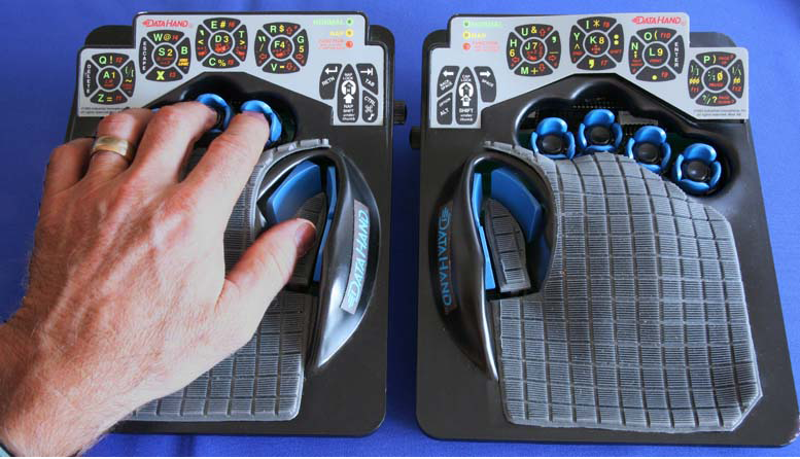
[kefcom] wrote in to give us a heads up about a modular, adaptive system he designed for anyone who is unable to operate a PS3, PS4, or PC with a standard controller. The project was inspired by Microsoft’s adaptive XBOX controller and works pretty much the same way — broken-out buttons, joysticks, and other inputs all connect to a hub that unifies them into a controller the console or computer can communicate with. The major difference is that this project is open source and can be realized much more cheaply.

If you want to give this a try, [kefcom]’s project repo has step-by-step instructions for disassembling two types of wireless controllers and converting them into hubs for modular controls. He’s looking for help with design, documentation, and finding reliable suppliers for all the parts, so let him know if you can assist.

Some players need something more accessible than just broken-out buttons and full-size joysticks. Here’s an adaptive controller that uses ridged foam rollers to actuate buttons.

No Windshield? No Problem, Says McLaren

All the best sports cars look like they’re moving when they’re just sitting there, and the lines on McLaren’s newest limited-edition plaything redefine that look of speed standing still. Maybe it’s the sneering headlights or the streamlined, reverse-1966 Batmobile styling. Whatever it is, the 804-horsepower two-seater project Elva looks like it’s leaping off the line into the future.

But this future is free from the last thing we’d expect to see removed from any vehicle, especially a $1.7 million supercar — the windshield. Now that the headphone jack has been deemed expendable, it seems that nothing is sacred. The Elva is already a permanent convertible with no windows.

Though McLaren didn’t start this weird and windowless fire, the Elva is meant to fan the flames of futurism. She joins the ranks of a few windshield-free models from Ferrari, Mercedes-Benz, and Aston Martin. In the other guy’s cars, you’ll need a helmet above 30MPH unless you love the thunderous sounds of air buffeting and blown-out hair. It’s a young idea with a few bugs to work out.

Continue reading “No Windshield? No Problem, Says McLaren”