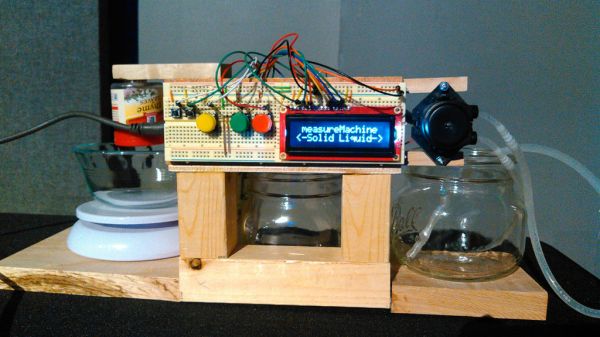
Does your dog or cat wake you up every morning, demanding to be fed? Maybe you feed Sparky in the evenings instead. But doesn’t that limit your spontaneity? It sure limited [Jorge]’s after-work plans. He has two dogs that eat the same type of food, but in different quantities. This was a big factor in the design and execution of his dual pet food dispenser.
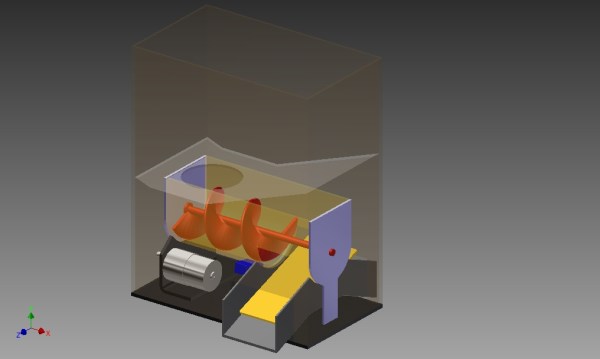
[Jorge] started by modeling his requirements in 3D. Dispensing takes place in two stages as food moves from the storage hopper to the bowls. A 12V printer motor turns the 3D-printed auger, which transports the nuggets to the staging area. Here, a servo controls a ramp in a see-saw motion, sending the food sliding sideways into one bowl or the other.
The dispenser is designed around a PIC18F2420. Although this micro was [Jorge] ‘s second choice, it ticks all the boxes in the design. His acrylic enclosure features four push buttons for navigation and selection through the 16×2 LCD. [Jorge] has an issue with the food getting stuck in the first stage. A friend suggested that he use vibration to agitate the food, but that didn’t work. [Jorge] ultimately added a stirring shaft with spokes that helps keep the morsels moving. Take the tour after the break.
If you want to dispense single doses of food on a timer, check out this automatic cat feeder made from scavenged parts.
Continue reading “Dual Pet Food Dispenser Is Doubly Convenient”