Ultra-Polished, Handmade Settlers Of Catan Redux

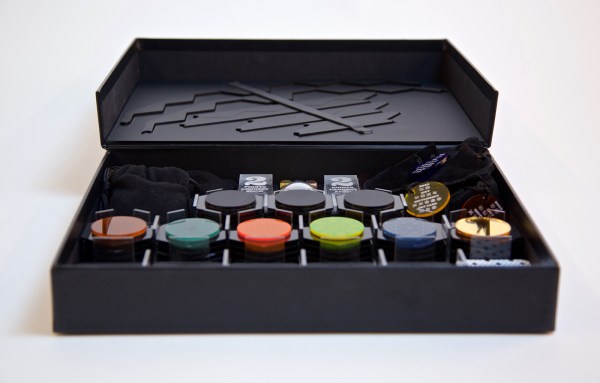
[Fuzzy Wobble] and [Amy Wang]’s Deep Space Settlers project is a one-of-a-kind re-invention of the popular board game Settlers of Catan, and showcases the polished results that are possible with the fabrication tools and methods available in many workshops and hackerspaces today. We reached out to the makers for some of the fabrication details, which they were happy to share.

(For those of you who are familiar with the game, technically this is a remake and slight evolution of the Seafarers expansion to the base Settlers of Catan game. A few rule changes were made, but it is mostly a total remodel and redesign.)

Continue reading “Ultra-Polished, Handmade Settlers Of Catan Redux” →

Easy UFO Lights On Your Drone For Halloween

Sometimes it’s not so much what you put together, it’s how you use it. The folks at Adafruit have put up a project on how to dress up your drone with ‘UFO lights’ just in time for Halloween. The project is a ring of RGB LEDs and a small microcontroller to give any quadcopter a spinning ‘tractor beam light’ effect. A 3D printed fixture handles attachment. If you’re using a DJI Phantom 4 like they are, you can power everything directly from the drone using a short USB cable, which means hardly any wiring work at all, and no permanent changes of any kind to the aircraft. Otherwise, you’re on your own for providing power but that’s probably well within the capabilities of anyone who messes with add-ons to hobby aircraft.

One thing this project demonstrates is how far things have come with regards to accessibility of parts and tools. A 3D printed fixture, an off-the-shelf RGB LED ring, and a drop-in software library for a small microcontroller makes this an afternoon project. The video (embedded below) also demonstrates how some unfamiliar lights and some darkness goes a long way toward turning the otherwise familiar Phantom quadcopter into a literal Unidentified Flying Object.

Continue reading “Easy UFO Lights On Your Drone For Halloween” →

Navigation Thing: Four Days, Three Problems, And Fake Piezos

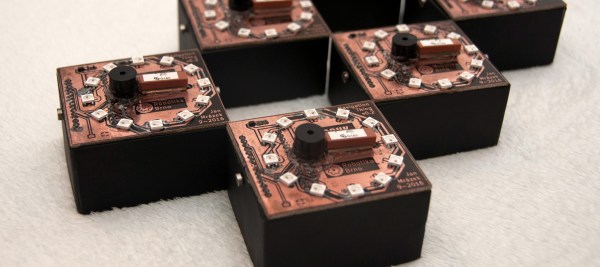
The “Navigation Thing“ was designed and built by [Jan Mrázek] as part of a night game activity for high school students during week-long seminar. A night-time path through a forest had stations with simple tasks, and the Navigation Thing used GPS, digital compass, a beeper, and a ring of RGB LEDs to provide a bit of “Wow factor” while guiding a group of students from one station to the next. The devices had a clear design direction:

“I wanted to build a device which a participant would find, insert batteries, and follow the beeping to find the next stop. Imagine the strong feeling of straying in the middle of the night in an unknown terrain far away from civilization trusting only a beeping thing you found. That was the feeling I wanted to achieve.”

The Navigation Things (there are six in total) guide users to fixed waypoints with GPS, a digital compass, and a ring of WS2812 LEDs — but the primary means of feedback to the user is a beeping that gets faster as you approach the destination. [Jan] had only four days to make all six units, which was doable. But as most of us know, delivering on a tight deadline is often less about doing the work you know about, and more about effectively handling the unexpected obstacles that inevitably pop up in the process.

Continue reading “Navigation Thing: Four Days, Three Problems, And Fake Piezos” →

Monstrous Suit Of Power Armor 3D Printed Over 140 Days

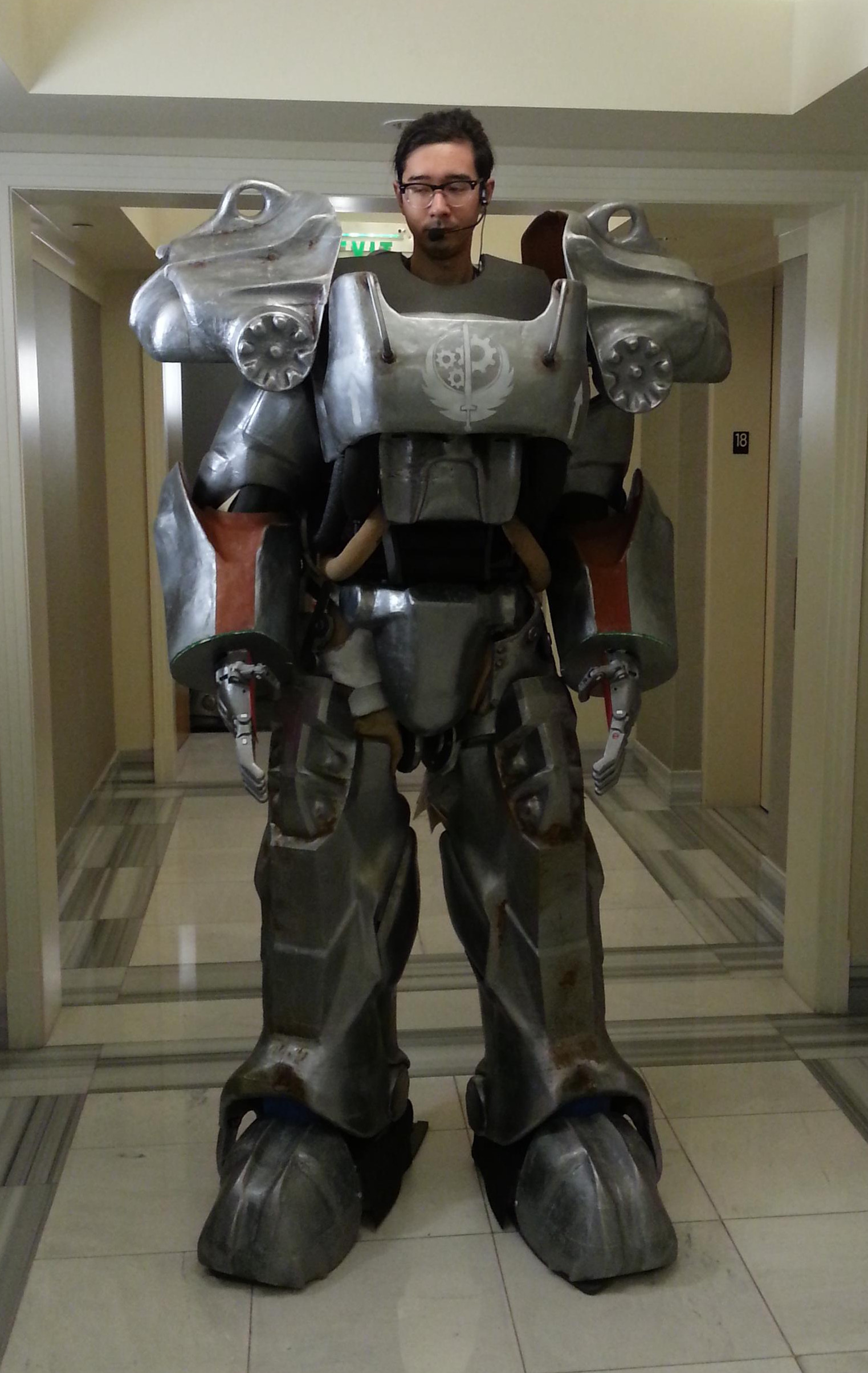
fallout-armour-3d-printed-no-helmet[hirocreations] printed an entire suit of enormous Fallout power armor on his Monoprice Maker Select 3D printer, which took some 140 days and over 120 pounds of IC3D PLA filament. Happily, [hirocreations] was able to arrange a sponsorship with IC3D for the build – who would be crazy enough to use so much filament over so long for an entire 7+ foot tall suit, right? Over those 140 days, the belts on the printer needed to be replaced twice but it otherwise chugged right along.

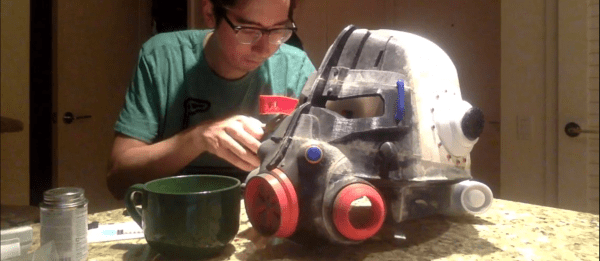
Most of the parts were printed at 0.46 mm layer height. Individual parts were welded (melted) together using what is essentially a soldering iron with a flat tip; many parts were too thin for any kind of joints or fixtures to be practical. Parts were smoothed with drywall spackle, lots of filler primer, and painted. Some of the parts – like the chest armor – are mounted on a frame made from PVC tubing. [hirocreations] may have gone through 120 pounds of filament, but the end result doesn’t weigh that much; the suit itself weighs in at 85-90 lbs, the rest of it went to support material, skirts, and print failures.

It was known from the start that weight could become a serious issue, so [hirocreations] went for a very light infill (10%) and 3-4 perimeter layers; he also extruded at a high temperature (~230C) which he said seemed to provide a very strong layer bond with the settings and filament he was using. So far, he says it’s taken some very hard knocks and nothing has broken or cracked. He has a short video series documenting the assembly, and you can see some of the raw armor parts before any finishing in one of the videos, embedded below.

Continue reading “Monstrous Suit Of Power Armor 3D Printed Over 140 Days” →

It’s A Clock! It’s A Puzzle! It’s The GoonieBox!

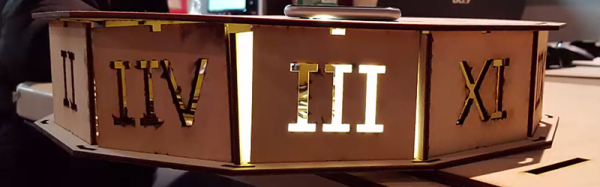
[Dr.Duino] recently completed the latest piece of what he calls “Interactive Furniture” – the GoonieBox. It took over 800 hours of design and assembly work and the result is fascinating. Part clock and part puzzle box, it’s loaded with symbols, moving parts, lights, riddles, sounds, switches, and locked compartments. It practically begs visitors to take a closer look.

The concept of Interactive Furniture led [Dr.Duino] to want to create a unique piece of decor that visitors could interact with. That alone wasn’t enough — he wanted something that wouldn’t require any explanation of how it worked; something that intrinsically invited attention, inspection, and exploration. This quest led to creating The GoonieBox, named for its twin inspirations of the 1985 film The Goonies as well as puzzles from the game “The Room“.

Embedded below are two short videos: the first demonstrates the functions of the box, and the second covers the build process. There’s laser-cut wood, plenty of 3D printed parts, and a whole lot of careful planning and testing.

Continue reading “It’s A Clock! It’s A Puzzle! It’s The GoonieBox!” →

Watch The Diesel Effect In Ballistic Gelatin

A striking video appears to demonstrate an explosion via the diesel effect in clear ballistic gel. The diesel effect or “dieseling” refers to when a substance ignites from the effects of pressure, and it’s the operating principle behind the gadgets known as Fire Sticks or Fire Pistons.

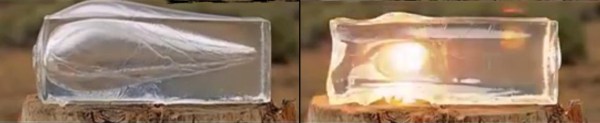
diesel-effect-ballistics-gelBallistic gel is a broad term referring to a large chunk of dense gel generally used in firearms-related testing to reliably and consistently measure things like bullet deformation, fragmentation, and impact. It’s tough, elastic, and in many ways resembles a gigantic gummi bear. Fans of Mythbusters (or certain DIY railguns) will recognize the stuff. Water-based blocks made with natural gelatin can be easily made at home, but end up with a yellow-brown color and have a limited shelf life due to evaporation. Clear blocks exist that are oil-based and don’t dry out like the water-based ones. It’s one of these that is in the embedded animation below.

Slow motion video capture is a natural companion to just about anything that you’d need ballistic gel for, and good thing — because the video captured what appears to be a diesel effect! The block is hit with a bullet, and as the bullet rapidly expands and dumps its energy into the gel, a cavity expands rapidly. During this process, some of the (oil-based) material in the cavity has been vaporized. After the expanded bullet exits (to the right of the gif above but easier to see in the video below), the cavity in the block begins to collapse. The resulting pressure increase appears to ignite the vaporized material, which explodes with a flash followed by some exhaust.

This effect has been observed in ballistic gel before, but this video shows a particularly clear ignition, followed by a secondary expansion of the cavity, then a flatulent-ish ejection of exhaust as the cavity collapses. If nothing else, it’s a very striking effect clearly captured on film. Slow-motion capture of destructive forces makes visible many things that would otherwise happen too quickly to perceive.

Continue reading “Watch The Diesel Effect In Ballistic Gelatin” →

3D Printed Nozzles Turbocharge Microsphere Production

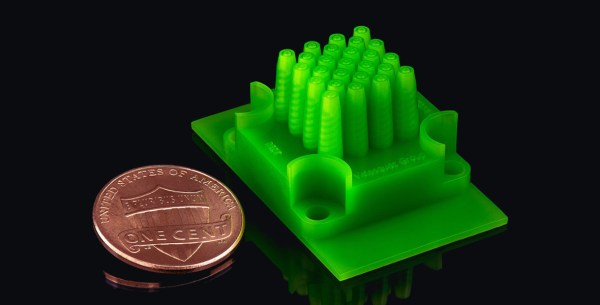
Researchers at MIT have used 3D printing to open the door to low-cost, scalable, and consistent generation of microencapsulated particles, at a fraction of the time and cost usually required. Microencapsulation is the process of encasing particles of one material (a core) within another material (a shell) and has applications in pharmaceuticals, self-healing materials, and dye-based solar cells, among others. But the main problem with the process was that it was that it was slow and didn’t scale, and it was therefore expensive and limited to high-value applications only. With some smart design and stereolithography (SLA) 3D printing, that changed. The researchers are not 3D printing these just because they can; they are printing the arrays because it’s the only way they can be made.

Continue reading “3D Printed Nozzles Turbocharge Microsphere Production” →