‘Radar’ Glasses Grant Vision-free Distance Sensing

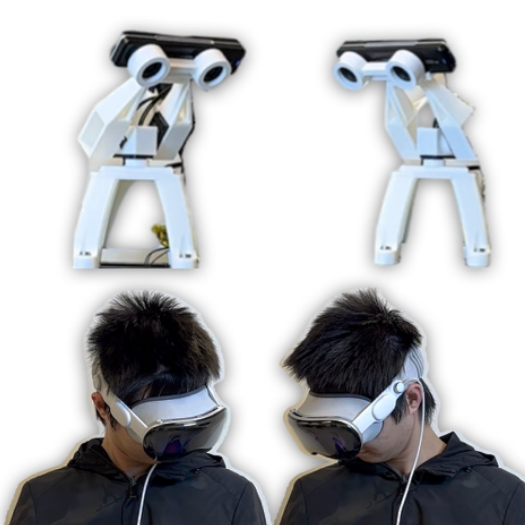
[tpsully]’s Radar Glasses are designed as a way of sensing the world without the benefits of normal vision. They consist of a distance sensor on the front and a vibration motor mounted to the bridge for haptic feedback. The little motor vibrates in proportion to the sensor’s readings, providing hands-free and intuitive feedback to the wearer. Inspired in part by his own experiences with temporary blindness, [tpsully] prototyped the glasses from an accessibility perspective.

The sensor is a VL53L1X time-of-flight sensor, a LiDAR sensor that measures distances with the help of pulsed laser light. The glasses do not actually use RADAR (which is radio-based), but the operation is in a sense quite similar.

The VL53L1X has a maximum range of up to 4 meters (roughly 13 feet) in a relatively narrow field of view. A user therefore scans their surroundings by sweeping their head across a desired area, feeling the vibration intensity change in response, and allowing them to build up a sort of mental depth map of the immediate area. This physical scanning resembles RADAR antenna sweeps, and serves essentially the same purpose.

There are some other projects with similar ideas, such as the wrist-mounted digital white cane and the hip-mounted Walk-Bot which integrates multiple angles of sensing, but something about the glasses form factor seems attractively intuitive.

Thanks to [Daniel] for the tip, and remember that if you have something you’d like to let us know about, the tips line is where you can do that.

UEVR Project Converts Games To VR, Whether They Like It Or Not

UEVR, or the Universal Unreal Engine VR Mod by [praydog] is made possible by some pretty neat software tricks. Reverse engineering concepts and advanced techniques used in game hacking are leveraged to add VR support, including motion controls, to applicable Unreal Engine games.

The UEVR project is a real-world application of various ideas and concepts, and the results are impressive. One can easily not only make a game render in VR, but it also handles managing the player’s perspective (there are options for attaching the camera view to game objects, for example) and also sensibly maps inputs from VR controllers to whatever the game is expecting. This isn’t the first piece of software that attempts to convert flatscreen software to VR, but it’s by far the most impressive.

There is an in-depth discussion of the techniques used to sensibly and effectively locate and manipulate game elements, not for nefarious purposes, but to enable impressive on-demand VR mods in a semi-automated manner. (Although naturally, some anti-cheat software considers this to be nefarious.)

Many of the most interesting innovations in VR rely on some form of modding, from magic in Skyrim that depends on your actual state of mind to adding DIY eye tracking to headsets in a surprisingly effective, modular, and low-cost way. As usual, to find cutting-edge experimentation, look to the modding community.

Möbius Tank’s Twisty Treads Became Bendy

[James Bruton]’s unusual Möbius Tank has gotten a little more unusual with the ability to bend itself, which allows it to perform turns even though it is a single-track vehicle.

The turning radius isn’t great, but three-point turns are perfectly feasible.

The Möbius Tank was a wild idea that started as a “what if” question: what if a tank tread was a Möbius strip? We saw how [James] showed it could be done, and he demonstrated smart design and assembly techniques in the process.

He’s since modified the design to a single-track, and added a flex point in the center of the body. Two linear actuators work together to make the vehicle bend, and therefore give it the ability to steer and turn. A normal tread would be unable to bend in this way, but the twist in the Möbius tread accommodates this pivot point perfectly well.

It works, but it’s not exactly an ideal vehicle. With the tread doing a 90-degree twist on the bottom, there isn’t a lot of ground clearance. In addition, since the long vehicle has only a single tread, it is much taller than it is wide. Neither does it any real favors when it comes to stability over uneven terrain, but it’s sure neat to try.

Even if it’s not practical, Möbius Tank is wild to look at. Check it out in the video, embedded just under the page break.

Continue reading “Möbius Tank’s Twisty Treads Became Bendy”

Simulate Running A Small Hardware Business With Hardware Hustle

[Oskitone]’s Hardware Hustle is a printable roll-and-write tabletop game that can be played on a single sheet of paper. It simulates attempting to run a small hardware business sustainably. Buy parts, make products, and sell them without burning yourself out!

If you’re not familiar with roll-and-write games, it’s a genre in which players take turns by rolling dice and then choosing how to assign those values in a game space as they progress from turn to turn. In the case of Hardware Hustle, it’s primarily a resource management game in which a player will be purchasing parts, assembling widgets, selling those widgets, and improving processes all while managing both money and opportunity costs.

The inspiration for Hardware Hustle comes from [Oskitone]’s own experience designing, building, and selling things like open-sourced, hackable synth kits that are known for their thoughtful design and fantastic use of 3D printing.

The game is in open beta-testing mode, so if you’d like to give it a try, head over to the PDF download section of the GitHub repository. Don’t forget to share your thoughts with the feedback form after playing. (If you’re wondering why a printable tabletop game has source code on GitHub, it’s because the game’s printable sheets are generated by JavaScript, making adjustments and tweaks and version control easier.)

Tips For 3D Printing Watertight Test Tubes

[DaveMakesStuff] uses 3D printed test tubes for plants and similar purposes, and he’s shared how to make them on a 3D printer, complete with different models each optimized for different nozzle sizes.

The slots in the model are a means of manipulating how the slicer creates a toolpath when printing in spiral vase mode. These areas end up denser and stronger than they otherwise would be.

It’s not too hard to get clear-looking prints in spiral vase mode by using a transparent filament, but the real value in his design is that it comes out reliably watertight, with an extra-strong base and rim.

How is this accomplished when using spiral vase mode, which extrudes only a single wall perimeter? By using fancy geometry on the part, which makes the nozzle follow a high-density path that turns back onto itself multiple times, in concept a little like a switchback trail. The result is extra-dense areas on both the rim and the bottom of the tubes. This helps make them not only watertight, but far stronger than a single wall.

This technique is reminiscent of an earlier method we saw of enhancing the strength of vase mode prints by modeling thin slots into an object. After slicing, the model still consists of a single unbroken spiral extrusion. But in practice, the extruded plastic forms what resemble structural ribs. Why? Because those technically-adjacent extruded lines are so close to one another that they end up sticking together. Something similar is being done here by [DaveMakesStuff] to ensure that the bottom and top of the tubes are extra strong.

You can see a short video (embedded below) that showcases the tubes, as well as some modular 3D-printable racks that [DaveMakesStuff] also makes. And should you want some tips on getting better transparency from your 3D prints, the essentials boil down to printing with transparent filament, slightly hotter, and with a slightly higher extrusion rate.

Continue reading “Tips For 3D Printing Watertight Test Tubes”

Open Source Needs A New Mission: Protecting Users

[Bruce Perens] isn’t very happy with the current state of Free and Open Source Software (FOSS), and an article by [Rupert Goodwins] expounds on this to explain Open Source’s need for a new mission in 2024, and beyond. He suggests a focus shift from software, to data.

The internet as we know it and all the services it runs are built on FOSS architecture and infrastructure. None of the big tech companies would be where they are without FOSS, and certainly none could do without it. But FOSS has its share of what can be thought of as loopholes, and in the years during which the internet has exploded in growth and use, large tech companies have found and exploited all of them. A product doesn’t need to disclose a single line of source code if it’s never actually distributed. And Red Hat (which [Perens] asserts is really just IBM) have simply stopped releasing public distributions of CentOS.

In addition, the inherent weak points of FOSS remain largely the same. These include funding distributions, lack of user-focused design, and the fact that users frankly don’t understand what FOSS offers them, why it’s important, or even that it exists at all.

A change is needed, and it’s suggested that the time has come to move away from a focus on software, and shift that focus instead to data. Expand the inherent transparency of FOSS to ensure that people have control and visibility of their own data.

While the ideals of FOSS remain relevant, this isn’t the first time the changing tech landscape has raised questions about how things are done, like the intersection of bug bounties and FOSS.

What do you think? Let us know in the comments.

Adding AI To NPCs Is Easy, Doing It Well Is Hard

Adding natural language interfaces to software is easier than ever, and that led [creikey] to prototype a game that hinges on communicating with NPCs. The prototype went through multiple iterations during which he mainly discovered things that did not work well. Ultimately, it led to [creikey] settling on a western-themed game called Dante’s Cowboy which he hopes to release as an experiment. He begins talking about the game around the 4:43 mark in the video, which directly precedes a recording of a presentation he gives at as an indie developer.

Games typically revolve around the player manipulating entities in an environment in order to make things happen. This interaction drives engagement and interesting decisions. But while adding natural language AI to NPCs makes them easy to talk with, talking by itself is a shallow interaction. Convincing NPCs to do things? That’s complex and far more difficult to implement. [creikey] realized the limitations large language models (LLMs) had and worked to overcome them to make a unique game experience.

The challenges boil down to figuring out how to drive meaningful interaction, aligning AI behavior with the gameplay context, and managing API costs. In his words, “it’s been a learning experience to figure out where [natural language AI] even belongs in a game, if it belongs at all.”

We’ve previously seen ChatGPT used to grant NPCs the ability to communicate naturally which is a fascinating tech demo, but gameplay-wise can boil down to being a complicated alternative to pressing a button. As [creikey] discovered, adding this technology into games in a way that feels meaningful takes a new kind of work.

Continue reading “Adding AI To NPCs Is Easy, Doing It Well Is Hard”