Math, Optics, And CNC Combine To Hide Secret Images In Acrylic

Magic mirrors, with an LCD panel hidden behind a partially reflectively mirror, are popular for a reason — they’re a good-looking way to display useful information. A “Magic Window,” however, is an entirely different thing — and from the look of it, a far cooler one.

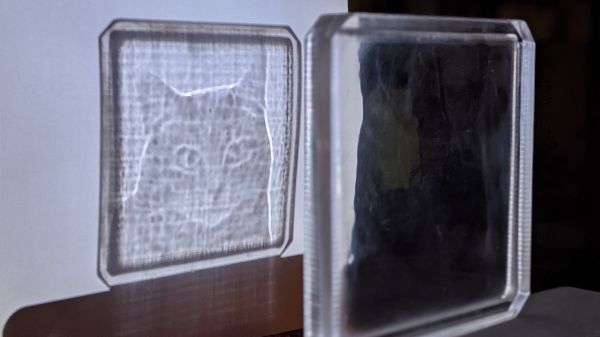
If you’ve never seen a Magic Window before, don’t worry — it’s partially because you’re not supposed to see it. A Magic Window appears to be a clear piece of glass or plastic, one with a bit of a wave in it that causes some distortion when looking through it. But as [Matt Ferraro] explains, the distortion encodes a hidden image, visible only when light passes through the window. It looks a bit like a lithophane, but it’s projected rather than reflected, and it relies on an optical phenomenon known as caustics. If you’ve ever seen the bright and dark patches cast on the bottom of a swimming pool when sunlight hits the surface, you’ve seen caustics.

As for how to hide an image in a clear window, let’s just say it takes some doing. And some math; Snell’s Law, Fermat’s Theorem, Poisson’s Equation — all these and more are mentioned by [Matt] by way of explanation. The short story is that an image is morphed in software, normalized, and converted into a heightmap that’s used to generate a toolpath for a CNC router. The design is carved into a sheet of acrylic by the router and polished back to clarity with a succession of sandpaper grits. The wavy window is then ready to cast its hidden shadow.

Honestly, the results are amazing, and we marvel at the skills needed to pull this off. Or more correctly, that [Matt] was able to make the process simple enough for anyone to try.

Continue reading “Math, Optics, And CNC Combine To Hide Secret Images In Acrylic”

Hackaday Links Column Banner

Hackaday Links: August 22, 2021

It’s usually pretty hard to miss when Boston Dynamics drops a new video of one or more of their robots doing something flashy. But in case you’ve been under a rock the last few days, you might want to check out the Atlas parkour video. We last saw a pair of Atlas robots busting some dance moves with a few other Boston Dynamics robots, and while that was an incredible demonstration of the level of control they’ve engineered, they really were just playing back a series of preprogrammed moves. The obstacle course demo, though, seems like something different. There’s a good overview of the demo in IEEE Spectrum, where they point out that this is the first time we’ve seen Atlas show off using all four limbs at once for coordinated motion — that sweet vault over the fence. And really, it’s hard not to watch such human-like moves and not think that it’s just somebody in a robot suit. Even the stumbles feel human. What’s even more fun, though, is the behind-the-scenes look at Atlas. Especially for the face-plants and fails.

August 19 was the 100th anniversary of the birth of Gene Roddenberry, the creator of Star Trek. In the process of just trying to build a fictional universe to tell some interesting stories and make a little money, he managed to spawn not only an enduring science-fiction franchise but also to inspire generations of future scientists and engineers. The number of things that Star Trek writers invented to move their stories along that later showed up as actual products is astonishing, as are the weird coincidences like placing the fictional planet Vulcan in orbit around star 40 Eridani, only to find out that there’s actually a potentially habitable exoplanet circling that star. As a salute to Roddenberry, the Deep Space Network was used last week to send a message to 40 Eridani. One of the big dishes at the Goldstone DSN site in California blasted the 20-kW signal out on Thursday, starting it on its 16.5-year journey to the stars. We looked for details on what was sent, but the only description was that it contained a 1976 recording by the Great Bird of the Galaxy himself. Whatever it was, it’ll take at least 33 years to see if we get a response. Mark your calendars.

I’ve been doing a lot of work on cars lately, a task made considerably more approachable by the fact that the newest vehicle in the family fleet is from 2004. I find working on cars very satisfying, and I’m dreading the day when we’re forced to replace one of our old-timers with something more modern and less amenable to driveway repairs. That said, there’s also a lot to like about newer vehicles, particularly electric vehicles. It would be nice to have a way to move away from ICE vehicles while still being able to work on your ride. But if Ford’s tease this week of an EV crate motor comes to pass, it just might be the best of both worlds. The motor, bearing the unfortunate moniker “Eluminator” — just can’t resist putting that “E” in there, can they? — is supposed to be a drop-in replacement for an internal combustion engine, suitable for a “restomod” project. These car builds aim to make a car look as vintage as possible, but radically change the guts to add functionality — think a Raspberry Pi running a Spotify client that’s stuffed into a vintage Atwater Kent cathedral radio. We like the idea of electrifying an old car, but it seems to us that a crate motor is only part of the answer. Is there such thing as a crate battery?

And finally, there was an interesting article detailing a new approach to repairing ruptured eardrums using 3D printing. The tympanic membrane is a thin, delicate sheet of tissue that is easily punctured, whether by blunt-force trauma, infections, or even by loud sounds like gunshots or explosions. Hearing is compromised when an eardrum is damaged, and the hole can serve as a route for pathogenic microorganisms to get into the inner ear. Fixing the hole usually requires a graft from the patient’s own tissues, often sourced from the little dongle covering the ear canal. But this tissue isn’t nearly as thin as the natural eardrum, and while hearing can be restored, it’s often muddy and muffled. The new technique is to 3D-print a custom graft for the patient, using a special polymer and printer. The artificial membrane mimics the structure of the natural tympanic membrane and restores more natural hearing immediately. It also serves as a scaffold for the body to fill in with natural cells, hopefully returning natural function as the 3D-printed part is absorbed. It’s interesting work, and the video in the linked article is pretty fascinating too.

Minimalist Robot Arm Really Stacks Up

There’s nothing like a little weekend project, especially one that ends up better than you expected. And when you literally build a robotic arm out of workshop scraps, so much the better.

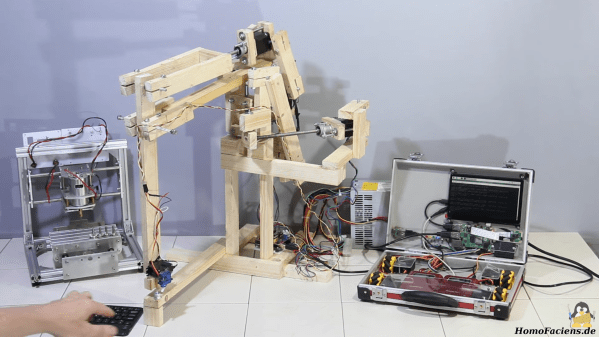
Longtime readers will no doubt recognize the build style used here as that of [Norbert Heinz], aka “Homofaciens” on YouTube. [Norbert] has a way of making trash do his bidding, and has shown us all kinds of seemingly impossible feats of mechatronics with just what’s lying around. In this case, his robot arm is made from scrap wooden roofing battens, or what we’d call furring strips here in the US. The softwood isn’t something you’d think would make a great material for building robots, but [Norbert] makes its characteristics work for him, like using wax-lubricated holes for hinge points. Steppers and lead screws cannibalized from an old CNC build, along with the drive electronics, provide the motion. It’s a bit — compliant — but precise enough to pick up nuts and stack them nicely. The video below gives an overview of the build, and detailed instructions are available too.

We always appreciated [Norbert]’s minimalist builds, and seeing what can be accomplished with almost nothing is always inspirational. If you’re not familiar with his work, check out his cardboard and paperclip CNC plotter, his tin can encoders, or his plasma-powered printer.

Continue reading “Minimalist Robot Arm Really Stacks Up”

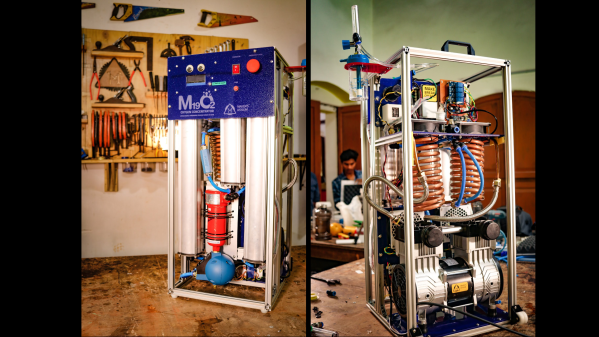
Two views of the M19O2 oxygen concentrator

Design Improvements Make DIY Oxygen Concentrator Even Better

A lot of projects we feature on these pages are of the “one and done” variety — tactical builds that serve a specific purpose with little need for further development. Some projects, though, come out as rough prototypes and then go through multiple rounds of refinement, a process we really enjoy tracking down and following. And when the project is something as important as an oxygen concentrator that can be built and maintained easily, all the better.

The need for cheap oxygen concentrators stems directly from the COVID-19 pandemic, which suggested that high-flow oxygen therapy was a better choice than invasive intubations and mechanical ventilation. But medical-grade oxygen isn’t always easy to come by in all parts of the world, so easily built oxygen concentrators, which rely on the nitrogen-adsorbing properties of the mineral zeolite, are meant to fill the gaps. Early versions of the M19O2 and the related OxyKit concentrator, had a very homebrew feel to them, built on wooden frames as they were. And while the rustic nature of the early builds didn’t detract from their utility, the hackers behind them, including our own [Anool Mahidharia], have been making incremental improvements aimed at not only making the devices work better, but also making them easier to build.

The hackers at Maker’s Asylum have done a fantastic job at documenting their work, with everything posted to a GitHub repo so that anyone can undertake a build. And really, for something as important as making oxygen when it’s needed, there’s really no reason not to give this a try.

Game Development Hack Chat

Join us on Wednesday, August 18 at noon Pacific for the Game Development Hack Chat with Kyle Donnelly!

Chances are we all have fallen into the time trap of computer games at one point or another. It’s easy to do — the worlds that games put before us can be immersive and addictive, and even if they’re populated by fantastical creatures hell-bent on our virtual destruction, they offer a degree of escapism and relaxation that can be hard to come by with any other form of entertainment.

But what does it take to build these virtual worlds? How exactly does one come up with all the ideas needed to make a game fresh and exciting? And once you’ve got the ideas, how do you turn them into the code needed to make the whole thing work? Kyle Donnelly has quite a bit of experience with the game development process, seeing his idea through from initial prototyping to working with a publisher and even getting the game demonstrated at conventions. Along the way, he picked up a collection of tips and shortcuts to make the process easier, as well as developing a small suite of tools to help set up and test game levels quickly and easily, and to deal with the custom physics of his virtual world.

Join us as Kyle stops by the Hack Chat to talk about game development from an angle that rarely gets much coverage — from the software side.

join-hack-chatOur Hack Chats are live community events in the Hackaday.io Hack Chat group messaging. This week we’ll be sitting down on Wednesday, August 18 at 12:00 PM Pacific time. If time zones have you tied up, we have a handy time zone converter.

Banner Art: Video Games Awesome Fanart by sacolin99.

Hackaday Links Column Banner

Hackaday Links: August 15, 2021

Unless you’re in the market for a new car, household appliance, or game console, or if you’re involved in the manufacture of these things, chances are pretty good that the global semiconductor shortage hasn’t directly impacted you yet. But we hobbyists might be due for a comeuppance as the chip shortage starts to impact our corner of the market. We suppose it’s natural that supplies of the chips needed to build Arduinos and Raspberry Pis would start to dry up, as semiconductor manufacturers realign their resources to service their most lucrative markets. Still, it was all sort of abstract until now, but seeing dire quotes from the likes of Adafruit, Pololu, and Sparkfun about the long lead times they’re being quoted — some chips won’t be seen until 2023! — is disheartening. As are the reports of price gouging and even hoarding; when a $10 part can suddenly command $350, you know something has gone seriously wrong.

But have no fear — we’re certain the global chip shortage will have no impact on the planned 2027 opening of the world’s first space hotel. Voyager Station — once dubbed Von Braun Station but renamed for some reason — looks for all the world like Space Station V in “2001: A Space Odyssey”, or at least half of it. The thing is enormous — witness the Starship docked in the center hub, as well as the several dozen shuttle-like craft — escape pods, perhaps? — attached to the outer rim. The renders are imaginative, to say the least — the station looks very sleek, completely unfettered by such banalities as, say, solar panels. We get that a private outfit needs to attract deep-pocketed investors, and that one doesn’t do that by focusing on the technical details when they can sell a “premium experience”. But really, if you’re going to space, do you want basically the same look and feel as a premium hotel on Earth, just with a better view? Or would you rather feel like you’ve actually traveled to space?

Speaking of space, did you ever wonder what the first programmable calculator in space was? Neither did we, but that doesn’t mean we didn’t find this detailed story about the HP-65 that was sent up on the Apollo-Soyuz Test Project in 1975 pretty fascinating. The ASTP was the last hurrah of Apollo, and an often underappreciated engineering challenge. Linking up the two spacecraft safely was not trivial, and a fair number of burn calculations had to be made in orbit to achieve rendezvous and docking, as well as to maintain orbit. The HP-65, a programmable calculator that went for about $750 at the time (for the non-space-rated version, of course) had several programs loaded onto its removable magnetic cards, and the Apollo crew used it to verify the results calculated by the Apollo Guidance Computer (AGC).

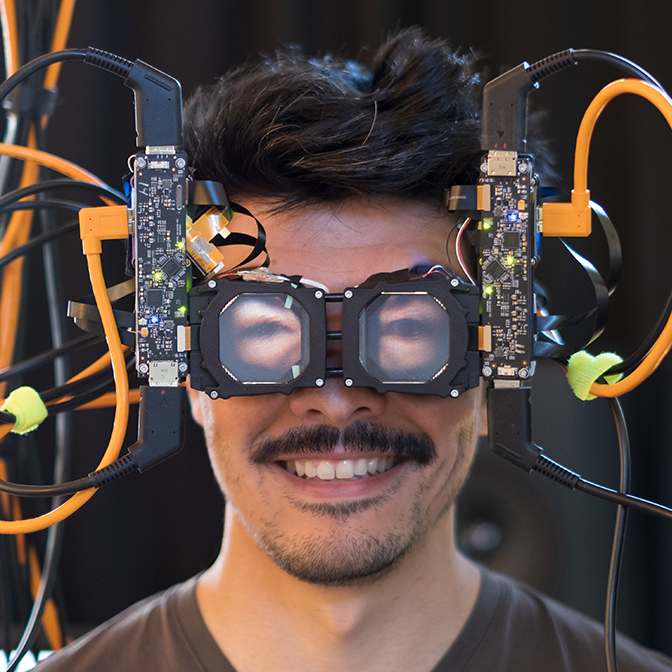
Facebook, a company that exists by providing people with a product they don’t need but now somehow can’t live without, is now dipping a toe into weird, weird waters: reverse-passthrough virtual reality. The idea, we take it, is that as users more widely adopt VR and integrate it into their daily lives, the VR headsets everyone will be wearing will make face-to-face contact more difficult. So what better way to solve that problem than by projecting a live image of the VR user’s eyes onto a screen outside the VR rig, for any and all to see? Pure genius, and not the least bit creepy. They’ve perhaps got a bit of work to go before achieving their goal of “seamless social connection between real and virtual worlds”.

And speaking of eyes, it’s good to know that developers are still hard at work keeping the most vital applications running at peak efficiency on today’s hardware. Yes, the venerable XEyes, a program for the X Window System on Unix-like operating systems that draws a pair of googly eyes on the screen to follow your mouse movements, has finally moved to version 1.2.0. It’s been 11 years since the 1.1.0 upgrade, so it was a long time coming. If you haven’t had the chance to play with XEyes, fear not — just about any Linux machine should be able to show you what you’ve been missing. Or, you know, you could even run it on a camera as the video below the break shows.

Continue reading “Hackaday Links: August 15, 2021”

No Hole In One: Perseverance Strikes Out On First Mars Core Attempt

There’s a military adage that no plan survives first contact with the enemy. While we haven’t gone to war with Mars, at least not yet, it does seem to be a place where the best-laid scientific plans are tested in the extreme. And the apparent failure of Perseverance to retrieve its first Martian core sample is yet another example of just how hard it is to perform geotechnical operations on another planet.

To be sure, a lot about the first sampling operation went right, an especially notable feat in that the entire process is autonomous. And as we’ve previously detailed, the process is not simple, involving three separate robotic elements that have to coordinate their operations perfectly. Telemetry indicates that the percussive drill on the end of the 2.1 m robotic arm was able to use its hollow coring bit to drill into the rock of Jezero crater, and that the sample tube inside the coring bit was successfully twisted to break off the core sample.

But what was supposed to happen next — jamming of the small core sample inside the sample tube — appears not to have happened. This was assessed by handing the sample tube off to the Sample Handling Arm in the belly of Perseverance, where a small probe is used to see how much material was recovered — none, in this case. NASA/JPL engineers then began a search for the problem. Engineering cameras didn’t reveal the core sample on the Martian surface, meaning the sample handling robots didn’t drop it. The core sample wasn’t in the borehole either, which would have meant the camming mechanism designed to retain the core didn’t work. The borehole, though, looked suspicious — it appears not to be deep enough, as if the core sample crumbled to dust and packed into the bottom of the hole.

If this proves to be the cause of the failure, it will be yet another example of Martian regolith not behaving as expected. For InSight, this discovery was a death knell to a large part of its science program. Thankfully, Perseverance can pick up and move to better rock, which is exactly what it will be doing in September. They still have 42 unused sample tubes to go, so here’s to better luck next time.

[Featured images: NASA/JPL-Caltech]