A Ploopy Pick And Place

A fair number of hackers reach that awkward age in their careers – too old for manual pick and place, but too young for a full-fledged PnP machine. The obvious solution is to build your own PnP, which can be as simple as putting a suction cup on the Z-axis of an old 3D-printer. Feeding parts into the pick and place, though, can be a thorny problem.

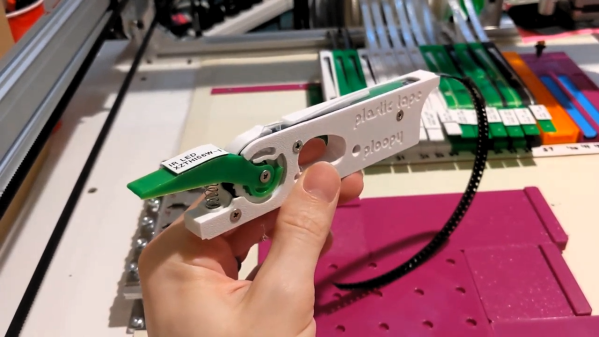
Or not, if you think your way through it like [Phil Lam] did and build these semi-automated SMD tape feeders. Built for 8-mm plastic or paper tapes, the feeders are 3D-printed assemblies that fit into a rack that’s just inside the work envelope of a pick and place machine. Each feeder has a slot in the top for the tape, which is advanced by using the Z-axis of the PnP to depress a lever on the front of the case. A long tongue in the tape slot gradually peels back the tape’s cover to expose a part, which is then picked up by the PnP suction cup. Any machine should work; [Phil] uses his with a LitePlacer. We like the idea that parts stay protected until they’re needed; the satisfyingly clicky lever action is pretty cool too. See it briefly in action in the video below.

It looks like [Phil] built this in support of his popular Ploopy trackball, which is available both as a kit and fully assembled. We think the feeder design is great whether you’re using PnP or not, although here’s a simpler cassette design for purely manual SMD work.

Continue reading “A Ploopy Pick And Place”

P-51 Cockpit Recreated With Help Of Local Makerspace

It’s surprisingly easy to misjudge tips that come into the Hackaday tip line. After filtering out the omnipresent spam, a quick scan of tip titles will often form a quick impression that turns out to be completely wrong. Such was the case with a recent tip that seemed from the subject line to be a flight simulator cockpit. The mental picture I had was of a model cockpit hooked to Flight Simulator or some other off-the-shelf flying game, many of which we’ve seen over the years.

I couldn’t have been more wrong about the project that Grant Hobbs undertook. His cockpit simulator turned out to be so much more than what I thought, and after trading a few emails with him to get all the details, I felt like I had to share the series of hacks that led to the short video below and the story about how he somehow managed to build the set despite having no previous experience with the usual tools of the trade.

Continue reading “P-51 Cockpit Recreated With Help Of Local Makerspace”

A Beginner’s Guide To X-Ray Crystallography

In graduate school, I had a seminar course where one of the sections was about X-ray crystallography. I was excited, because being able to discern the three-dimensional structure of macromolecules just by shining X-rays on them seemed like magic to me. And thanks to a lackluster professor, after the section it remained just as much of a mystery.

If only I’d had [Steve Mould] as a teacher back then. His latest video does an outstanding job explaining X-ray crystallography by scaling up the problem considerably, using the longer wavelength of light and a macroscopic target. He begins with a review of diffraction patterns, those alternating light and dark bands of constructive and destructive interference that result when light shines on two closely spaced slits — the famous “Double-Slit Experiment” that showed light behaves both as a particle and as a wave and provided our first glimpse of quantum mechanics. [Steve] then doubled down on the double-slit, placing another pair of slits in the path of the first. This revealed a grid of spots rather than alternating bands, with the angle between axes dependent on the angle of the slit pairs to each other.


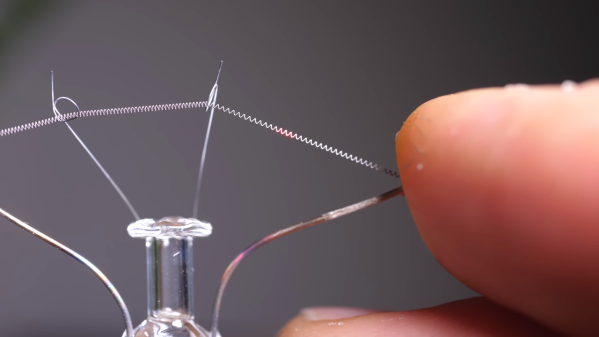
To complete the demonstration, [Steve] then used diffraction to image the helical tungsten filament of an incandescent light bulb. Shining a laser through the helix resulted in a pattern bearing a striking resemblance to what’s probably the most famous X-ray crystallogram ever: [Rosalind Franklin]’s portrait of DNA. It all makes perfect sense, and it’s easy to see how the process works when scaled down both in terms of the target size and the wavelength of light used to probe it.

Hats off to [Steve] for making something that’s ordinarily complex so easily understandable, and for filling in a long-standing gap in my knowledge.

Continue reading “A Beginner’s Guide To X-Ray Crystallography”

Fail Of The Week: Padlock Purports To Provide Protection, Proves Pathetic

Anyone in the know about IoT security is likely to steer clear of a physical security product that’s got some sort of wireless control. The list of exploits for such devices is a long, sad statement on security as an afterthought, if at all. So it’s understandable if you think a Bluetooth-enabled lock is best attacked via its wireless stack.

As it turns out, the Master 5440D Bluetooth Key Safe can be defeated in a few minutes with just a screwdriver. The key safe is the type a realtor or AirBnB host would use to allow access to a property’s keys. [Bosnianbill] embarked on an inspection of the $120 unit, looking for weaknesses. When physical attacks with a hammer and spoofing the solenoids with a magnet didn’t pay off, he decided to strip off the resilient skin that Master so thoughtfully provided to prevent the box from marring the finish of a door or gate. The denuded device thus revealed its awful secret: two Phillips screws, each securing a locking shackle to the cover. Once those are loose, a little prying with a screwdriver is all that’s need to get the keys to the kingdom.

In a follow-up video posted later, [Bill] took a closer look at another key safe and found that Master had made an anemic effort to fix this vulnerability with a squirt of epoxy in each screw head. It’s weak, at best, since a tap with a hammer compresses the gunk enough to get a grip on the screw.

We really thought [Bosnianbill]’s attack would be electronic, like that time [Dave Jones] cracked a safe with an oscilloscope. Who’d have thought a screwdriver would be the best way past the wireless stack?

Continue reading “Fail Of The Week: Padlock Purports To Provide Protection, Proves Pathetic”

Testing Your Grit: Tales Of Hacking In Difficult Situations

What’s your work area like? Perhaps you’re mostly a software person, used to the carpeted land of cubicles or shared workspaces, with their stand-up desks and subdued lighting. Or maybe you’ve got a lab bench somewhere, covered with tools and instruments. You might be more of a workshop person, in a cavernous bay filled with machine tools and racks of raw material. Wherever you work, chances are pretty good that someone is paying good money to keep a roof over your head, keeping the temperature relatively comfortable, and making sure you have access to the tools and materials you need to get the job done. It’s just good business sense.

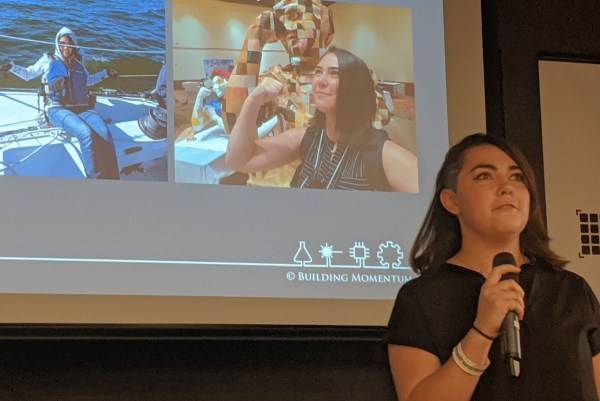
Now, imagine you’ve lost all that. Your cushy workspace has been stripped away, and you’ve got to figure out how to get your job done despite having access to nothing but a few basic tools and supplies and your own wits. Can you do it? Most of us would answer “Yes,” but how many of us have ever tested ourselves like that? Someone who has tested her engineering chops under difficult conditions — and continues to do so regularly — is Laurel Cummings, who stopped by the 2019 Hackaday Superconference to tell us all about her field-expedient life with a talk aptly titled, “When It Rains, It Pours”.

Continue reading “Testing Your Grit: Tales Of Hacking In Difficult Situations”

Austere Engineering Hack Chat

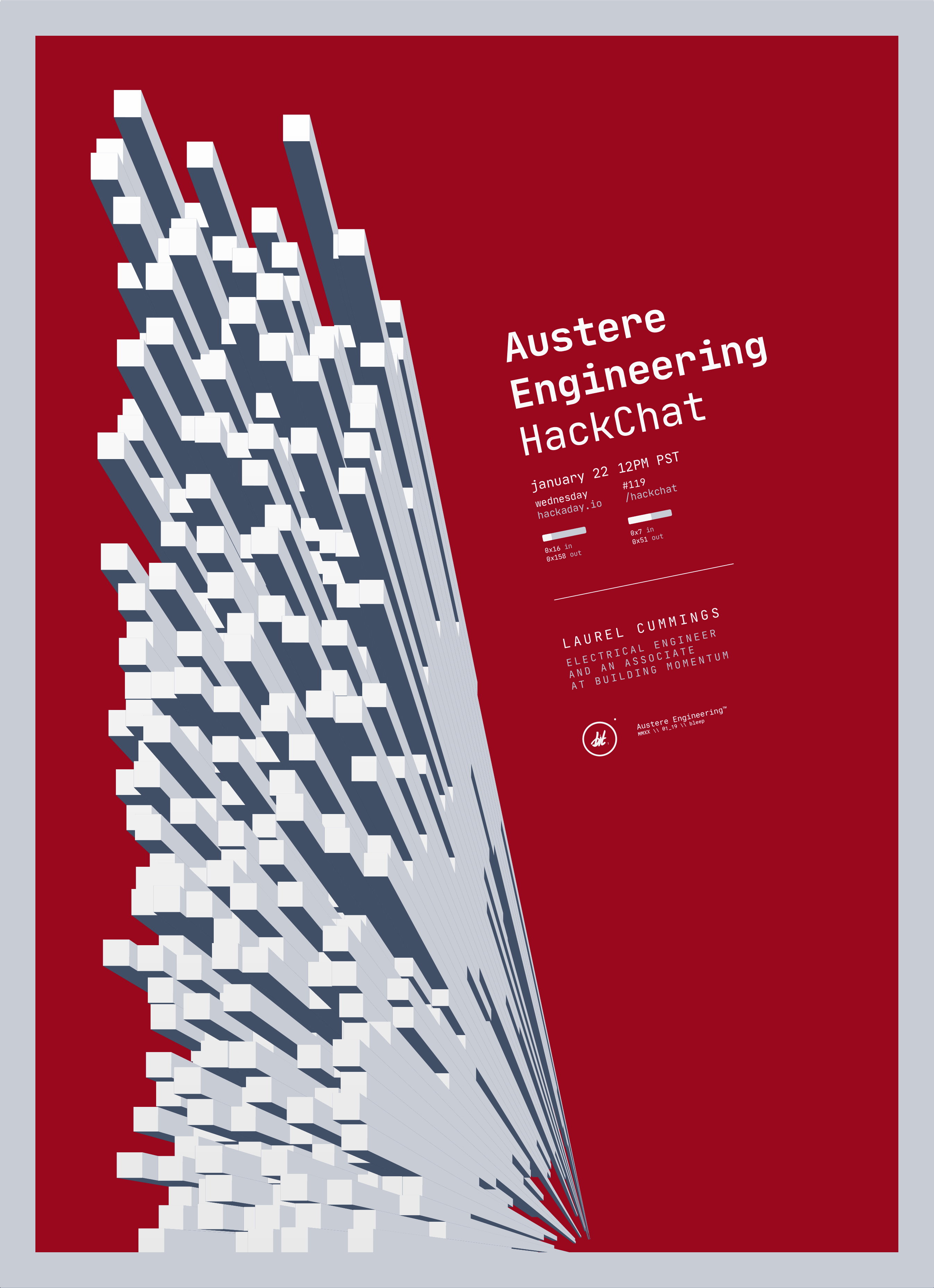
Join us on Wednesday, January 22 at noon Pacific for the Austere Engineering Hack Chat with Laurel Cummings!

For most of us, building whatever it is that needs building is something that occurs in relative comfort and abundance. Sure, there are cold workshops and understocked parts bins to deal with, but by and large, we’re all working in more or less controlled environments where we can easily get to the tools and materials we need to complete the job.

But not all engineering is done under such controlled conditions. Field operations often occur miles from civilization, and if whatever you need is not in the back of the truck, it might as well not exist. At times like this, the pressure is on to adapt, improvise, and overcome to get the job done, especially if people’s lives and well-being are at stake.

All of this is familiar territory for Laurel Cummings, an electrical engineer and an associate at Building Momentum, a technology development and training concern based in Virginia. Her job is to get out in the field and work with the company’s mainly military and corporate clients and help them deal with the challenges of austere environments, including disaster response efforts.

From a North Carolina beach ravaged by Hurricane Florence to the deserts of Kuwait, Laurel has had to think her way out of more than a few sticky situations. Join us as we discuss what it takes to develop and deploy field-expedient solutions under less-than-ideal situations, learn how to know when good enough is good enough, and maybe even hear a few war stories too.

join-hack-chatOur Hack Chats are live community events in the Hackaday.io Hack Chat group messaging. This week we’ll be sitting down on Wednesday, January 22 at 12:00 PM Pacific time. If time zones have got you down, we have a handy time zone converter.

Click that speech bubble to the right, and you’ll be taken directly to the Hack Chat group on Hackaday.io. You don’t have to wait until Wednesday; join whenever you want and you can see what the community is talking about.


Hackaday Links Column Banner

Hackaday Links: January 19, 2020

We’ve seen some interesting pitches in personal ads before, but this one takes the cake. Japanese billionaire Yusaku Maezawa is looking for a date to go along with him on his paid trip to the Moon, with the hope of finding a life partner. Maezawa is slated to be SpaceX’s first commercial lunar flyby customer, and will make the trip no earlier than 2023. That should give him plenty of time to go through the 20,000 applications he received from single women 20 and older with bright personalities and positive attitudes. And he should have plenty of time to make an awesome mixtape for the ride.

Imagine snooping through your kid’s garbage can only to find a used syringe lying in there. Most of us would likely be able to tell that the syringe once contained thermal compound or solder paste and be suitably proud of the little chip off the block, but apparently Cooler Master has fielded enough calls from panicked normie parents that they decided to change the design of their applicators. Given the design of the new applicator we doubt that’s really the reason, but it’s a good marketing story, and we can totally see how someone could mistake the old applicator for something illicit.

It looks as though SpaceX could be getting itself into legal trouble with its Starlink launches. Or more correctly, the FCC might, having apparently violated the National Environmental Policy Act, a Nixon-era law that requires government agencies to consider the environmental impact of any projects they approve. The Federal Communications Commission has been using a loophole in the law to claim a “categorical exemption” from these reviews when approving communications projects, particularly space-based projects. It’s not clear whether space is legally considered part of the environment, so the lawyers are hashing that out. If the FCC gets sued and loses, it’s not clear what happens to the existing Starlink satellites or future launches. Stay tuned for details.

Don’t forget that the Open Hardware Summit is coming soon. The 2020 meeting is the 10th anniversary of the confab, to be held on March 13 in New York. Hackaday is, of course, a proud sponsor of the conference, and our own Sophi Kravtiz will be the keynote speaker! Get your tickets soon.

Tired of off-loading data manipulation and analysis tasks to R in your Python programs? Then you’re probably already aware of Pandas, the Python library that converts data into dataframe objects for easier manipulation. Pandas has (have?) been in pre-release for years, but there’s now a legit 1.0.0 release candidate available. Now might be the time for you Python data mungers to get onboard the Pandas Express.

And finally, the Consumer Electronics Show is a yearly gift to anyone in the tech media, providing as it does so many examples of outrageous uses for the latest technology. To wit, we have LuluPet, the world’s first feces-analyzing cat litter box. LuluPet uses a built-in camera along with IR sensors and an “AI chip” to monitor your cat’s dookie and provide an alert if anything looks awry. On the one hand, inspecting cat poop is a job we’d love to outsource, but on the other hand, most cats we know are quick to cover the evidence of their excretions with kitty litter, leaving a clay-encrusted blob rather than the turds with defined borders that would seem to be needed for image recognition to do its job. We’ll reserve judgment on this one until we see a review.