Hackaday Links Column Banner

Hackaday Links: January 12, 2020

Nothing ruffles feathers more reliably than a software company announcing changes to its licensing terms. And so it goes with AutoDesk, who recently announced that Eagle would no longer be available as a standalone product and would now be bundled with Fusion 360. It looks like there’s still a free option for personal use, which is good even if it limits designs to two schematic sheets, two board layers, and 80 cm² board area. And perhaps this means there will be a Linux version of Fusion 360 too.

With the Y2K bug now twenty years in the rearview mirror, it’s entertaining to look back at that time and all the hype that surrounded it. Usually we talk about the effort that went into fixing vulnerable systems, but do we ever talk about the recipes of Y2K? The Advent of Computing podcast recently did an episode that gives a great background of the Y2K bug, plus discusses what people were planning to do for food after the bug detonated all the world’s nukes when the new millennium rolled around. Pantries stocked with canned goods, wood stoves to cook on and keep warm by when the powerplants all self-destructed on January 1 – it was all part of the vibe at the time.

We suppose when you put 60 birds into orbit at a time, it doesn’t take long to make a sizable impact on the planet’s constellation of satellites. Still, it came as a surprise that SpaceX was able to claim the title of world’s largest commercial satellite constellation after just three Starlink launches. We guess the operative term is “commercial” here, since some governments probably have far more satellites in service than the 182 Starlinks that have been launched so far. That’s a far cry from the 11,000 plus eventually predicted to form the Starlink constellation, but it’s already having an impact.

As a proud Idahoan, I feel personally triggered by what’s billed as the world’s first smart potato. True, I live in the part of the state with the trees and the bears, not the spuds, but still, it’s right there on our license plates. While clearly tongue-in-cheek, the Smart Potato pokes fun of our official State Vegetable, which I find beyond the pale. Seems like anything can be crowdfunded these days.

Speaking of which, check out Kohler’s Alex-connected smart toilet. For a mere $7,000 you can have a toilet that does everything a regular, boring old toilet does, but with lights. In fairness, the value of a good bidet can’t be overstated, but the ability to talk to your toilet and have it talk back seems a little on the iffy side. Perhaps teaming it up with the Charmin Poop-Bot, a self-balancing robot that connects to your phone and brings you a roll of toilet paper if you find yourself without a square to spare.

And finally, drummer Neil Peart died this week at the far-too-young age of 67. While there’s probably a fair number of Rush fans in the core hackaday demographic, there’s no hack or other tie-ins here. I’m just sad about it and wanted to share the news.

DIY Ionizer Clears The Air On A Budget

Have you ever had a good, deep breath of the air near a waterfall, or perhaps after a thunderstorm? That unmistakably fresh smell is due to ionized air, specifically negative ions, and many are the claims concerning their health benefits. A minor industry has sprung up to capitalize on the interest in ionized air, and while [Amaldev] wanted to clean up the Mumbai air coming into his home, he didn’t want to pay a lot for a commercial unit. So he built his own air ionizer for only about $10.

When [Amaldev] dropped this in the Hackaday tip line, he indicated that he’d been taking some heat for the design from Instagram followers. We imagine a fair number of the complaints stem from the cluster of sewing needles that bristle from one end of the PCB and are raised to 6,000 volts by a fifteen-stage Cockcroft-Walton multiplier. That’s sure to raise eyebrows, or possible the hair on one’s head if you happen to brush by the emitters. Or perhaps [Amaldev]’s critics are dubious about the benefits of ionized air; indeed, some commenters on the video below seem to think that the smoke in the closed jar was not precipitated by the ion stream as [Amaldev] claims, but rather somehow was settled by heat or some other trickery.

Neither of those bothers us as much as the direct 230-volt mains connection, though. We’d have preferred to see at least an isolation transformer in there, or perhaps a battery-powered flyback circuit to supply the input to that multiplier. Still, the lesson on cascade multipliers was welcome, and we found the smoke-clearing power of ionized air pretty amazing.

Continue reading “DIY Ionizer Clears The Air On A Budget”

Stacks Of Spring Washers Power The Drawbar On This CNC Mill Conversion

With Tormach and Haas capturing a lot of the entry-level professional market for CNC machines, we don’t see too many CNC conversions of manual mills anymore. And so this power drawbar conversion for a Precision Matthews mill really caught our eye.

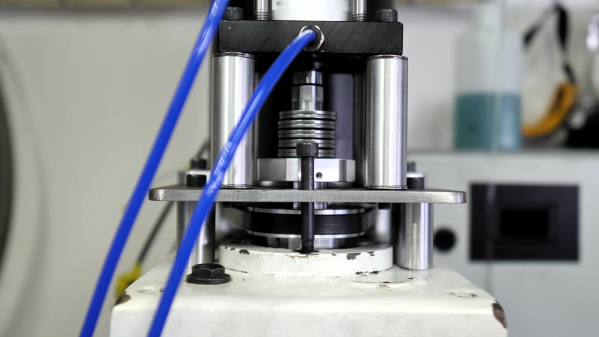
What’s that, you say? Didn’t [Physics Anonymous] already build a power drawbar for a mill? They did, and it was quite successful. But that was based on a pneumatic impact wrench, and while it worked fine on a manual mill, the same approach would be a bit slow and cumbersome on a CNC mill. For this build, they chose a completely different approach to providing the necessary upward force to draw the collet into the collet holder and clamp down on the tool: springs. Specifically, Belleville spring washers, which are shaped like shallow cups and can exert tremendous axial force over a very short distance.

[PA] calculated that they’d need to exert 2,700 pounds (12,000 Newtons) of force over a length of a couple of inches, which seems outside the Belleville washer’s specs. Luckily, the springs can be stacked, either nested together in “series” to increase the load force, or alternating in “parallel” to apply the rated force over a greater distance. To compress their stack, they used a nifty multi-stage pneumatic cylinder to squash down the springs and release the collet. They also had to come up with a mechanism to engage to machine’s spindle only when a tool change is called for. The video below details the design and shows the build; skip to 11:32 to see the drawbar in action.

We’re looking forward to the rest of [Physics Anonymous]’ conversion. They’re no strangers to modifying off-the-shelf machines to do their bidding, after all – witness their improvements to an SLA printer.

Continue reading “Stacks Of Spring Washers Power The Drawbar On This CNC Mill Conversion”

Using Lookup Tables To Make The Impossible Possible

Embarrassing confession time: I never learned my multiplication tables in grade school. Sure, I had the easy tables like the twos and the fives down, but if asked what 4 x 7 or 8 x 6 was, I’d draw a blank. As you can imagine, that made me a less than stellar math student, and I was especially handicapped on time-limited tests with lots of long multiplication problems. The standard algorithm is much faster when you’ve committed those tables to memory, as I discovered to my great woe.

I was reminded of this painful memory as I watched Charles Lohr’s 2019 Supercon talk on the usefulness and flexibility of lookup tables, or LUTs, and their ability to ease or even completely avoid computationally intensive operations. Of course most LUT implementations address problems somewhat more complex than multiplication tables, but they don’t have to. As Charles points out, even the tables of sines and logarithms that used to populate page after page in reference books have been ported to silicon, where looking up the correct answer based on user input is far easier than deriving the answer computationally.

Yes, this is a Minecraft server all thanks to LUTs.

One of the most interesting examples of how LUTs can achieve the seemingly impossible lies in an old project where Charles attempted to build a Minecraft server on an ATMega168. Sending chunks (the data representations of a portion of the game world) to clients is the essential job of a Minecraft server, and on normal machines that involves using data compression. Rather than trying to implement zlib on an 8-bit microcontroller, he turned to a LUT that just feeds the raw bytes to the client, without the server having the slightest idea what any of it means. A similar technique is used by some power inverters, which synthesize sine wave output by feeding one full cycle of values to a DAC from a byte array. It’s brute force, but it works.

Another fascinating and unexpected realization is that LUTs don’t necessarily have to be software. Some can be implemented in completely mechanical systems. Charles used the example of cams on a shaft; in a car’s engine, these represent the code needed to open and close valves at the right time for each cylinder. More complicated examples are the cams and gears once found in fire control computers for naval guns, or the programming cards used for Jacquard looms. He even tips his hat to the Wintergatan marble machine, with its large programming drum and pegs acting as a hardware LUT.

I found Charles’ talk wide-ranging and fascinating. Originally I thought it would be an FPGA-heavy talk, but he didn’t actually get to the FPGA-specific stuff until the very end. That worked out fine, though — just hearing about all the cool problems a LUT can solve was worth the price of admission.

And for the curious, yes, I did eventually end up memorizing the multiplication tables. Oddly, it only clicked for me after I started playing with numbers and seeing their relationships using my first calculator, which ironically enough probably used LUTs to calculate results.

Continue reading “Using Lookup Tables To Make The Impossible Possible”

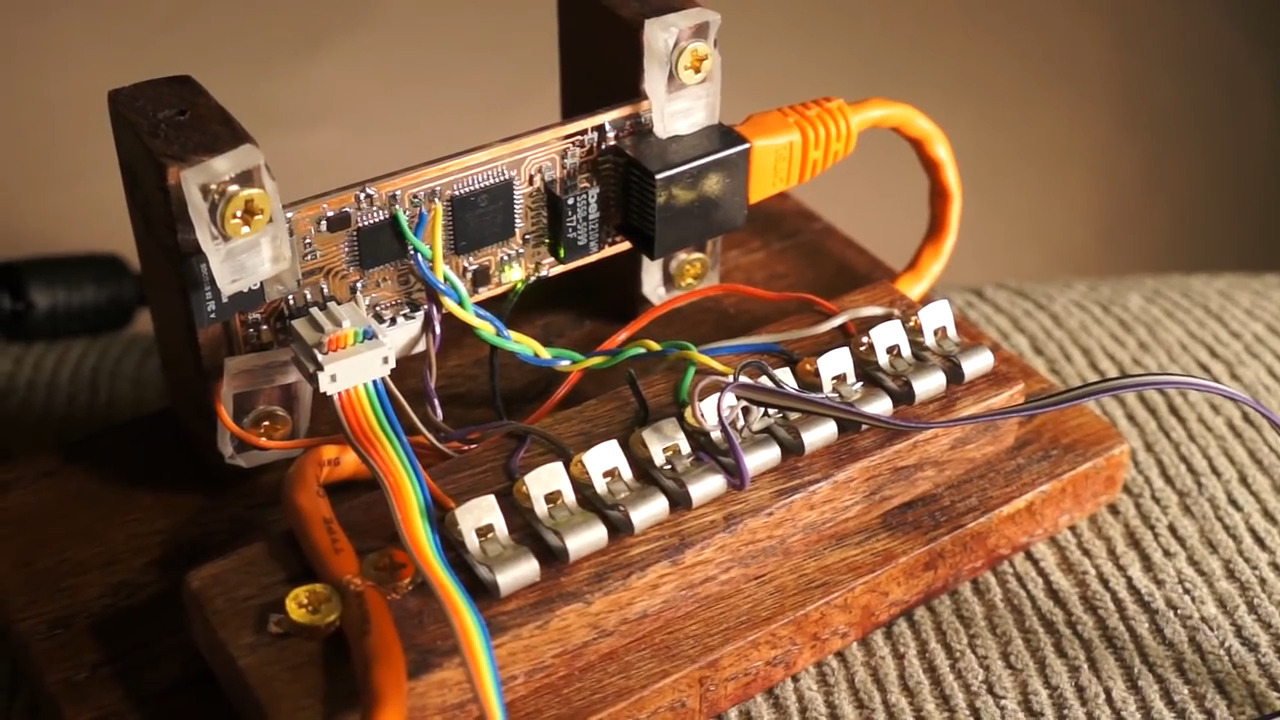
Hardware Hack Makes Robocall Blocking Service Even Better

Sorry to bear sad tidings, but your car’s extended warranty is about to expire. At least that’s what you’ll likely hear if you answer one of those robocalls that have descended like a plague upon us. We applaud any effort to control the flood of robocalls, even if it means supplementing a commercial blocking service with a DIY ring-blocker.

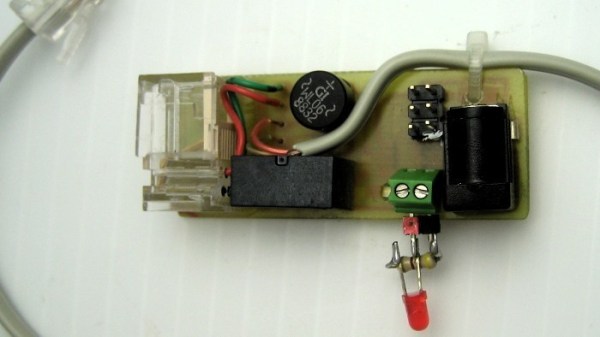
The commercial service that [Jim] engaged to do his landline blocking is called Nomorobo – get it? It uses the Simultaneous Ringing feature many VoIP carriers support to intercept blacklisted robocallers, but with a catch: it needs caller ID data, so it lets the first ring go through. [Jim]’s box intercepts the ringing signal coming from his Xfinity modem using a full-wave rectifier and an analog input on an Arduino. Once the ring pattern is received, the Arduino flips a relay that connects all the phones in the house to the line, letting the call ring through. If Nomorobo has blocked the call, he’ll never hear a thing. There were a few glitches to deal with, like false positives from going off- and on-hook, but those were handled in software. There’s also a delay in displaying caller ID information on his phones, but it’s a small price to pay for peace.

Any escalation in the war on robocalls is justified, and we applaud [Jim] for his service. Should you feel like joining the fray, step one is to know your enemy. This primer on robocalling will help.

Thanks to [Phil] for the tip.

Add-On Makes ESP32 Camera Board Easier To Program

Don’t you just hate it when dev boards have some annoying little quirk that makes them harder to use than they should be? Take the ESP32-CAM, a board that started appearing on the market in early 2019. On paper, the thing is amazing: an ESP32 with support for a camera and an SD card, all for less than $10. The trouble is that programming it can be a bit of a pain, requiring extra equipment and a spare finger.

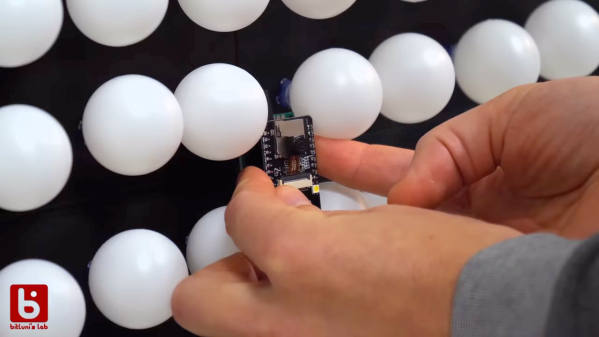
Not being one to take such challenges lying down, [Bitluni] has come up with a nice programming board for the ESP32-CAM that you might want to check out. The problem stems from the lack of a USB port on the ESP32-CAM. That design decision leaves users in need of a USB-to-serial adapter that has to be wired to the GPIO pins of the camera board so that programs can be uploaded from the Arduino IDE when the reset button is pressed. None of that is terribly complex, but it is inconvenient. His solution is called cam-prog, and it takes care of not only the USB conversion but also resetting the board. It does that by simply power cycling the camera, allowing sketches to be uploaded via USB. It looks to be a pretty handy board, which will be available on his Tindie store.

To demonstrate the add-on, he programmed his ESP32-CAM and connected it to his enormous ping pong ball video wall. The video quality is about what you’d expect from a 1,200 pixel display at 40 mm per pixel, but it’s still pretty smooth – smooth enough to make his interpretive dance moves in the last few minutes of the video pretty interesting.

Continue reading “Add-On Makes ESP32 Camera Board Easier To Program”

Fail Of The Week: Thermostat Almost Causes A House Fire

Fair warning: any homeowners who have thermostats similar to the one that nearly burned down [Kerry Wong]’s house might be in store for a sleepless night or two, at least until they inspect and perhaps replace any units that are even remotely as sketchy as what he found when he did the postmortem analysis in the brief video below.

The story begins back in the 1980s, when the Southern New England area where [Kerry] lives enjoyed a housing boom. Contractors rushed to turn rural farmland into subdivisions, and new suburbs crawled across the landscape. Corners were inevitably cut during construction, and one common place to save money was the home’s heating system. Rather than engage an HVAC subcontractor to install a complicated heating system, many builders opted instead to have the electricians install electric baseboards. They were already on the job anyway, and at the time, both copper and electricity were cheap.

Fast forward 40 years or so, and [Kerry] finds himself living in one such house. The other night, upon catching the acrid scent of burning insulation, he followed his nose to the source: a wall-mounted thermostat for his electric baseboard. His teardown revealed burned insulation, bare conductors, and scorched plastic on the not-so-old unit; bearing a 2008 date code, the thermostat must have replaced one of the originals. [Kerry] poked at the nearly combusted unit and found the root cause: the spot welds holding the wires to the thermostat terminal had become loose, increasing the resistance of the connection. As [Kerry] points out, even a tenth of an ohm increase in resistance in a 15 amp circuit would dissipate 20 watts of heat, and from the toasty look of the thermostat it had been a lot more than that.

The corner-cutting of the 1980s was nothing new, of course – remember the aluminum wiring debacle? Electrical fires are no joke, and we’re glad [Kerry] was quick to locate the problem and prevent it from spreading.

Continue reading “Fail Of The Week: Thermostat Almost Causes A House Fire”