Hackaday Links Column Banner

Hackaday Links: September 29, 2019

In a sure sign that we’ve arrived in the future, news from off-world is more interesting this week than Earth news. When the InSight probe landed on Mars last year, it placed the first operating magnetometer on the Red Planet. Since then, the sensitive instrument has been logging data about the planet’s magnetic field, and now there are reports that researchers have discovered a chain of pulsations in the magnetic field. Pulsations in planetary magnetic fields aren’t all that strange; pulse trains that occur only at Martian midnight are, though. Researchers haven’t got a clue yet about what this means. We assume they’ve eliminated artifacts like something on the lander being turned on at local midnight, so when they figure it out it should be fascinating.

In more news from the future, Boston Dynamics is trolling us again. We covered the announcement early this week that they’re putting their Spot quadruped robot on sale – sort of. Turns out you need to be selected to qualify based on the application you have in mind, plus have several Ferraris full of cash to spend. While everyone was watching the adorable antics of Spot as it wandered through improbably industrial vignettes, Boston Dynamics also released this slightly terrifying video of their Atlas robot running through a gymnastics routine.  It starts with a headstand and a front roll and ends with a slipt leap and whatever the gymnastics equivalent of a figure skating axel jump is. Yes, it has a special roll cage attached to make the tumbles a bit smoother, but it’s still some remarkable stuff.

How are your RF design skills? If they’re good enough to design an RF power amp, you might want to check out this homebrew RF design challenge. Put on by NXP Semiconductors, the design must use one of their new LDMOS RF power transistors. They’ll send you samples so you can build your design, and you stand to win up to $3000 plus $1000 worth of NXP products. The contest opened back in May but is running through the middle of November, so you’d better hurry.

Speaking of RF, wouldn’t it be interesting to see a snapshot of the RF spectrum over the entire planet? ElectroSense thinks so, and they’re working on a crowdsourcing model to set up a globe-spanning network of connected RF sensors. The idea is similar to what FlightAware does for monitoring the locations of aircraft with a distributed network of ADS-B receivers. But where FlightAware only monitors a narrow slice of spectrum, ElectroSense wants it all – DC to 6 GHz. You can build a sensor from an SDR and a Raspberry Pi and start contributing to the effort, which only has a handful of sensors at the moment.

Has affordable metal 3D-printing finally arrived? For certain values of affordability, it soon will, when One Click Metal launches their new selective laser melting printer. Thomas Sanladerer did a video with the principals, and the prototype looks promising. SLM is not a new process, but patents on the core process recently ran out, so startups like One Click Metal are jumping into the market. Their printer won’t be cheap — you’ll still need to write a check with many zeroes — but with more players, the price should come down.

And finally, what’s this world coming to when a startup specializing in building giant fighting robots can’t make a go of it? MegaBots is shutting down, and while that’s certainly bad news for its founders and employees, it’s great news for anyone in the market for used battle bots. The company’s flagship bot, the 15-ton Eagle Prime, is currently up for auction on eBay. Bidding started at $1 with no reserve, but if you were looking for a steal, you’re a bit late. The high bid is currently $100,100, which is still an incredible buy considering it cost $2.5 million to build. You’ll have to pay for shipping, but you’ll have a super-destructive mecha of your own to drive around. And think how cool you’ll look rolling into some kid’s backyard birthday party. Presumably one you’ve been invited to.
Probe The Galaxy On A Shoestring With This DIY Hydrogen-Line Telescope

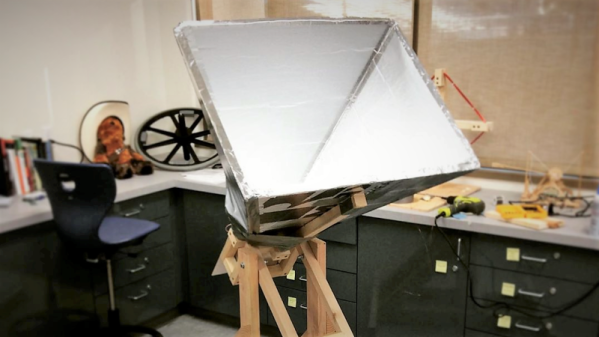
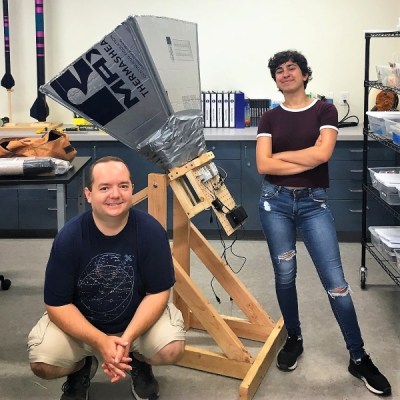
Foil-lined foam insulation board, scraps of lumber, and a paint-thinner can hardly sound like the tools of a radio astronomer. But when coupled with an SDR, a couple of amplifiers, and a fair amount of trial-and-error tweaking, it’s possible to build your own hydrogen-line radio telescope and use it to image the galaxy.

As the wonderfully named [ArtichokeHeartAttack] explains in the remarkably thorough project documentation, the characteristic 1420.4-MHz signal emitted when the spins of a hydrogen atom’s proton and electron flip relative to each other is a vital tool for exploring the universe. It lets you see not only where the hydrogen is, but which way it’s moving if you analyze the Doppler shift of the signal.

But to do any of this, you need a receiver, and that starts with a horn antenna to collect the weak signal. In collaboration with a former student, high school teacher [ArtichokeHeartAttack] built a pyramidal horn antenna of insulation board and foil tape. This collects RF signals and directs them to the waveguide, built from a rectangular paint thinner can with a quarter-wavelength stub antenna protruding into it. The signal from the antenna is then piped into an inexpensive low-noise amplifier (LNA) specifically designed for the hydrogen line, some preamps, a bandpass filter, and finally into an AirSpy SDR. GNURadio was used to build the spectrometer needed to determine the galactic rotation curve, or the speed of rotation of the Milky Way galaxy relative to distance from its center.
We’ve seen other budget H-line SDR receiver builds before, but this one sets itself apart by the quality of the documentation alone, not to mention the infectious spirit that it captures. Here’s hoping that it finds its way into a STEM lesson plan and shows some students what’s possible on a limited budget.

Mini-VFD Clock Floats The Display Above It All

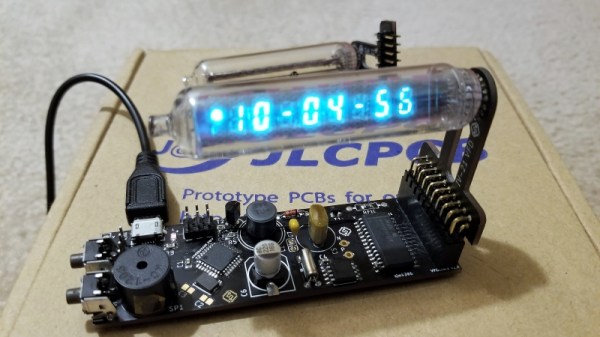
As [sjm4306] says, “You can never have too many clocks based on obsolete display technologies.” We couldn’t agree more, and this single-tube VFD clock is one we haven’t seen before.

The vacuum-fluorescent display that [sjm4306] chose to base this clock on is the IV-21, an eight-digit seven-segment display on the smallish side. The tube is Russian surplus from the ’80s, as all such displays seem to be. The main PCB sports an ATMega328, a boost converter to provide the high voltage needed to run the VFD, a real-time clock, and the driver chip for the tube segments. The tube itself lives on a clever riser card that elevates the display above the main PCB and puts it at the proper angle for reading. [sjm4306] designed it to be modular; should you want to user a bigger VFD you need only make a new riser PCB. Figuring out the proper way to space the through-holes in Eagle proved elusive, but he hacked a solution using a spreadsheet to handle the trigonometry and spit out Cartesian coordinates for each hole. Pretty neat. The video below shows the clock assembly and a test.

We really like the look of this clock for some reason – perhaps it’s the quirky nature of the VFD, or the soft teal glow of the digits. We’ve featured plenty of clocks with odd displays before: VFDs large and small, faux-NIMO, de-encapsulated LED “filaments”, and lots and lots of Nixies.

Continue reading “Mini-VFD Clock Floats The Display Above It All”

Ask Hackaday: What Good Is A Robot Dog?

It is said that Benjamin Franklin, while watching the first manned flight of a hot air balloon by the Montgolfier brothers in Paris in 1783, responded when questioned as to the practical value of such a thing, “Of what practical use is a new-born baby?” Dr. Franklin certainly had a knack for getting to the heart of an issue.

Much the same can be said for Spot, the extremely videogenic dog-like robot that Boston Dynamics has been teasing for years. It appears that the wait for a production version of the robot is at least partially over, and that Spot (once known as Spot Mini) will soon be available for purchase by “select partners” who “have a compelling use case or a development team that [Boston Dynamics] believe can do something really interesting with the robot,” according to VP of business development Michael Perry.

The qualification of potential purchasers will certainly limit the pool of early adopters, as will the price tag, which is said to be as much as a new car – and a nice one. So it’s not likely that one will show up in a YouTube teardown video soon, so until the day that Dave Jones manages to find one in his magic Australian dumpster, we’ll have to entertain ourselves by trying to answer a simple question: Of what practical use is a robotic dog?

Continue reading “Ask Hackaday: What Good Is A Robot Dog?”

High-Speed PCB Design Hack Chat With Bil Herd

Join us on Wednesday, September 25 at noon Pacific for the High-Speed PCB Design Hack Chat with Bil Herd!

Printed circuits have become so commoditized that we seldom think much about design details. EDA software makes it easy to forget about the subtleties and nuances that make themselves painfully obvious once your design comes back from the fab and doesn’t work quite the way you thought it would.

PCB design only gets more difficult the faster your circuit needs to go, and that’s where a depth of practical design experience can come in handy. Bil Herd, the legendary design engineer who worked on the Commodore C128 and Plus4/264 computers and many designs since then, knows a thing or two in this space, and he’s going to stop by the Hack Chat to talk about it. This is your chance to pick the brain of someone with a wealth of real-world experience in high-speed PCB design. Come along to find out what kind of design mistakes are waiting to make your day miserable, and which ones can be safely ignored. Spoiler alert: square corners probably don’t matter.

join-hack-chatOur Hack Chats are live community events in the Hackaday.io Hack Chat group messaging. This week we’ll be sitting down on Wednesday, September 25 at 12:00 PM Pacific time. If time zones have got you down, we have a handy time zone converter.

Click that speech bubble to the right, and you’ll be taken directly to the Hack Chat group on Hackaday.io. You don’t have to wait until Wednesday; join whenever you want and you can see what the community is talking about. Continue reading “High-Speed PCB Design Hack Chat With Bil Herd”

Hackaday Links Column Banner

Hackaday Links: September 22, 2019

Of all the stories we’d expect to hit our little corner of the world, we never thought that the seedy doings of a now-deceased accused pedophile billionaire would have impacted the intellectual home of the open-source software movement. But it did, and this week Richard Stallman resigned from the Computer Science and Artificial Intelligence Lab at MIT, as well as from the Free Software Foundation, which he founded and served as president. The resignations, which Stallman claims were “due to pressure on MIT and me over a series of misunderstandings and mischaracterizations”, followed the disclosure of a string of emails where he perhaps unwisely discussed what does and does not constitute sexual assault. The emails were written as a response to protests by MIT faculty and students outraged over the university’s long and deep relationship with Jeffrey Epstein, the late alleged pedophile-financier. This may be one of those stories where the less said, the better. If only Stallman had heeded that advice.

They may be the radio stations with the worst programming ever, but then again, the world’s atomic clock broadcasting stations can really keep a beat. One of the oldest of these stations, WWV, is turning 100 this year, and will be adding special messages to its usual fare of beeps and BCD-encoded time signals on a 100-Hz subcarrier. If you tune to WWV at 10 past the hour (or 50 minutes past the hour for WWVH, the time station located in Hawaii) you’ll hear a special announcement. There was also talk of an open house at the National Institute of Standards and Technology complete with a WWV birthday cake, but that has since been limited to 100 attendees who pre-registered.

For the machinists and wannabes out there, the Internet’s machine shop channels all pitched in this week on something called #tipblitz19, where everyone with a lathe or mill posted a short video of their favorite shop tip. There’s a ton of great tip out there now, with the likes of This Old Tony, Abom79, Stefan Gotteswinter, and even our own Quinn Dunki contributing timesaving – and finger saving – tips. Don’t stop there though – there’s a playlist with 77 videos at last count, many of them by smaller channels that should be getting more love. Check them out and then start making chips.

Most of us know that DLP chips, which lie behind the lens of the projectors that lull us to sleep in conference rooms with their white noise and warm exhaust, are a series of tiny mirrors that wiggle around to project images. But have you ever seen them work? Now you can: Huygens Optics has posted a fascinating video deep-dive into the workings of digital light processors. With a stroboscopic camera and a lot of fussy work, the video reveals the microscopic movements of these mirrors and how that syncs up with the rotation of a color filter wheel. It’s really fascinating stuff, and hats off to Huygens for pulling off the setup needed to capture this.

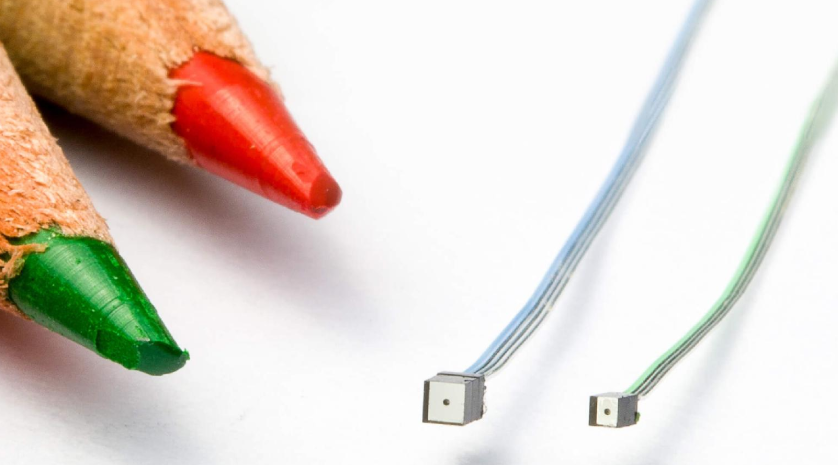
And speaking of tiny optics, get a load of these minuscule digital cameras, aptly described by tipster David Gustafik as “disturbingly small.” We know we shouldn’t be amazed by things like this anymore, but c’mon – they’re ridiculously tiny! According to the datasheet, the smaller one will occupy 1 mm² on a PCB; the larger stereo camera requires 2.2 mm². Dubbed NanEye, the diminutive cameras are aimed at the medical market – think endoscopy – and at wearables manufacturers. These would be a lot of fun to play with – just don’t drop one.

[Mr. Carlson] Fixes A Fridge

A dead refrigerator is an occurrence determined to frustrate any homeowner. First there’s the discovery of hundreds of dollars in spoiled food, and then the cost of a repair call and the delay of the inevitable wait for parts. It’s clear to see why a hacker like [Mr. Carlson] would seek another way.

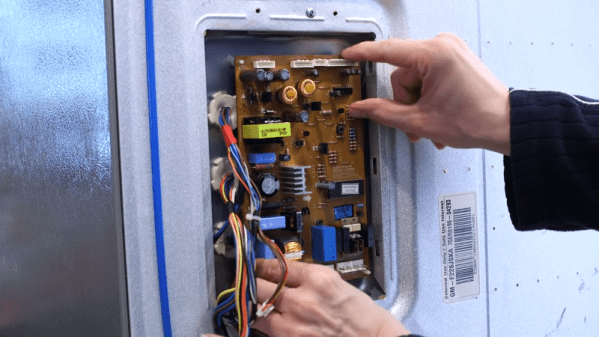
Now, normally a fridge repair video would by unlikely fodder for a Hackaday article. After all, there’s generally not much to a fridge, and even with the newer microprocessor-controlled units, diagnosis and repair are usually at the board-level. But [Mr. Carlson] has had this fridge since 2007, and he’s got some history with it. An earlier failure was caused by the incandescent interior lights welding relay contacts closed thanks to huge inrush currents when starting the cold filaments. That left the light on all the time, heating the interior. His fix was a custom solid-state relay using zero-crossing opto-isolators to turn the bulbs on or off only when the AC power was at a minimum.

That repair kept things going for years, but when the latest issue occurred, [Mr. Carlson] took a different tack. He assumed that a board that has been powered 24-7 for the last twelve years is likely to have a bad capacitor or two. He replaced all the caps, threw in a few new relays to be on the safe side, and powered the fridge back up. It whirred back to life, ready for another decade or so of service.

Kudos to [Mr. Carlson] for his great repair tips and his refusal to surrender. The same thing happened when his solder sucker started to give up the ghost and he fixed it by adding a variable-frequency drive.

Continue reading “[Mr. Carlson] Fixes A Fridge”